
Mike Lehman
Higgsfield vs Freepik: Which AI Product Photography Tool Is Better for E-commerce?
TL;DR: Higgsfield offers realistic, cinematic photos, while Freepik provides faster, simpler, and more realistic product image generation.
Product images are a major factor in most purchase decisions. While it directly impacts the conversion rate of e-commerce products, it is usually the most expensive and time-consuming element in a campaign. This has led more e-commerce brands to adopt AI-powered product photography tools to streamline workflows, shorten production timelines, and reduce costs.
However, more Gen-AI tools are on the rise like never before, and choosing a platform that delivers on its promise seems increasingly difficult. With more consumers showing displeasure in AI-generated product photos, the pressure to create professional product images that eliminate doubts and convert is much higher than before.
This is what tools like Higgsfield and Freepik promise: greater realism and creativity than their counterparts. If you're an e-commerce brand choosing between Higgsfield and Freepik, this guide will help you decide which tool best suits your needs and budget.
What is Higgsfield?
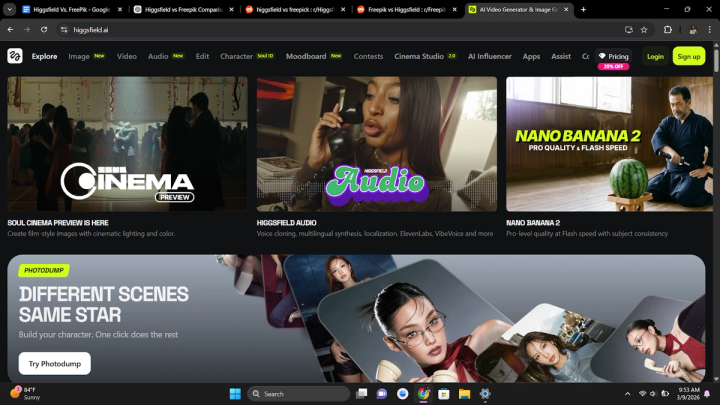
Higgsfield is a full-stack content creation toolkit for creators, businesses, and marketing managers. The suite comprises video-creation and editing tools, AI models, and style presets for creating HD and cinematic visuals from text and images. Most users find it useful for creating social media content, publications, and paid campaigns. The platform also integrates a powerful image generation feature that e-commerce owners can use to create professional images for their businesses.
Some of the features offered by Higgsfield are:
- One-click Ad creator
- Text-to-image
- Visual effects and templates
- Avatar and character tools
- Image editing tools
Pros
- Realistic aesthetics
- Huge presets library
- Fast image production
- Affordable pricing (starting from as low as $9)
Cons

- Poor product detail retention
- Limited in consistent variations
- Incapable of complex generations
- Poor customer support
- Difficult subscription cancellation
Pricing
When you sign up on Higgsfield, you'll be given 10 free credits for your trial, after which you'll need to purchase a paid plan to continue image generation on the platform.
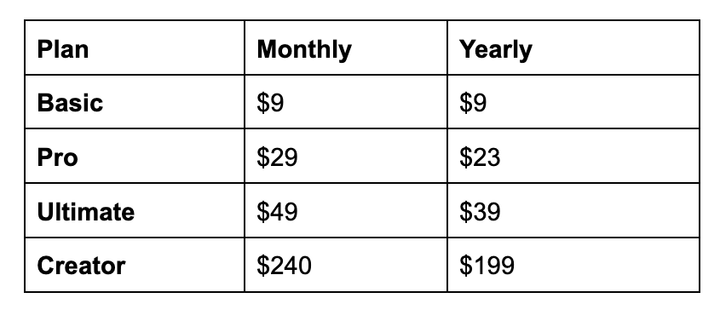
Higgsfield Pricing Plan
What Freepik Offers
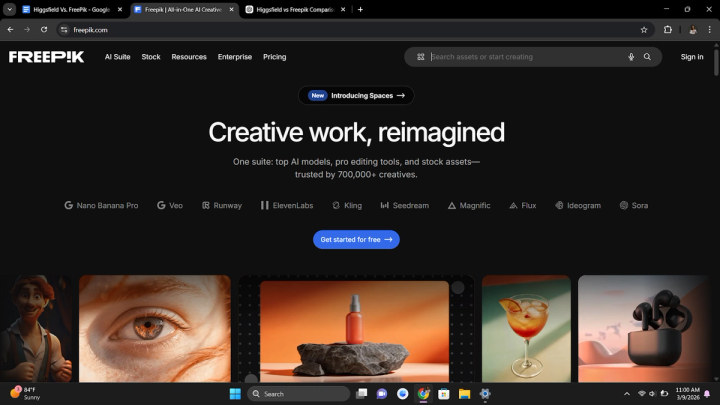
Freepik is a full AI creative suite that compiles multiple AI models together into a single interface. Like Higgsfield, it combines a large catalogue of stock assets (photos, vectors, PSDs, and mockups). For e-commerce brands, Freepik can be used to generate product photos or scenes, background variations, social media creatives, and multiple variants for A/B testing.
Freepik integrates some powerful content creation features into its toolkit, such as:
- Image generation
- Video generation
- Background removal
- Upscaling
- Mockups
- Collaborative canvases
Pros
- Photorealistic outputs
- Commercial licensing under paid plans
- Comprehensive AI models suite
- Large-scale image generation and automation
- Intuitive interface
Cons

- Strict censorship policy
- Long generation times leading to queuing
- Occasional bugs
Pricing
Freepik offers 4 pricing tiers, including a free trial, so users can test the platform before committing to a financial plan.
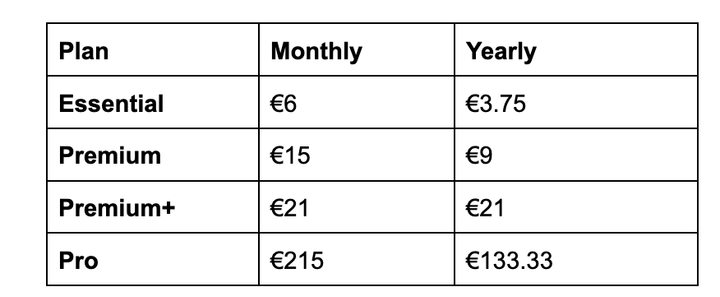
Freepik Pricing Plan
Head-to-Head Comparison: Higgsfield Vs. Freepik
To help you select the better tool between Higgsfield and Freepik for your e-commerce brand, we've compared the two platforms based on these five core factors:
- Scalability
- AI model variety
- Image Realism
- Workflow
- Interface intuitiveness
Here is an overview below:
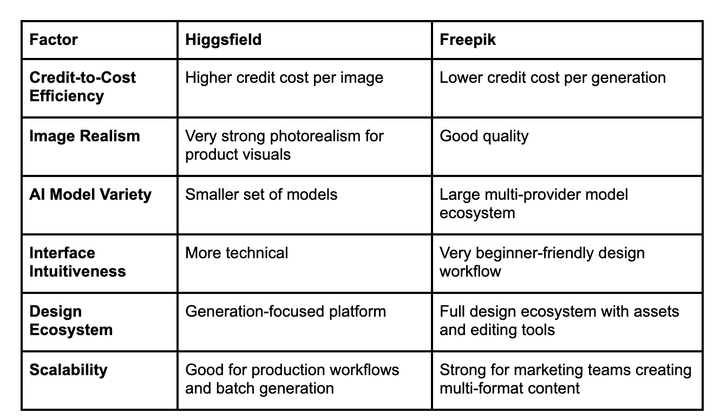
Freepik Vs Higgsfield
Scalability: Freepik
Freepik’s pricing package shows a more robust, scalable, and flexible plan. Below is the breakdown of the pricing plans of both tools and their credit allocation:
Freepik:
- Essential — $3.75/month for 84,000 AI credits per year with access to 200M+ premium assets (images, vectors, templates, mockups) and a commercial usage license.
- Premium — $9/month for 216,000 AI credits per year, with all Essential plan features.
- Premium+ — $21/month for 540,000 AI credits per year and unlimited generations on 30+ AI models.
- Pro — $133.33/month for 3.6M AI credits per year with 20% extra credits on top-ups.
Higgsfield:
- Basic — $9/month for 150 AI credits per month with access to more AI models than in the free plan.
- Pro — $23/month for 600 AI credits, with access to more advanced models and higher generation limits.
- Ultimate — $39/month for 1200 AI credits, including Unlimited Nano Banana Pro generations.
- Creator — $199/month for 6,000 AI credits with all of the Ultimate plan features.
This clearly shows a wide disparity between Higgsfield and Freepik’s credit-to-cost efficiency. While Higgsfield offers higher photorealism and cinematic results, it has a lower generation capacity (40 images/month) than Freepik (~4000 images/month).
Verdict: Freepik is a better option for scalability, especially for e-commerce brand owners with large catalogues and who require multiple SKU variants for campaigns.
AI Model Variety: Freepik
Freepik has 1.6 times as many models as Higgsfield. With 15 unique models, compared to Higgsfield’s 7, both platforms share 6 models in common, which are the most used AI models for image generation.
The models both platforms share are:
- Flux
- Nano Banana
- Seedream
- GPT Image
- Qwen Image
- Z-Image
The models unique to Freepik are:
- Mystic
- Google Imagen
- Ideogram
- Recraft
- Reve
- Runway
- Grok Image
- Classic
- Cinematic
The models unique to Higgsfield include:
- Wan Image
These shared models are the most popular models used for creating realistic outputs across both platforms. This explains why both platforms can produce similar visual quality, since they rely on the same underlying AI engines.
Verdict: Overall, Freepik’s access to multiple AI image models surpasses Higgsfield’s focus on a smaller set of flagship models.
Realism: Higgsfield
Higgsfield is designed to produce hyper-realistic, camera-like images with accurate lighting, textures, and micro-details. Its models simulate real photographic effects such as natural lighting behavior and detailed textures, which helps images look closer to actual photos.
For example, Higgsfield’s image model focuses on rendering fine details like skin texture, pores, lighting depth, and imperfections, which are essential for convincing realism in product or lifestyle images. Freepik, on the other hand, is designed for creators who need to iterate quickly on images, product mockups, and marketing graphics.
Verdict: While Freepik has a structured image-generation capability, Higgsfield can generate outputs that look more realistic and less AI-generated.
Workflow: Freepik
On the annual plan, Freepik lets you use all your yearly credits at any time, whereas Higgsfield only lets you use 1/12 of your yearly credits per month, and those credits do not roll over to the next month. This makes Freepik a better option for brands that require more creatives at certain times of the year and provides flexibility for image generation at any time.
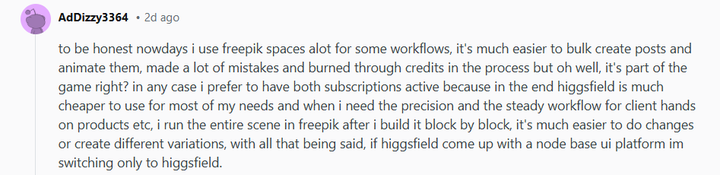
Users on Reddit also mention that Freepik is easier for bulk creation and animation than Higgsfield.
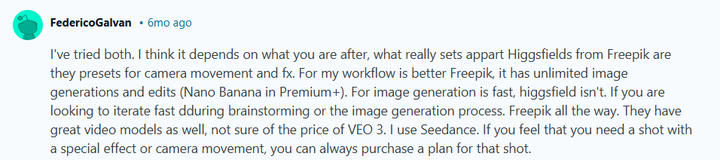
In terms of performance, Freepik is faster and more stable than Higgsfield. Some Higgsfield users complain of having to wait in a “queue” to receive their outputs, which can be daunting for brand owners who need product visuals on the spot. What’s even more challenging is the “battery system” that Higgsfield recently set up when using their Unlimited offer. Once the battery is depleted, users have to pay or wait until the next day to continue generating.
Verdict: With the node feature in the “Spaces” feature, Freepik offers faster, high-volume asset generation.
Interface Intuitiveness: Freepik
Based on our review, Freepik has a simpler and more intuitive interface than Higgsfield. Higgsfield UI looks clunky, cluttered, and complicated. The many features, tools, and options make it feel overwhelming, requiring a learning curve to get the most out of the platform.
You also have to manually switch the unlimited toggle each time you want to generate an image or use a different model. This can be quite frustrating if you need to generate multiple images.
Freepik, however, offers a simple, minimalist interface that is intuitive to navigate. You can access all the platform’s features on the home page, and the tools don't feel out of reach. With a few sections, you can easily go back to other pages without having to struggle to find your way through.
Verdict: Freepik’s interface focuses on simplicity and user-friendliness for non-technical users, while Higgsfield UI is more technical-driven and requires a learning curve.
Conclusion: Which is Better?
Offering greater credit-to-cost efficiency, generation flexibility, more models, and a simpler, intuitive interface, Freepik serves E-commerce brand owners with smaller budgets and multiple variations. Higgsfield, however, positions itself as a more realistic, creative, and photographic tool for products with intricate details and that require greater realism to convert.
For brands that scale quickly and require hundreds of creatives across several seasonal campaigns, a platform that offers both realism and workflow scalability is more efficient than combining the best qualities of both platforms.
This is where Pikes shines. Built for e-commerce brands, it is a product-centric photography tool that generates studio-level realism and scalability.
FAQ
Do Freepik or Higgsfield produce more consistent product images?
Some users report that Higgsfield outputs can be inconsistent across renders when prompts become complex, meaning you may need multiple attempts to get the desired result. Freepik’s strength is that it offers multiple models, so users can switch to another if one fails to deliver consistent results.
Can these tools replace real product photography?
Higgsfield and Freepik can produce high-quality product visuals, but they still have limitations, such as distorted branding and inconsistent product text. However, tools like Pikes ensure consistency even in detail-heavy products.
Which platform is better for generating many product variations?
Higgsfield’s workflow is designed for rapid generation and iteration, allowing users to quickly experiment with many prompts and variations. However, Freepik can also handle large volumes, especially on plans that support unlimited generation.
Is Freepik or Higgsfield better for marketing creatives?
Freepik tends to be better for complete marketing workflows because it includes stock images, design templates, editing tools, and mockup generators. Freepik also offers access to over 200 million creative assets to complement AI-generated visuals.
Higgsfield is more focused on the generation itself than on full creative production.

Written by
Mike Lehman
Mike Lehman is a senior content strategist at Pikes. Before joining Pikes, Mike spent nearly a decade working with Glossier, Haus, and Athletic Brewing, leading campaigns that blended storytelling and data.