

Mike Lehman
Higgsfield vs. Kive vs. Pikes AI: Which One Preserves Product Details Best?

AI product photography tools have taken the e-commerce industry by storm. Cutting costs and reducing turnaround time by over 90%, it is a cost-efficient method for brands that want to generate marketable assets without the hassle and stress of traditional product photography.
However, like every innovation that has passed the walls of history, it has a major setback that only a few AI tools have been able to successfully conquer. And that is product detail consistency. Especially for an industry where product details matter just as much as the ingredients used in making them, this issue is a limitation that costs e-commerce brands their audience’s trust and ultimately revenue.
This article evaluates the product detail capacity of Higgsfield, Kive, and Pikes AI to help you select the best tool for ensuring consistency across all your generated assets.
What Product Detail Preservation Really Means and Why Most AI Tools Get It Wrong
Product detail preservation isn't about whether a generated image looks good. It's about whether the image looks like your product.
When using Gen AI platforms for generating content for your product, there are five elements that you must protect in every generated asset:
- Label text: The words on your packaging must be legible and accurate, not reimagined, scrambled, or replaced with gibberish texts.
- Logo placement: Your logo needs to appear where it appears on your actual product, in the exact form and size.
- Packaging form: The shape, structure, and dimensions of your product shouldn't change in the generated assets.
- Color accuracy: Your brand colors and your product's actual colors need to match across every image and video output.
- Consistency at scale: All of the above needs to hold not just once, but across every asset in a high-volume content pipeline
The reason most AI tools fail in these criteria is that they are trained to produce visually compelling outputs and are not optimized for detail retention and consistency. When a model encounters a product label with a specific font, layout, and color, it doesn't read it the way a camera does. It interprets it the way an artist might and then improvises.
For a filmmaker or content creator, that improvisation is often a feature. But for an e-commerce brand, it is a liability.
How Higgsfield Handles Product Detail Preservation
Higgsfield is one of the most capable Gen AI tools for creators who need high-impact and expressive visual content. It integrates multiple AI models, including Kling, Sora 2, and Veo 3, to generate cinematic videos and apply a wide range of visual effects.
But high-impact and on-brand are two different standards.
Higgsfield itself acknowledges its limitations in preserving small details and texts.

The reason comes back to how it is trained. Higgsfield's model is optimized for cinematic creativity, not brand fidelity. When it processes a product image, it treats the label as a visual element to be interpreted and recreated, not an asset to be preserved. The output looks professional, but does not look like your product.
If you run product listings on e-commerce platforms, or produce creatives for paid ads where brand accuracy is legally and commercially critical, this limitation is a major one. It makes the platform effectively unusable for this use case, regardless of how good the lifestyle imagery looks around it.
Verdict: Higgsfield is a strong tool for content creators and filmmakers. For e-commerce brands that need product accuracy, it consistently falls short where it matters most.
How Kive AI Handles Product Detail Preservation
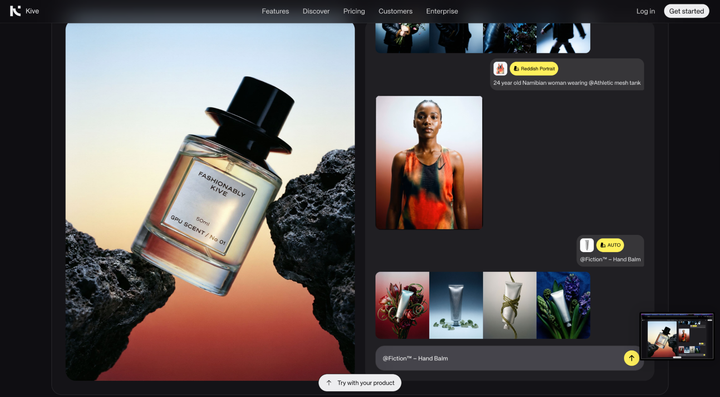
Kive AI performs better than Higgsfield on product detail preservation. Its Studio presets create more controlled generation environments, and the static product shots feature maintains better label consistency.
However, the core issue with Kive's approach to brand fidelity is that the feature, which actually solves the label accuracy problem (custom brand model training), is locked behind the Pro plan, billed at $75 per month annually. On the Basic plan, you get AI image and video generation, but you cannot train a model on your specific product, and this shows across your generated assets.
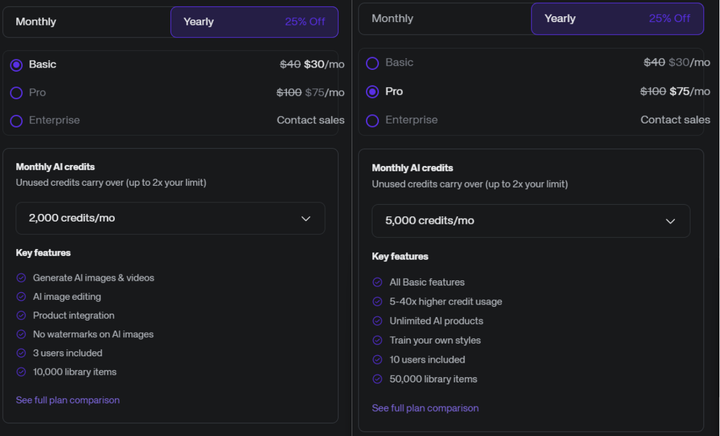
While Kive's asset library, collaboration tools, and workflow organization remain genuinely strong, it cannot maintain high-fidelity product imagery at scale. It can get you part of the way there at the Pro tier, yet results are still not guaranteed.
Verdict: Kive is better than Higgsfield for product detail consistency. But at scale, it requires the most expensive plan, and the results are still not consistent.
How Pikes AI Handles Brand Fidelity from the Ground Up
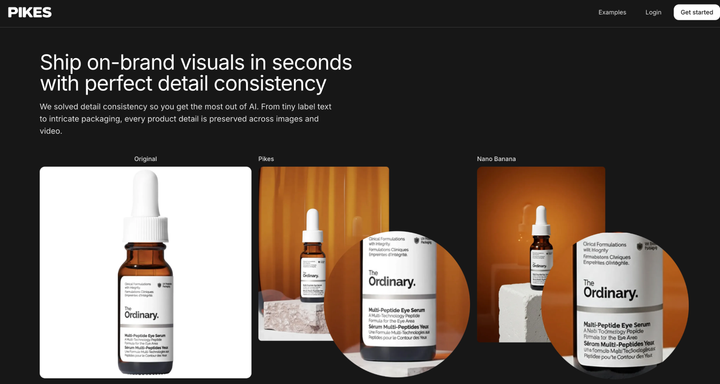
Pikes AI is an AI product photography tool built specifically for e-commerce brand owners and product marketers. Unlike Higgsfield and Kive, which serve broader creative markets and include e-commerce as one of many use cases, Pikes was designed from day one to create studio-quality product content that looks exactly like your product, every time.
Pikes AI's proprietary model is engineered to preserve product labels, logos, packaging text, and form without distortion. Your label text stays legible. Your logo appears where it appears on your actual product, and your packaging shape doesn't change between generations.
If you want to move even faster, you can access a full library of ready-to-use templates for product visuals. You simply select a template, upload your product, and generate. You’ll get high-quality, on-brand output in the time it takes to upload an image.
Caveat: Pikes is purpose-built for e-commerce product content, not for general-purpose use.
Head-to-Head Comparison Across Higgsfield, Kive, and Pikes
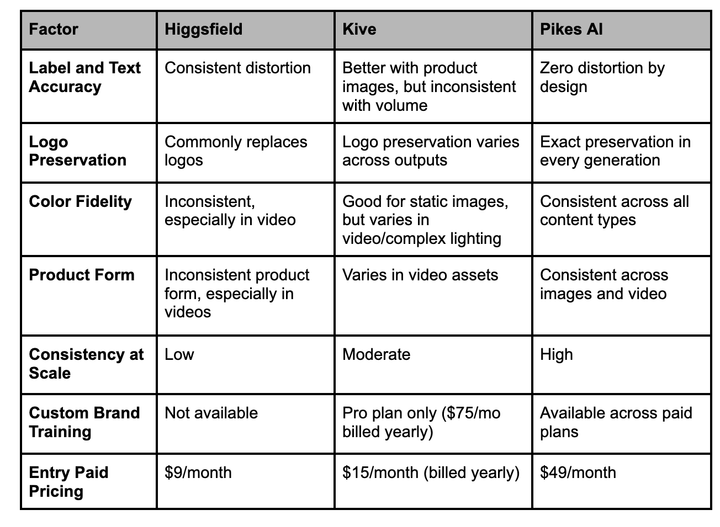
Summary Comparison between Higgsfield, Kive, and Pikes AI
Label, Text, and Logo Accuracy
Higgsfield's label distortion problem is well-documented across user reviews. Labels get rewritten, logos get replaced, and text on packaging becomes unreadable in a way that makes the output unusable for any commercial purpose.
Kive performs better on static shots, and the studio presets can create more controlled environments for product imagery. But without custom brand model training, which is only available on the Pro tier, the label accuracy is inconsistent across different product types and generation conditions.
Pikes AI, on the other hand, preserves label text, logos, and packaging design without distortion across all generation types. It is the only platform in this comparison where product detail consistency is an integrated feature, even in the lowest tier.
Color Fidelity and Product Form
Higgsfield usually changes color and product form, especially in video and animated outputs. If your product color is a core part of your brand identity, this is a real problem that may affect your brand recognition.
Kive handles color well in product images. However, under complex lighting conditions or in video generation, there can be variation. The product form is also well-preserved in product photos, but in video outputs, there are inconsistencies.
Pikes maintains color accuracy and product form consistently across still images, lifestyle scenes, and video. The platform generates your product images in the same color, the same shape, and across every content type, every time.
Consistency at Scale
Higgsfield's output variance makes it difficult to use for any brand running a high-volume content pipeline. When results are inconsistent from generation to generation, you can't build a reliable production workflow around the tool, as you’ll spend more time reviewing and rejecting outputs than you save.
Kive is more consistent than Higgsfield, but the credit-deduction issue on failed generations creates a financial cost that compounds at scale. You're paying for outputs you can't use, on the most expensive plan.
Pikes AI's style and character features ensure visual consistency across every one of your generated assets. If your brand generates hundreds of product images and video creatives per month, this feature makes your content pipeline operationally viable.
Which Tool Should You Use?
Higgsfield is built for filmmakers, content creators, and social media teams who need cinematic visuals and expressive video content. For e-commerce brands that need product accuracy, it is the wrong tool.
Kive AI is for you if your team's primary need is a broad digital asset management system for organizing large libraries of diverse, non-ecommerce creative files.
Pikes AI is designed from the ground up around what e-commerce brands actually need. Your product looks exactly like your product, in every image and every video, at any volume. If product detail preservation is the question, Pikes is the answer!
Frequently Asked Questions
Why do AI tools distort product labels and logos?
Most AI image generation models are trained to interpret product labels and logos as visual elements. Then, rather than preserving it exactly, it reconstructs it based on patterns from its training data. The result is incoherent texts and logos that resemble the original but aren't accurate.
Platforms like Pikes AI address this by training their model specifically on the requirements of branded product content, making label and logo preservation a core function rather than an afterthought.
Can Higgsfield be used for e-commerce product photography?
Higgsfield can generate lifestyle and product-adjacent imagery, but it consistently struggles with label and logo accuracy, which is a fundamental requirement for e-commerce product content.
Does Kive AI preserve product labels on all pricing plans?
Not reliably. Custom brand model training, the feature that most directly improves label and logo accuracy, is only available on Kive's Pro plan, billed at $75 per month annually. On the Basic plan, label consistency depends on the model's interpretation of your product, which produces variable results across different product types and generation conditions.
How does Pikes AI prevent label and logo distortion?
Pikes AI is trained to treat product labels, logos, and packaging as fixed assets to be preserved, not visual elements to be interpreted. This means your label text stays legible, the logos appear correctly, and the packaging form is maintained across every generation type.

Written by
Mike Lehman
Mike Lehman is a senior content strategist at Pikes. Before joining Pikes, Mike spent nearly a decade working with Glossier, Haus, and Athletic Brewing, leading campaigns that blended storytelling and data.