

Mike Lehman
Higgsfield vs. Gemini: Which Should You Choose in 2026?
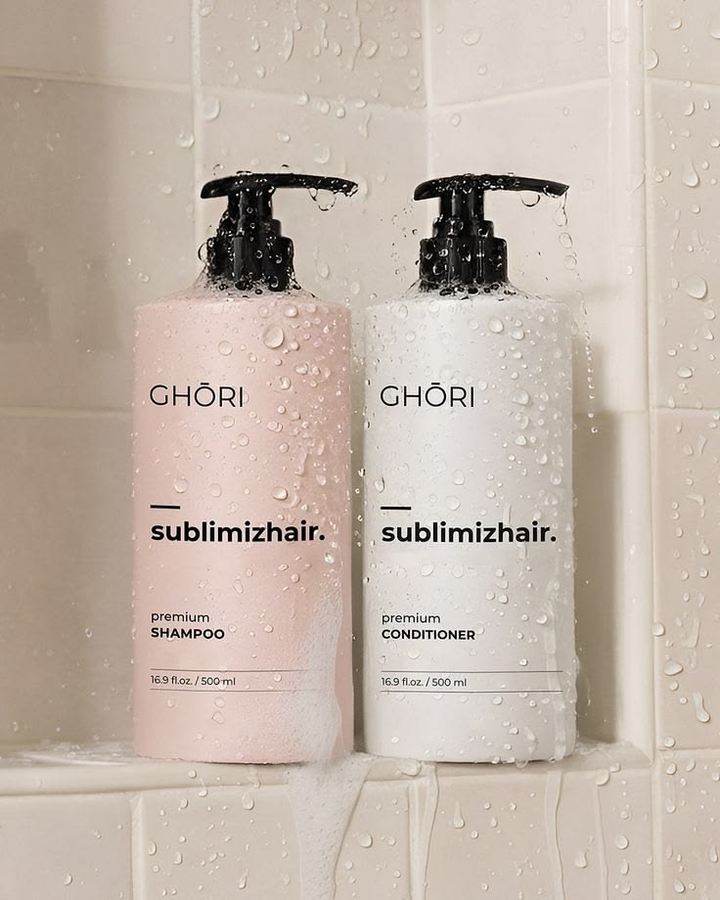
Higgsfield and Gemini are two of the most talked-about AI content creation tools right now. One is built for cinematic creators. The other is built for everything and everyone.
Higgsfield is loved by video creators and social media marketers who need director-level control over AI-generated content. Google Gemini, powered by the Nano Banana 2 image model and Veo 3 video model, is one of the most capable general-purpose AI platforms available. E-commerce brands are using it to generate product visuals at zero extra cost alongside everything else Gemini already does.
While both tools have genuine strengths, they also carry limitations that matter specifically for e-commerce brands running product listings and paid campaigns at scale.
This article breaks down exactly where Higgsfield and Gemini stand in 2026 for E-commerce.
How Higgsfield AI Handles E-commerce Content
Higgsfield is a multi-model AI video and image generation platform founded by ex-Google Brain engineers. It incorporates 15+ top-tier models, including Sora 2, Veo 3.1, and Kling 3.0 under a single subscription. It also has over 70 cinematic camera presets and a UGC builder for ad-style content. For creative professionals and social media teams, the feature depth is genuinely impressive.
With the Ads 2.0 feature and UGC Builder, you can create talking-head ad videos and product-adjacent lifestyle content. The 70+ camera presets also give you a level of cinematic control that most AI tools don't.
All of these features make Higgsfield a good platform for filmmakers, brand content creators, or social media marketing teams.
But for e-commerce brands that need product accuracy and consistent branded output at scale, it has several limitations.
Pros
- Access to 15+ video models, including Sora 2, Veo 3.1, and Kling 3.0
- 70+ cinematic camera presets
- Affordable pricing model
- UGC Builder for talking-head ad-style content
- VFX library and Lipsync Studio
- Strong output quality for lifestyle and social media content
- Available on iOS/Android via the Diffuse app
Cons
- Product label and text distortion
- Not purpose-built for e-commerce product photography or branded content
- Complex credit system
- Fast consumption of credits for some models' usage
- No performance marketing workflow, competitor ad intelligence, or ad creative tools built in
- Achieving a polished, usable video requires multiple iterations
How Google Gemini Handles E-commerce Content
Google Gemini is another multimodal AI platform that handles text, images, audio, and video across a single interface. For image generation, it uses the Nano Banana 2 model, which handles lighting, composition, and text better than most general-purpose models. For video, it uses Veo 3 to generate 8-second video clips with native audio from photo or text inputs.
The Nano Banana 2 model produces competitive product shots, handles background replacement, and can generate lifestyle scenes from a single product image. Brands managing their marketing inside this ecosystem enjoy good integration with Google Workspace.
Google's developer documentation even positions Nano Banana 2 as suitable for e-commerce product shots and advertising creatives. But general-purpose suitability and purpose-built performance are two very different standards.
Pros
- Powerful model with strong text rendering for general use
- Photo-to-video capability for animating product images
- Integration with other Google tools, such as Gmail, Drive, and Workspace.
- Available globally in 150+ countries
- Strong general image quality and composition
Cons
- Does not preserve product details
- Frequent generation failures
- Video generation limited to 3 videos/day (Pro) or 5 videos/day (Ultra)
- Watermarked outputs even in paid tiers
- No ready-to-use templates or Chat Mode for product content
Head-to-Head Comparison: Higgsfield vs. Gemini for E-commerce Brands
Summary Comparison
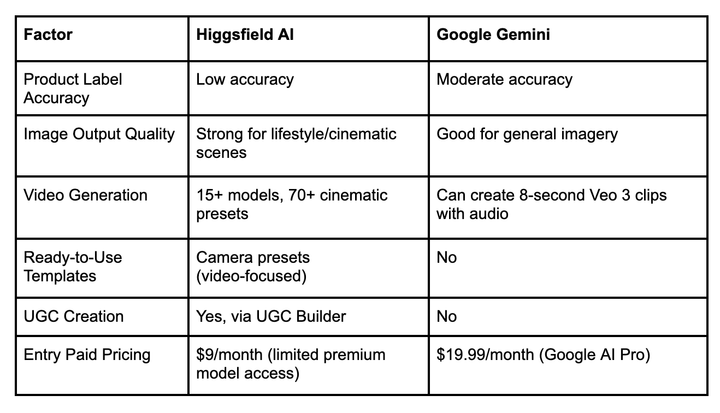
Product Detail Accuracy
This criterion is important for any e-commerce brand as it can either breed skepticism or build trust in your target audience. And it is where both tools show their limitations most clearly.
Higgsfield clearly acknowledges its inability to retain small or intricate product details in generated assets. For brands like skincare, supplements, or packaged food that use detailed labels, this is a limitation that no amount of reiteration or tweaking can fully resolve.
Gemini handles text rendering better than Higgsfield in product images. The Nano Banana 2 model has improved significantly on general text accuracy, and for basic product shots with minimal label complexity, the results are usable. The problem it still has is consistency and precision at scale.
Gemini is a general-purpose model. It interprets your product rather than preserving it. It produces variant outputs in product images with complex packaging and multi-color labels. There’s also no dedicated custom brand model or character consistency feature to ensure brand fidelity across hundreds of generations.
Edge: Gemini has better baseline text rendering than Higgsfield, but neither tool offers the label and logo accuracy that commercial e-commerce content requires.
Video Generation
Higgsfield is a video-first platform with access to Sora 2, Veo 3.1, Kling 3.0, and 70+ cinematic presets. This heavy-model capacity gives creative teams a level of video production control that Gemini's interface doesn't match. For brands that need cinematic lifestyle video content or engaging social media clips, Higgsfield's output is much better.
However, premium video models on Higgsfield consume credits fast. Sora 2 and Veo 3.1 cost 40–70 credits per video, meaning on the Plus plan at $34/month, you get roughly 14–25 Sora 2 videos without accounting for the iterations most videos require to produce a usable result. Real-world usable output is significantly lower than headline credit numbers suggest.
Gemini's Veo 3 video generation produces 8-second clips with native audio and is available to Pro and Ultra subscribers. It is capable, but limited to 3–5 videos per day, which makes it unscalable for any brand running high-volume video content production.
Edge: Higgsfield has more creative flexibility and a higher output quality for videos, despite the credit system friction.
Performance Marketing Capabilities
Neither platform was built for performance marketing workflows.
Higgsfield can generate UGC-style ad content, which makes it relevant for brands running social media ad campaigns. But there is no competitor ad research, Meta ad creative workflow, or in-platform intelligence to help you create strategic marketing campaigns.
Gemini, on the other hand, has no performance marketing features at all. It can only generate images and short videos. What you do with them in an ad context happens entirely outside the platform.
Edge: Higgsfield is better, due to the UGC Builder, but neither tool closes the performance marketing loop that e-commerce brands need to create content that converts.
Ease of Use and Workflow
Gemini's interface is conversational and familiar, especially for teams already working inside the Google ecosystem. This integration also means your generated assets can move directly into other tools without switching platforms. And generating a product image is only a prompt away.
Higgsfield, however, has a learning curve. The platform’s comprehensive list of models, features, and presets makes it overwhelming for entry or mid-level creators. You need to constantly explore, learn, and implement the platform’s features to maximize it.
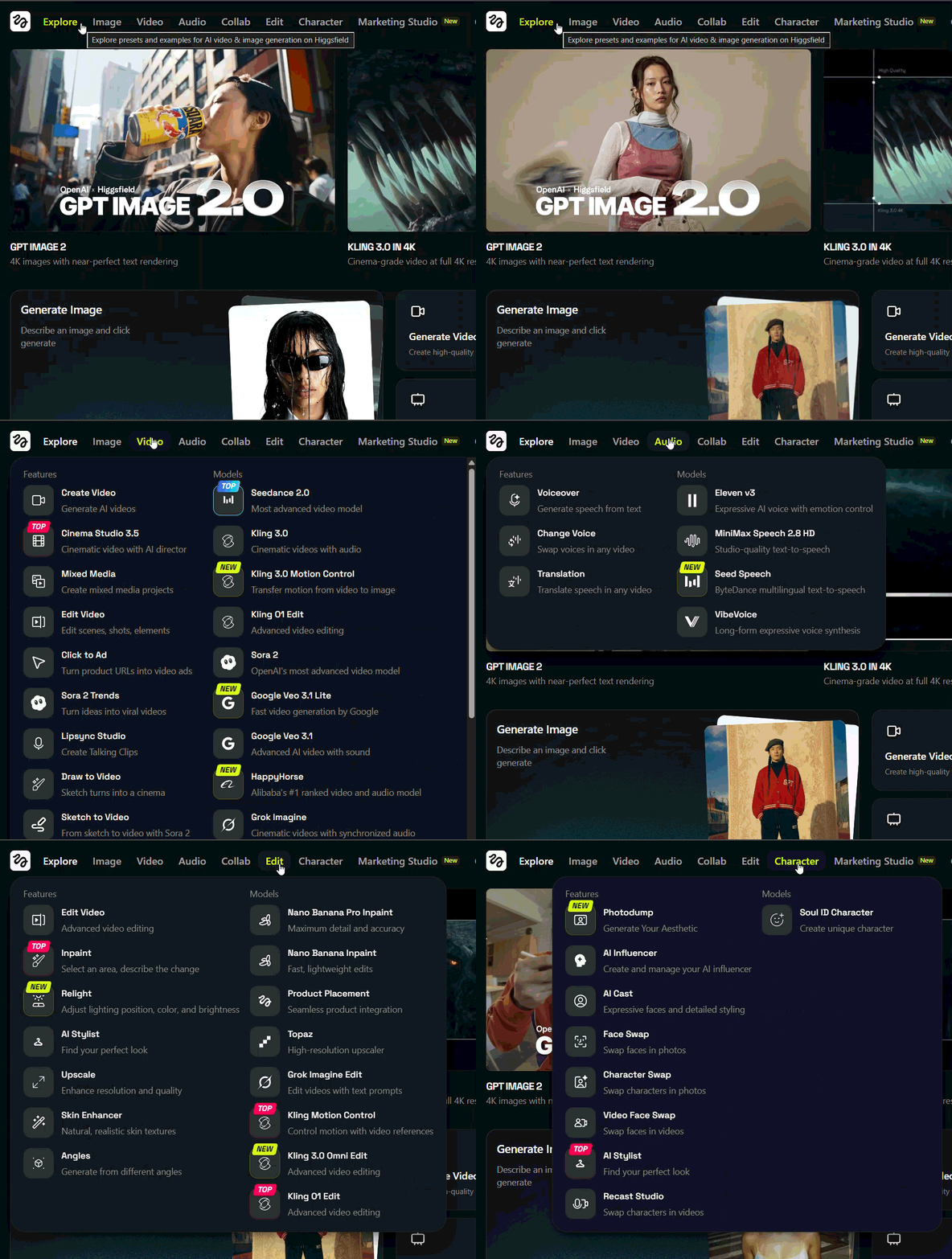
You may still be discovering new tools and features even after using the tool for a long time.
The credit system, model selection, and camera preset configuration mean there is a meaningful ramp-up period before teams can produce at speed. Advanced features like Cinema Studio, Lipsync, and Draw-to-Video also expand your content generation prowess, but it is complex for non-technical teams.
Edge: Gemini has a lower learning curve and is more intuitive for non-technical teams.
Pricing Reality
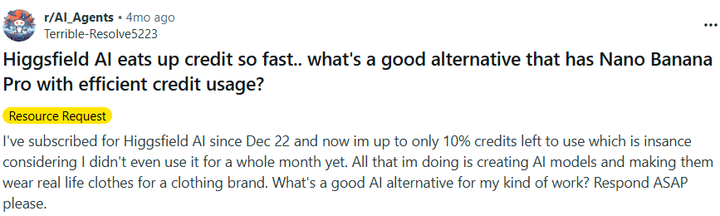
Higgsfield's entry pricing at $9/month looks affordable, but the credit math quickly changes the picture. Premium model access (Sora 2, Veo 3.1) requires the Pro plan ($17.40/month annually) or above. Multiple Reddit users also complain that the credit burns fast in a short timeline.
Gemini image and video generation is included in Google AI Pro ($19.99/month) and Ultra ($249.99/month). Both plans have limited daily generation, which makes product generation unscalable. This makes it particularly useless for brands trying to build a high-volume product content pipeline.
Edge: Gemini offers better value if you're already in Google’s ecosystem. Higgsfield offers more creative depth but at a higher cost.
Which Tool Is Enough for E-commerce Brands?
Higgsfield and Gemini are both impressive at what they were built for. Higgsfield for cinematic video creation. Gemini for general-purpose AI assistance across text, image, and short video.
But neither tool was built for the specific content stack that e-commerce brands need to run at scale. This includes:
- High-volume product generation with zero label or logo distortion
- Consistent, on-brand output across every generation
- Video ads and animated product content without daily generation caps
- Performance marketing visuals built for Meta and other ad platforms
- Competitive intelligence that tells you what creatives are converting in your category right now
- A unified workflow that doesn't require three different tools to take a product from shoot to ad
This is precisely the gap Pikes AI was built to fill.
Pikes AI: The Complete E-commerce Content Platform
Pikes AI is a Gen-AI platform built specifically for e-commerce brand owners and product marketers. It can create product content that looks exactly like your product, drives performance, and scales without friction.
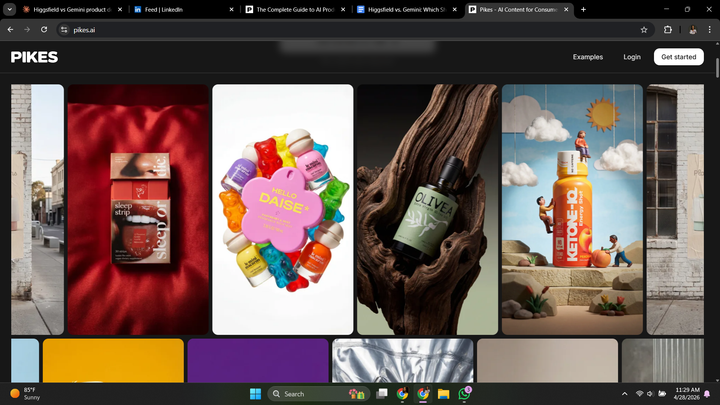
Over 1000 fast-growing consumer brands currently trust Pikes for their product content pipeline, and the platform covers every content type they need in one place.
Zero distortion in every generation
Pikes generates studio-level product images without distorting the labels, logos, text, or form. This feature is not exclusive to specific pricing plans but is available in all tiers.
Detailed prompt generation with Chat Mode
You no longer have to figure out or spend hours crafting detailed prompts for your content generation. Simply describe what you need in natural language, and Pikes will generate it. Any member of your team can produce professional product content from the first session.
Ready-to-Use Templates
Reduce the number of hours you spend on image generation by accessing a full library of production-ready templates for product visuals. You can produce professional outputs without writing a single prompt or editing from scratch.
Performance Marketing and Ad Intelligence
Pikes generates Meta-ready ad creatives alongside product photography on the same platform. The built-in ad intelligence tool lets you search for the best-performing competitor ads in your industry and analyze what's working so you can replicate their approach directly in PikesC.
Claude AI Integration
Pikes integrates Claude AI directly into the platform so you can use Claude's capabilities to generate and refine product images within your workflow.
Caveat: Pikes is purpose-built for e-commerce and not for general-purpose use. It is also not ideal for high-end cinematic filmmaking or expressive social video creation.
Pikes is the right choice when branded product content and performance marketing are the core requirements.
Try Pikes AI Today
Frequently Asked Questions
Can Gemini generate product images for Amazon listings?
Gemini can generate product images for product listings. However, consistency will vary in products with heavy packaging, texts, and multi-color. For Amazon listings where brand accuracy is commercially and legally important, a purpose-built tool like Pikes AI provides more reliable results.
Does Higgsfield support product photography for e-commerce?
Higgsfield can generate product imagery and lifestyle content, but it was not built for e-commerce product photography. For occasional lifestyle content, it is usable. But when it comes to creating consistent, label-accurate product images at scale, it is not fit for purpose.
Is Google Gemini free for image generation?
Image generation in Gemini requires a Google AI Pro ($19.99/month) or Ultra ($249.99/month) subscription. A free tier exists, but does not include image or video generation. Pro subscribers are capped at 3 videos per day and a limited number of image generations, making Gemini
What makes Pikes AI different from both Higgsfield and Gemini?
Pikes AI preserves product labels and logos without distortion, includes a competitor ad intelligence tool, and has a Chat Mode that makes content creation accessible to any team member. Higgsfield and Gemini are both powerful tools, but they were simply designed for different jobs.
Is Pikes AI worth it for a $10M+ e-commerce brand?
Yes. The cost of a single traditional product photoshoot typically exceeds an entire month of Pikes subscription (starting at $49/month). And it produces the same professional quality as traditional product photography.
At this revenue level, brands are typically running consistent paid campaigns, managing product listings across multiple channels, and producing content at a volume that makes asset quality and pipeline reliability commercially significant.

Written by
Mike Lehman
Mike Lehman is a senior content strategist at Pikes. Before joining Pikes, Mike spent nearly a decade working with Glossier, Haus, and Athletic Brewing, leading campaigns that blended storytelling and data.