

Mike Lehman
Pomelli AI vs. Photoroom: Which Is Better for E-commerce Brands?
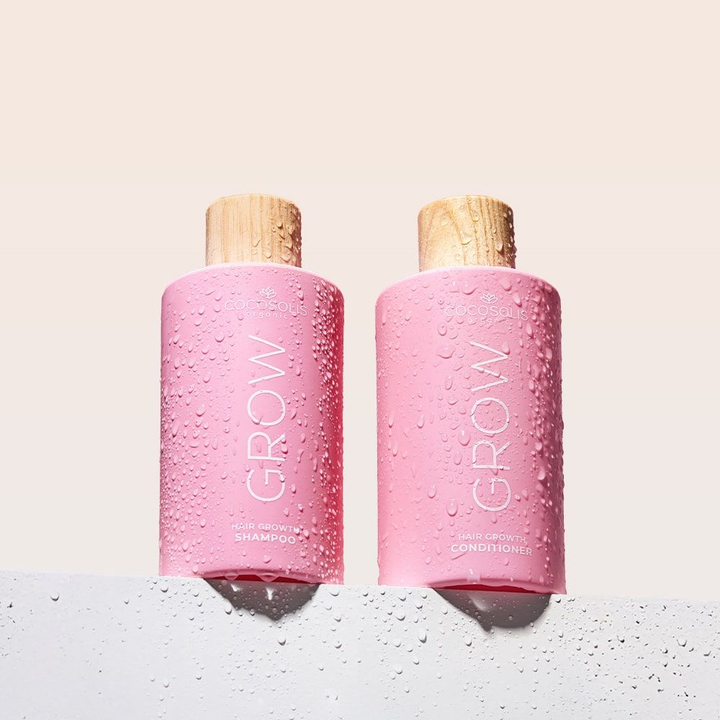
Pomelli AI is Google's free AI marketing tool that has been making waves since its Photoshoot feature launched in February 2026. Photoroom, on the other hand, has been a go-to for background removal and product image editing for years. Most E-commerce sellers use both tools as they have their varying strengths. But if you need high-volume, studio-quality product content that performs in paid ads, listing pages, and across social media, these two tools carry limitations that compound quickly at scale.
This article compares Pomelli AI and Photoroom across the areas that matter most to you if you own an e-commerce brand, so you can make the right choice or, better still, choose a more effective alternative.
How Pomelli AI Handles E-commerce Product Content
Pomelli allows you to take a basic photo of your product and transform it into studio-quality product imagery using Google's Nano Banana 2 model. You can also generate studio shots, lifestyle scenes, and in-use contexts from a single upload for free.
The free pricing alone has made Pomelli one of the most talked-about tools in the AI marketing space. But beyond Photoshoot, what makes Pomelli genuinely interesting is its Business DNA feature. It scans your website URL and extracts your color palette, fonts, tone of voice, and visual style. Then it uses that profile to generate marketing assets that feel on-brand rather than generic.

For small businesses and early-stage brands with limited budgets, that combination is genuinely compelling.
Pros
- 100% free during beta with up to 300 image generations per month.
- Business DNA that auto-extracts your brand identity from your website.
- Studio and lifestyle product shots generation from a single photo.
- Short video clips generation from static images.
- Available in 170+ countries and languages.
Cons
- Cannot generate performance marketing visuals or ad creatives for Meta campaigns.
- No competitor ad intelligence or in-platform research tools.
- No video ad creation workflow.
- Products with intricate labels occasionally require multiple regeneration attempts.
- Requires a website with consistent branding for Business DNA to work well.
- One campaign at a time. No workflow for teams managing multiple promotions.
How Photoroom Handles E-commerce Product Content
Photoroom has been a popular choice for e-commerce sellers who need quick background removal and basic image editing without hiring a photographer. Its batch-editing feature, mobile optimization, and freemium access have made it common among Amazon and eBay sellers who need clean white-background images at volume.

The platform does what it does efficiently. Background removal is fast, the interface is simple, and the free tier makes it easy to start without commitment.
However, for brands that have moved beyond basic catalog images, Photoroom begins to show its limits clearly. Brands running paid ads, creating lifestyle content, or building a recognizable visual identity experience its incapabilities when trying to generate marketable assets.
Pros
- Fast and easy background removal
- Freemium plan available
- Mobile-optimized
- Batch edits and exports
- Simple, intuitive interface
Cons
- Distorts product labels and logos when editing branded content
- Virtual model feature produces low-quality, unrealistic outputs according to multiple user reports
- Poor customer support
- Limited creative capability
- No video generation, ad creative workflow, or competitor intelligence features
Head-on Comparison: Pomelli AI vs. Photoroom for E-commerce Brands
Output Quality and Creative Range
Pomelli AI's Photoshoot feature produces genuinely impressive results for what it costs, which is nothing. The studio and lifestyle templates are polished, and the Nano Banana 2 model handles lighting and shadow with more sophistication than most tools in its price bracket. If you’re testing different visual styles or generating quick campaign assets, the output quality is competitive.
Photoroom is a background replacement tool with some AI image generation added on. It is not a creative platform. The images it produces are competent for simple catalog use, but they lack the lighting nuance, scene variety, and overall visual quality that you may need for ads and social content. Its virtual model feature, which is intended to put products on AI-generated models, has been widely criticized for low-quality outputs that don't reflect real-world human proportions or brand context accurately.
Product Label and Logo Accuracy
Pomelli AI's Photoshoot is built on a generative model, meaning it interprets your product rather than capturing it precisely. Complex products with intricate labels or small text can require multiple generation attempts before the output is usable. The tool acknowledges this directly in its own documentation.
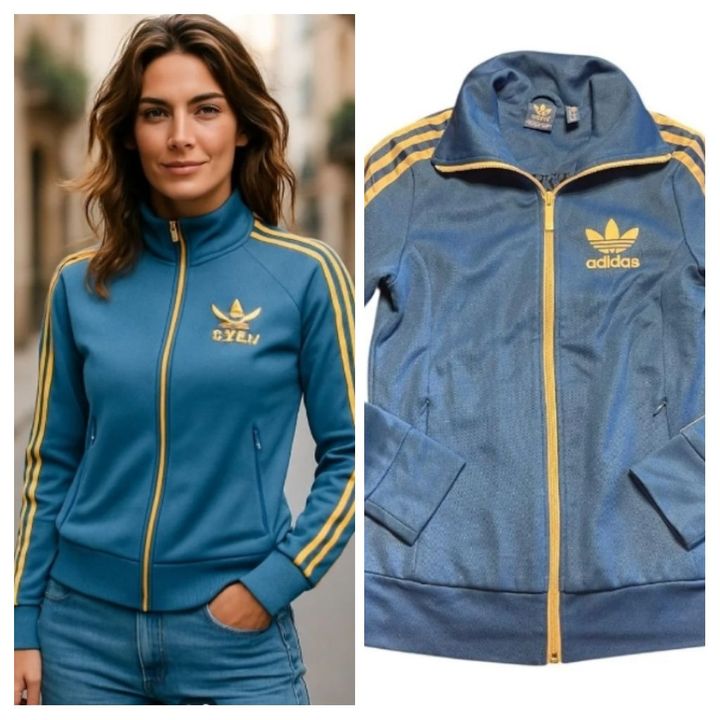
Photoroom's problem here is more severe and better documented. Users consistently report that Photoroom alters product labels, replaces logos, and changes brand elements when editing images, making the output legally and commercially unusable for branded product content. One user on Reddit showed a jacket whose collar shape, stripes, and logo were all visibly different from the original after Photoroom's virtual model feature processed it.
Performance Marketing and Ad Workflows
Pomelli AI generates social media campaign assets and is building toward Google Ads integration, but it is not designed for performance marketing at scale. There is no competitor ad intelligence, no Meta ad creative workflow, and no ability to clone high-performing ad formats from your category. If you run active paid campaigns, Pomelli can handle the top of the content pipeline, but you'll have to use other tools for conversion-focused creative work.
Photoroom has no performance marketing capabilities at all. It is an editing tool, not a content strategy platform.
Reliability
Photoroom is an established paid product. You know what you're paying for and what you'll get, within its limits.
Pomelli is a Google Labs beta experiment and is currently free. But Google Labs products operate on Google's timeline, not yours. Several Google Labs tools have been shut down or quietly discontinued after beta periods. Building your product content pipeline around a tool that hasn't announced pricing, could change its feature set at any time, and shows watermarks on free-tier images is a business risk that you should weigh carefully.
Pricing
Pomelli AI is free. Photoroom's paid plans start at $7.50/month (billed annually), with the Pro and Max tiers going higher.
On surface value, Pomelli wins the pricing comparison by a wide margin. But free-during-beta is not the same as reliably free, and for a $10M brand, the cost of rebuilding a content workflow when a beta product changes is far higher than a monthly subscription.
Why Neither Tool Is Enough for Fast-Growing E-commerce Brands
Between Pomelli AI and Photoroom, you can cover basic product imagery and simple editing. What you cannot cover is the full content stack that your e-commerce brand actually needs:
- Consistent, on-brand product images at high volume without label distortion
- Video ad creation and product image animation
- Performance marketing visuals for Meta and other ad platforms
- Competitor ad intelligence to inform your creative strategy
- UGC content creation
- A platform that combines best-in-class image and video models in one workflow
Neither Pomelli nor Photoroom was built for this. They were built for different, narrower use cases. And when your brand needs to scale faster, that narrowness becomes expensive.
Pikes AI: The Platform Built for E-commerce Brands at Scale
Pikes AI is a Generative AI platform designed specifically for e-commerce brand owners and product marketers. Unlike Pomelli, which approaches product photography from a general marketing tool angle, and Photoroom, which approaches it from a photo editing angle, Pikes was built from the ground up to serve one purpose: help consumer brands create studio-quality product content that drives sales, consistently and at scale.
Here is what you enjoy when you switch to Pikes for your e-commerce content assets:
- Zero Label and Logo Distortion: Pikes AI uses a proprietary model engineered to preserve your product labels, logos, packaging text, and form without distortion. Every generated image looks like your product, not an interpretation of it. This doesn’t require a paid upgrade or a pricing tier; it is how the platform is built.
- Chat Mode: Rather than configuring prompts and settings for each generation, you simply describe what you want in a conversation, and Pikes generates it. Any member of your team can use the platform from day one, regardless of technical background.
- Ready-to-Use Templates: A full library of production-ready templates for product visuals means you can generate professional content without any prompting at all. Select, upload, generate.
- Performance Marketing Visuals and Ad Intelligence: Pikes generates performance marketing creatives for Meta and other ad platforms, not just product photography. And it includes a built-in ad intelligence tool that lets you find the best-performing competitor ads, then clone the creative approach directly in Pikes. That way, you’ll be creating content informed by what's actually converting in your market.
- Claude AI Integration: Pikes has integrated Claude AI directly into the platform, so you can use Claude's capabilities to generate and refine your product images without leaving the platform.
One honest limitation: Pikes is purpose-built for e-commerce product content. If your primary need is a general marketing campaign generator or a lightweight background removal tool for catalog images, Pomelli or Photoroom may suit those specific tasks.
Pikes is the right choice when your priority is building a scalable, high-fidelity content pipeline for a growing product brand.
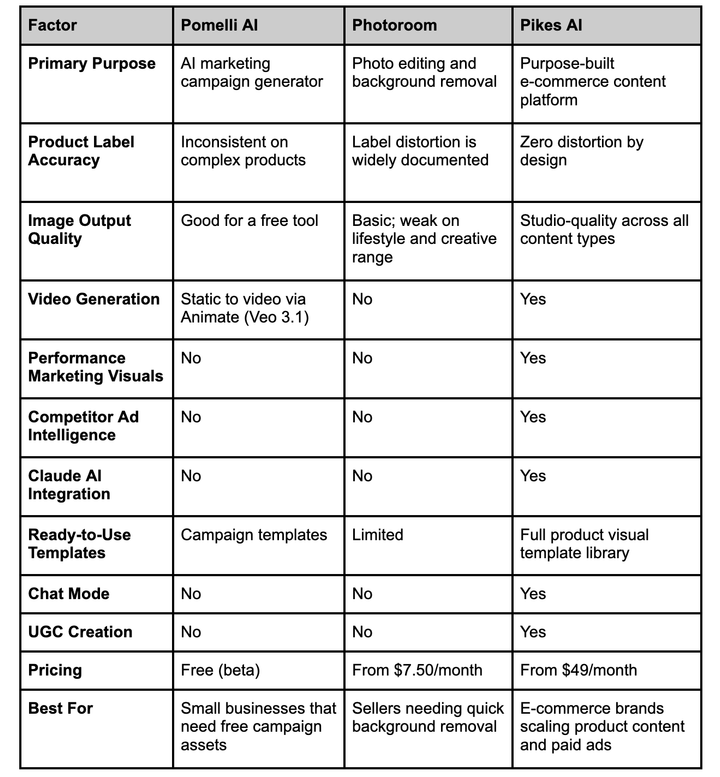
Summary Comparison
Final Verdict: When to Use Each
Pomelli AI is an impressive free tool, especially if you’re testing AI-generated product imagery without a budget.
Photoroom works for removing backgrounds and producing clean catalog images at speed.
Pikes AI is the choice for e-commerce brands that have moved past basic editing and free experiments and need a platform that can carry their full content pipeline.
Frequently Asked Questions
Can Pomelli AI create Meta ad creatives?
Not with a dedicated ad creation workflow. Pomelli generates social media campaign assets and is working toward Google Ads integration, but it does not have a built-in performance marketing workflow, competitor ad research tools, or Meta-specific ad creative generation. For performance marketing at scale, it leaves a significant gap.
What makes Pikes AI different from Pomelli AI and Photoroom?
Pikes AI is purpose-built for e-commerce brand content, which is the core difference. It preserves product labels and logos without distortion, generates performance marketing visuals for Meta and other ad platforms, includes a competitor ad intelligence tool, offers both best-in-class image and video models in one platform, and has a Chat Mode that makes content creation conversational. Neither Pomelli nor Photoroom was designed around these requirements.
Is Pikes AI good for small e-commerce brands?
Yes. Pikes AI offers a free trial with no credit card required, making it accessible for brands at any stage. The Starter plan at $49/month includes up to 325 professional brand asset generations per month, which, compared to the cost of a single professional product photoshoot, represents significant value from the first month of use.
Which tool is best for generating product images for Amazon listings?
For basic white-background catalog images, Photoroom works. For lifestyle, studio-quality, and ad-ready product images that meet Amazon's and other platforms' standards — without label distortion or quality inconsistency — Pikes AI is the stronger choice. Its model is specifically engineered to maintain product accuracy across all generation types.

Written by
Mike Lehman
Mike Lehman is a senior content strategist at Pikes. Before joining Pikes, Mike spent nearly a decade working with Glossier, Haus, and Athletic Brewing, leading campaigns that blended storytelling and data.