
Mike Lehman
AI Studio Photos: Get Professional Studio Quality Without the Studio

Studio-quality product photos have always been the gold standard for e-commerce because they come with clean lighting, sharp details, and perfect shadows. They are the kind of images that make a product feel premium and trustworthy even from afar. But the problem is that traditional studio shoots are slow, expensive, and hard to scale, especially for fast-growing brands.
But things seem to be changing fast. AI studio photos now make it possible for brands to achieve the same studio-quality look without stepping into a studio at all. With modern AI product studios like Pikes AI, e-commerce brands can create studio-quality visuals without going through the process of booking a studio, hiring a photographer, or waiting weeks for edits.
In this guide, we’ll break down how AI replicates studio conditions to produce high-quality product photos and how your brand can use it to move faster without sacrificing quality.
What Makes Studio Photography Look Professional?
Studio-quality product photos aren’t about expensive cameras or fancy studios. They’re more about control – control over light, depth, background, and detail. When these elements are handled properly, your products look clean, premium, and trustworthy, communicating to the shopper even before they read a single word from the descriptions. Let’s break things down so you understand better.
Controlled Lighting
Professional studio photography uses carefully placed light sources to shape the product. Nothing is left to chance; the highlights are intentional, and the shadows are soft, not harsh. This is what gives products that polished, high-end look instead of flat or uneven lighting.
Depth, Shadows, and Dimension
Shadows are not mistakes. In studio photography, they’re deliberate. A subtle ground shadow anchors the product. It adds depth and prevents it from looking like it’s floating. Without this, even a sharp image can feel artificial.
Clean Backgrounds
Studio backgrounds are chosen to support the product. Neutral tones, smooth gradients, or minimal sets help the product stand out while keeping the focus exactly where it should be.
Sharp Detail and True Colors
Professional studio photos preserve what matters most. They preserve things like crisp labels and readable text, accurate colors, and realistic textures. This accuracy helps build trust, especially for skincare, supplements, and CPG products where customers expect what they see to match what arrives.
When all these elements come together, the image doesn’t just look good; it also feels reliable. That’s what “studio quality” really means.
How AI Replicates Studio Conditions

Now, we have modern AI product studios that have done well in replacing professional studio photography. They aren’t guessing what a studio photo should look like; they’re trained to recreate the same visual principles photographers rely on, but in a fully digital environment.
Virtual lighting models
AI studio tools simulate professional lighting setups without physical equipment. Instead of real softboxes or reflectors, AI uses virtual light sources that can be positioned, softened, or intensified to match classic studio looks. This makes it possible to achieve clean, balanced lighting consistently across every product image.
Depth and edge awareness
One of the biggest differences between basic image editing and true AI studio photos is depth awareness. AI understands where the product begins and ends. So, it keeps the edges sharp and ensures the shapes stay intact. This prevents the flat, cut-out look that often happens with manual background removal.
Realistic material rendering
AI product studios are trained to recognize how different materials interact with light. For that reason, your matte packaging diffuses light softly, and glossy bottles reflect highlights. Also, transparent containers show depth instead of looking opaque. These details are what make AI studio photos feel real rather than artificial.
Lighting, Shadows, and Reflections in AI Studio Photos
When many people hear AI studio photos, they are often tempted to worry about lighting and all of that. And really, that’s a valid concern because lighting is vital to studio-quality images; it determines the final result of your product image. If you get it right, your product looks premium. And if you get it wrong, even the best packaging can feel cheap.
Interestingly, this is one area where AI studio photos have improved dramatically. Photographers in a real studio carefully control where light falls and where it doesn’t, and AI studio photography follows the same logic.
You can create soft and even lighting for clean e-commerce shots or add more contrast for a premium, editorial feel. The key difference is consistency. Once the lighting style is set, it stays the same across every product and variation. And that is a plus over traditional photoshoots.
For shadows, AI studio tools generate subtle ground shadows that anchor the product in the scene. This avoids the “floating product” look that’s common with basic cutouts. The shadows adapt to the product’s shape and angle, hence helping images feel more realistic and less synthetic.
Background Options and Customization
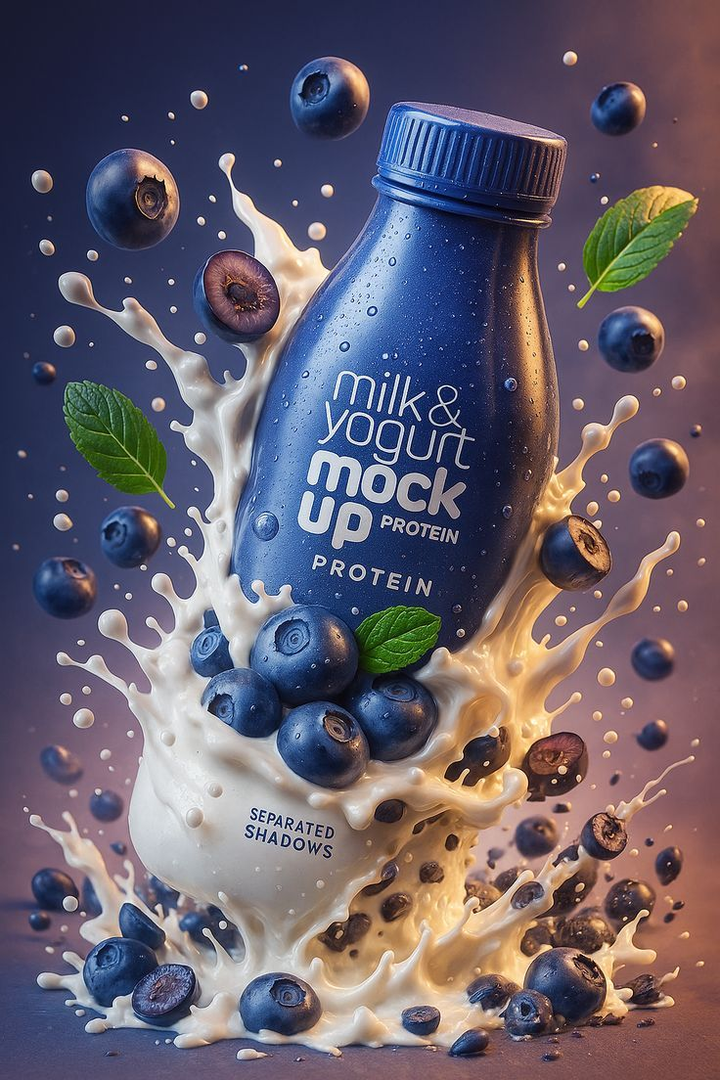
In studio photography, the background is never an afterthought; it’s chosen to support the product, control attention, and fit the channel where the image will be used. With AI studio photos, you can expect that same level of intention without the limits of physical sets.
Clean Studio Backgrounds
For e-commerce listings and marketplaces, simplicity is a major entity to work toward. And this is quite easy with AI studios. These tools make it easy to place products on different polished and compliant backgrounds, whether it’s white, grey, or brand-color backgrounds. These backgrounds keep the focus on the product while meeting platform requirements for stores like Amazon and Shopify.
Lifestyle-Style Studio Sets
Not every studio photo needs to be plain; sometimes what you need are lifestyle visuals. AI studio photography can recreate lifestyle-inspired environments that still feel controlled and professional. It provides soft surfaces, subtle textures, or minimal props that clearly show context without distracting from the product.
And if you will be needing your photo for ads and hero images, where emotion is a big deal, you will surely appreciate AI studios in this sense.
Brand Color and Mood Control
There is hardly any other way you can achieve flexibility better than with AI. You can easily adjust background colors, tones, and moods to match your brand guidelines exactly. AI lets you maintain visual identity across every image, whether your brand leans towards clean and clinical or warm and natural.
Consistency Across Products
In physical studios, keeping backgrounds consistent across multiple shoots takes planning and luck. But with AI studio photos, consistency is built in. The same background style can be applied across entire catalogues, helping products look cohesive and professionally produced, even as new SKUs are added.
Comparison: Real Studio vs AI Studio Photos
When you take a quick look at studio photography vs AI studio photos, it’s easy to see that they both aim to achieve the same outcome, which is getting clean, professional visuals that make products look their best.
But with a much closer look, the difference begins to show in terms of how they get there, and what that means for speed, cost, and flexibility.
For a quick comparison:
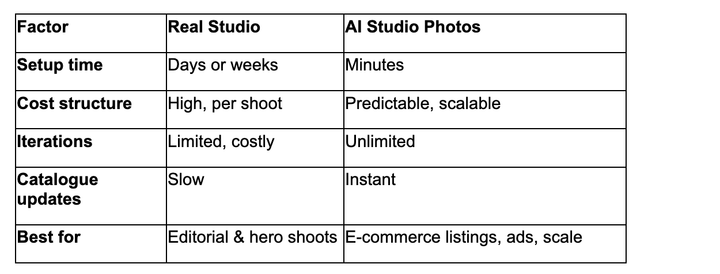
Traditional Studio Photos Vs AI Studio Photos
Now, let’s take a deeper dive to see how the two compare.
Traditional Studio Photography
A real studio gives you physical control, no doubt. Here, you will work with photographers, props, lighting setups, and sets to achieve the perfect visuals. When you’re able to get everything well, you’re sure going to love the results. But the process comes with trade-offs.
- Time: Getting a professional photographer, scheduling shoots, shipping products, waiting for edits, and sometimes doing reshoots can all delay the timeline. Most times, you don’t get your photos until weeks after the shoot.
- Cost: Traditional photoshoots can be expensive – photographer fees, studio rental, stylists, props, and post-production all require a lot of resources.
- Flexibility: Once a shoot is done, you will usually need to book another session if you have to make any changes.
- Scalability: Managing dozens of SKUs or frequent launches becomes expensive and slow.
Traditional studios work best for big brand campaigns or hero shoots where budgets and timelines are less constrained.
AI Studio Photography
AI studio photos recreate the studio environment digitally. You don’t need any physical setup or scheduling.
- Speed: You can create images in a matter of minutes, not weeks.
- Cost: Pricing is predictable, and you don’t have to pay per shoot.
- Flexibility: Backgrounds, lighting, and styles can be adjusted instantly.
- Scalability: Entire product catalogues can be updated or expanded without friction.
When to Use AI Studio Photos vs a Real Studio
With its virtual studio photography, AI studio photos can be very powerful. However, this still doesn’t make them a replacement for every type of shoot. The good thing is knowing when AI is the better option, and when a physical studio still makes sense.
When AI Studio Photos Are the Right Choice
AI studio photography works best when speed, consistency, and scale matter most. It’s ideal for:
- E-commerce product pages and collections
- Amazon, Walmart, and marketplace listings
- Paid ads on Meta, TikTok, and Google
- Product launches and rapid testing
- Frequent packaging updates or rebrands
- Growing catalogues with multiple SKUs
In these cases, AI studios deliver studio-quality visuals faster and more affordably, without compromising accuracy.
When a Real Studio Still Makes Sense
Physical studios still have a place, especially for:
- High-end brand campaigns or editorial shoots
- Model-heavy lifestyle content
- Influencer or storytelling-led visuals
- One-off hero assets with larger budgets
These shoots focus more on emotion, people, and narrative than on repeatable product accuracy.
Creating Studio Quality AI Photos with Pikes
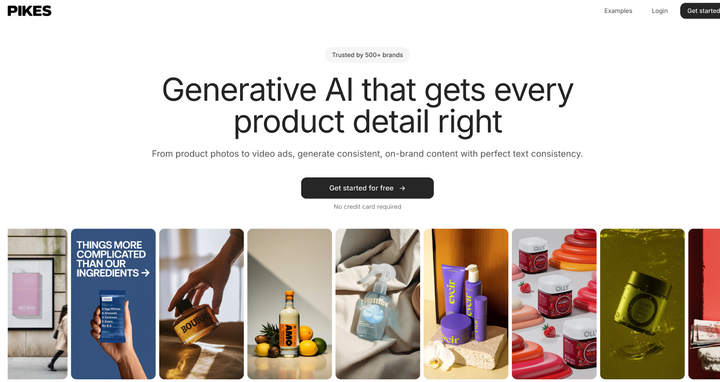
Now, let’s get a bit more practical with AI studio photos; let’s show you how Pikes AI has been saving the day for many e-commerce brand owners looking for studio-quality AI photos. Let’s get to know what the AI product studio is and how it can help.
Built for E-commerce
Pikes isn’t a design tool adapted for products. It’s a product-first AI studio. That means every image is generated with accuracy in mind:
- The labels stay sharp and readable
- The packaging shape doesn’t change
- Colors remain consistent across images
- Your products look like themselves, every time
This is especially important for categories like skincare, supplements, beverages, and CPG, where visual trust directly affects conversions.
Studio-Style Outputs on Demand
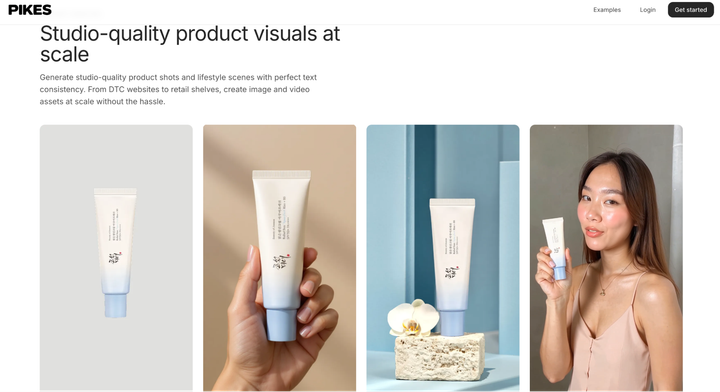
With Pikes, brands can create:
- Clean studio product shots for listings
- Lifestyle-style studio scenes for ads
- Multiple angles and variations from one product
- Images in the right dimensions for Amazon, Shopify, Meta, and TikTok
Lighting, shadows, and backgrounds are handled automatically, so teams don’t need to micromanage technical details.
Designed to Scale with Growing Brands
Pikes is used by 1,000+ consumer and ecommerce brands to upgrade their product visuals at scale. Instead of planning shoots around launches, brands can generate visuals as needed – for a single SKU or an entire catalogue refresh.
What used to take weeks now takes minutes with no scheduling, reshoots, or creative backlog. Pikes turns studio-quality product photography into an on-demand workflow, giving teams the freedom to test, iterate, and launch faster, all without sacrificing quality.
FAQs
Can AI studio photos really replace traditional studio photography?
For most e-commerce use cases, yes. The photos have proven to be an excellent option for product pages, ads, and marketplaces. While you can still use traditional studios for large editorial shoots, AI can handle the majority of day-to-day product visuals faster without going overboard with cost.
Are AI studio photos allowed on Amazon and other marketplaces?
Yes. As long as the images accurately represent the product and don’t go against the platform guidelines, AI studio photos are accepted. You can use it in places like Amazon, Shopify, Walmart, and paid ads without issues.
What types of products work best with virtual studio photography?
Virtual studio photography is especially effective for packaged products like supplements, skincare, beauty items, beverages, and consumer goods. If your product plays where clarity, consistency, and clean representation are important, AI studio photos will do you a lot of good.
How can I get started with AI Studio Photos?
You simply start by uploading a few existing images of your product into Pikes and then generate studio-style outputs. From there, you can expand into lifestyle scenes, ad creatives, and full catalogue updates, without ever booking a studio.

Written by
Mike Lehman
Mike Lehman is a senior content strategist at Pikes. Before joining Pikes, Mike spent nearly a decade working with Glossier, Haus, and Athletic Brewing, leading campaigns that blended storytelling and data.