Pontus Karlsson
Ghost Mannequin Photography: How It Works and Where Amazon Won't Accept It
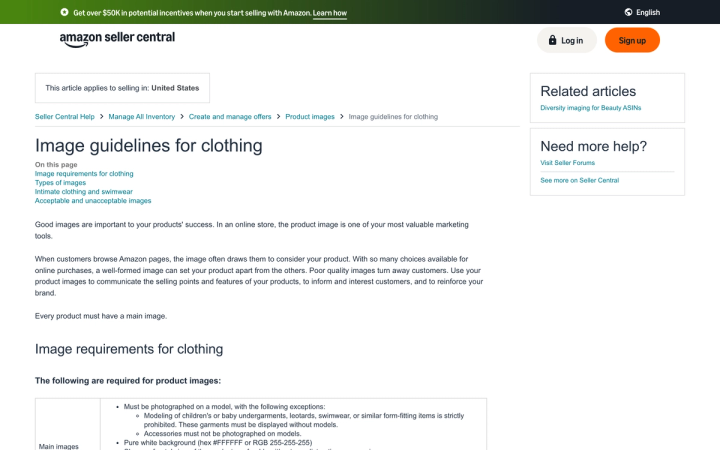
Ghost mannequin photography shoots a garment on a mannequin, then removes the mannequin in post so the clothing keeps its worn, three-dimensional shape against an empty background. It is the default look for apparel on DTC stores. Amazon is stricter than most guides admit: its clothing rules require adult-size main images to be photographed on a model, and separately prohibit any visible mannequin, hanger or holder.
That combination is where brands get their listings suppressed. Here is how the shot is made, and exactly where you can and cannot use it.
What is ghost mannequin photography?
Every ghost mannequin image is a composite of at least two frames. You photograph the garment dressed on a mannequin, photograph the parts the mannequin hides, and merge the two so the finished image shows the garment holding a body shape with nothing inside it.
The technique goes by several names: invisible mannequin, hollow man, 3D ghost. They all describe the same output, which is volume without a person.
The reason it exists is cost and consistency. A model shoot needs booking, styling, direction and a usable frame from a person who will not be available again when you add a colourway in six weeks. A mannequin holds the same pose forever. For a catalog with variants, that repeatability is the whole point.
How do you actually shoot a ghost mannequin image?
Four steps. Step three is what most in-house shoots leave out, and it is the one that makes the effect work.
1. Dress the mannequin properly. Pin and clamp the garment from behind so it sits the way it would on a body: shoulders square, side seams straight, hem level. Every wrinkle you leave here is retouching time later.
2. Shoot the front. Camera at chest height, garment square to the sensor. Amazon requires a frontal view for clothing main images, so shoot straight rather than at a flattering angle.
3. Shoot the inside neck separately. Take the garment off, turn the collar or neckline so the interior back shows, and photograph it from the same camera position under the same light. This second frame is what fills the neck opening in the composite. Without it you get a flat black hole where the collar should be, which is the tell that separates a real ghost mannequin shot from a cut-out.
4. Composite and clean. Mask the mannequin out, drop the interior frame behind the neckline, then match the two exposures. Keep the background at pure white if the image is going anywhere near Amazon. The specification is hex #FFFFFF, RGB 255-255-255, and "near enough" fails it.
Two frames per garment, per colourway. That multiplier is the real cost of ghost mannequin work, and it is why the technique is priced per garment rather than per shoot day. We break the broader numbers down in our guide to product photography pricing.
Where does Amazon allow ghost mannequin images?
Amazon's rules pull in two directions here. Its Image guidelines for clothing state that main images "must be photographed on a model," with two exceptions: children's and baby undergarments, leotards, swimwear and similar form-fitting items are strictly prohibited from being modelled, and accessories must not be photographed on models.
Separately, Amazon's prohibited-image list for clothing main images includes any "product shown on a visible mannequin, hanger, or holder," and its general Product image guide adds that you must not show any part of a mannequin "regardless of the mannequin's appearance," including clear, solid-colour, flesh-toned or framework mannequins.
A ghost mannequin image clears the second rule, since no mannequin is visible. It does not satisfy the first one for adult apparel.
| Where you're using it | Ghost mannequin | Why |
|---|---|---|
| Amazon main image, adult clothing | Not compliant | Main images must be photographed on a model |
| Amazon main image, accessories | Compliant | Accessories must not be photographed on models |
| Amazon main image, children's form-fitting items | Compliant | These must be displayed without models |
| Amazon alternate images (up to 8 per SKU) | Compliant | The on-model rule applies to main images |
| Your own Shopify or DTC store | Compliant | You set the standard |
| A visible mannequin or hanger anywhere on Amazon | Prohibited | Explicitly listed as an unacceptable main image |
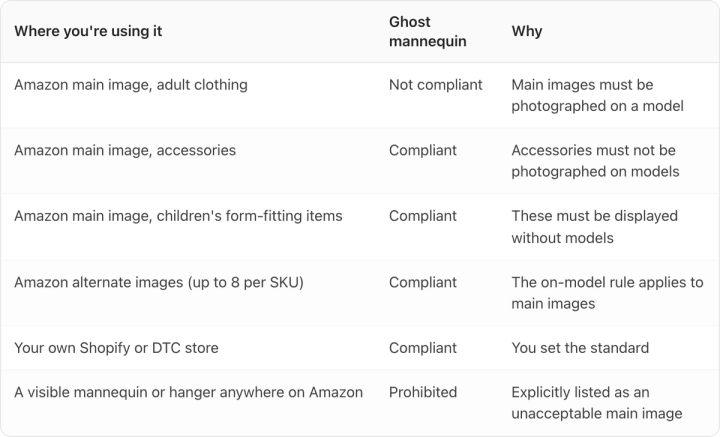
For adult apparel on Amazon, then, ghost mannequin belongs in the alternate slots rather than the main image. Amazon recommends at least six additional images plus a video beyond the main image, and allows up to eight alternate images per parent or child SKU, so there is plenty of room for it.
The rest of the main-image spec applies either way: pure white background, frontal view, the whole product in frame with nothing clipped, minimum aspect ratio close to 3:4, and the product occupying 85% of the image area. Images need to be 1,000 pixels or larger on one side to activate zoom. Our full breakdown of Amazon product image requirements covers the technical specs in detail.
If you are producing apparel imagery with AI, one more rule applies. Amazon asks sellers to tag images containing photorealistic, entirely AI-generated people with the keyword contains-synthetic-performer in the image file's IPTC metadata. Ghost mannequin images contain no people, so the tag does not apply to them, though an AI on-model shot does need it.
Ghost mannequin vs flat lay vs on-model
| Method | Shows fit and drape | Amazon adult main image | Cost driver | Best for |
|---|---|---|---|---|
| Ghost mannequin | Yes, body shape without a person | No, alternate images only | Two frames plus a composite, per colourway | Catalog consistency across variants |
| Flat lay | Poorly; the garment reads two-dimensional | No | One frame, minimal retouching | Accessories, kids' form-fitting items, social |
| On-model | Best: real fit, movement, scale | Yes | Model, styling and studio time | Hero images and the Amazon main slot |
| On a visible mannequin | Yes | Prohibited | One frame | Internal reference only |
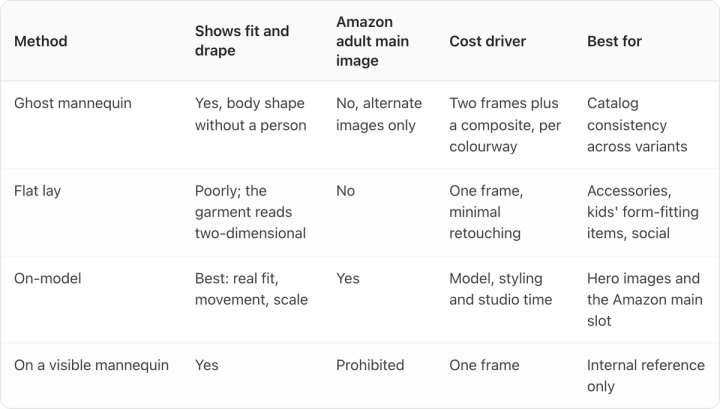
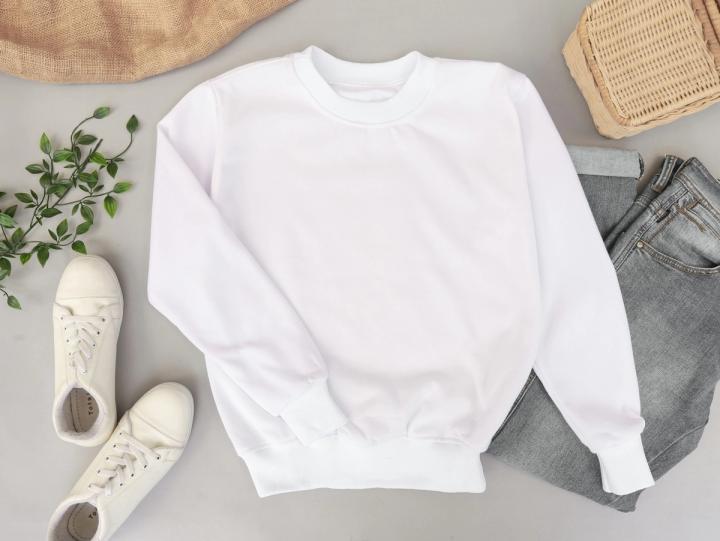
Flat lay is cheaper and faster, and for accessories it is what Amazon effectively pushes you toward. It just cannot show how a garment sits on a body, which is what drives returns when a customer guesses wrong. Ghost mannequin is the middle option: most of the fit information, none of the model logistics.
Most apparel brands end up running all three: on-model for the main image and hero placements, ghost mannequin across the variant grid, flat lay for accessories and detail shots. Our fashion product photography guide covers how to plan a shoot that produces all three in one session.
How many ghost mannequin shots does a catalog actually need?
More than most brands budget for, because Amazon requires a main image for every parent and every child SKU. A shirt in four colours is five main images, not one.
Layer the alternate slots on top, given that Amazon recommends at least six additional images and one video per listing, and a modest twenty-style range with four colourways each turns into hundreds of frames. That is the arithmetic that pushes apparel brands toward repeatable production rather than repeated shoot days. We work through the per-SKU maths in how many product photos you need per SKU.
Can AI generate ghost mannequin images?
It can, and the composite step is where it helps most. Masking the mannequin, filling the neckline, matching exposures and dropping the background to pure white is mechanical work that scales badly with human retouchers and well with a model.
The limit is fidelity. On apparel, the details that matter are the ones general-purpose image models drift on first: stitch lines, weave texture, the exact colour of a dyed fabric, and any printed or embroidered branding. A shot that looks convincing at thumbnail size and falls apart at Amazon's zoom threshold has saved you nothing.
That fidelity problem is what Pikes is built around: generating from your real product images and holding label, colour and material detail consistent across a catalog rather than reinventing them each generation. If you are producing apparel imagery at variant scale, it is free to start with no credit card. Test it on your most detailed garment rather than your plainest one.
Frequently asked questions
Is ghost mannequin photography allowed on Amazon?
Yes for alternate images, accessories and children's form-fitting garments. No for adult clothing main images, which Amazon's clothing guidelines require to be photographed on a model. A visible mannequin, hanger or holder is prohibited in main images regardless of category.
What is the difference between ghost mannequin and invisible mannequin?
There is none. Ghost mannequin, invisible mannequin, hollow man and 3D ghost all describe the same composite technique. Different studios simply use different names for it.
How many photos do you need to make one ghost mannequin image?
At least two: the garment on the mannequin, and a separate frame of the interior back or collar shot from the same position. Garments with visible linings, cuffs or open plackets may need three or four.
What background should a ghost mannequin image use?
Pure white, hex #FFFFFF or RGB 255-255-255, if the image is going on Amazon. Amazon also requires a frontal view, the whole product in frame, a minimum aspect ratio close to 3:4, and the product filling 85% of the image area.
Does ghost mannequin work for every garment?
It works best on structured pieces that hold a shape: shirts, jackets, knitwear, outerwear. Very soft or draping fabrics collapse without a body inside them, and heavily patterned pieces make the neckline composite harder to hide.
Is ghost mannequin cheaper than hiring a model?
Per garment, usually yes. There is no booking, styling or model fee, and the mannequin reproduces the same pose indefinitely for new colourways. The trade-off is retouching time, since every image is a composite rather than a single capture.