

Mike Lehman
Pomelli AI Review (2026): Is Google’s Viral AI Product Photography Tool Worth It?

AI tools are launching every week, but Pomelli AI seems to be making a significant wave lately. As Google’s experimental AI marketing tool, it promises to read your brand, understand your tone, and generate on-brand visuals in your exact style. For small teams and busy founders, that sounds almost too good to ignore.
But if you’re here, you’re probably not just curious. You’re likely evaluating and want to know whether this viral AI tool is actually good for ecommerce product photography or if it’s just another clever content generator.
In this Pomelli AI review, we’ll break down what this tool does well, where it struggles, how much it costs, and whether it’s the right fit for your brand in 2026.
What Is Pomelli AI?
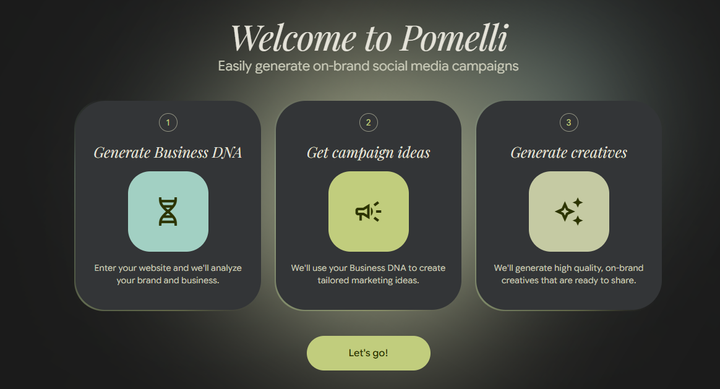
Let’s start with what Pomelli AI is exactly. Perhaps that will help clear the air to a good extent. Pomelly AI is an experimental AI marketing tool developed through Google Labs. The tool was said to be designed to help businesses generate branded content quickly.
Instead of acting purely as a design tool, the Pomelli AI tool positions itself as a kind of automated marketing assistant. You simply give it your website; it gets a feel of and understands your brand, and then creates on-brand visuals and campaign assets for you.
At the core of Pomelli AI's product photography and content generation is something called a “Business DNA Profile.” After you enter your website URL, Pomelli scans your site to analyze your tone of voice, color palette, typography, image style, and messaging. Based on that analysis, it generates a profile that guides future outputs.
From there, the tool can create assets for various platforms, including social media posts, Google Ads visuals, email banners, and simple campaign layouts. You can later add your own input to personalize the tone even further. You can do this using natural language prompts like “make this more playful” or “emphasize sustainability,” and the system will adjust accordingly.
However, one thing you should bear in mind is that Pomelli isn’t built exclusively for product photography; it’s broader. It’s more of an AI marketing content generator that includes visual assets as part of its workflow.
For small businesses or solopreneurs who want to generate on-brand content quickly, that’s a compelling proposition. But for ecommerce brands that need nothing but high-precision product visuals, that difference is a big deal. Don’t worry; we’ll explore that further as we go. Just keep reading.
Key Features of Pomelli AI
Pomelli AI is designed to simplify content creation for marketers and small teams. While it isn’t built exclusively as a product photography engine, it does offer several features that can support visual asset creation. Here’s what stands out.
1. Business DNA Builder
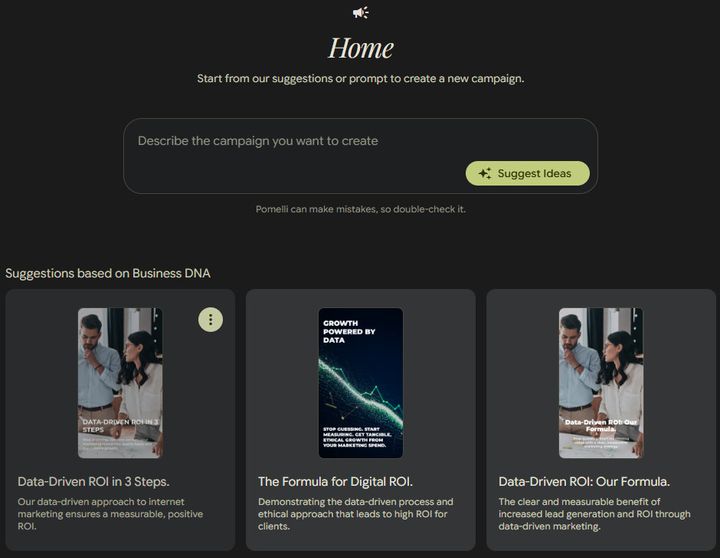
This is Pomelli’s signature feature. Instead of uploading a detailed brand guide, you paste in your website URL. The system scans your site and then builds a “Business DNA Profile” based on tone of voice, brand messaging, color palette, fonts and typography, image style and aesthetic, and many more.
The idea is that once your DNA profile is created, every visual and piece of copy stays aligned with your brand automatically.
2. AI Asset Generation
After analyzing your brand, Pomelli can generate complete marketing assets across multiple formats. You choose a suggested campaign or type in your own idea, and the AI builds layouts using modular blocks. It’s fast, and it works well for first drafts or campaign brainstorming.
3. AI Background & Scene Creation
Pomelli AI product photography includes the ability to generate product scenes and AI backgrounds. You can place products into different visual contexts without manually designing layouts from scratch.
That said, the focus is more on marketing visuals than highly detailed, studio-grade product realism. It is designed for speed and cohesion rather than deep lighting control.
4. Natural Language Customization
You don’t need technical design skills. You can simply type instructions like:
- “Make the tone more playful.”
- “Highlight sustainability.”
- “Use softer colors.”
The system then adjusts layouts and messaging based on your prompt. This makes the Pomelli AI tool accessible to even non-designers.
5. Multi-Platform Content Packs
One helpful feature is the ability to generate a full campaign across platforms in one go. Instead of creating assets one by one, Pomelli can output variations sized for Instagram, YouTube, Google Ads, and email. That can be a huge time-saver for brands juggling multiple channels.
Pros and Cons of Pomelli AI by Google Labs
No tool is perfect, and a balanced Pomelli AI review has to look at both sides. Pomelli does some things very well, especially for small teams. But it also has limitations that matter for serious ecommerce brands.
Pros of Pomelli AI
- Brand DNA automation: The Business DNA builder is genuinely useful. Instead of manually uploading brand guidelines, the tool only needs your website URL to figure out your brand identity. For non-designers, this removes a lot of friction.
- Fast content generation: Pomelli is quick. You can go from just an idea to having your full social visuals ready in minutes. If you’re juggling multiple marketing tasks, you’ll definitely appreciate that speed.
- Beginner-friendly interface: The tool doesn’t require design skills. You can adjust outputs with simple prompts. That makes it accessible for solopreneurs and small businesses.
- Multi-channel campaign creation: The convenience the tool offers when it comes to generating content for various platforms is very appealing. From Instagram posts to Google Ads visuals and email banners, you can get all of these in a single workflow.
- Free beta access (for now): At the time of writing, Pomelli is still in beta, which means users can test it without committing to high costs.
Cons of Pomelli AI
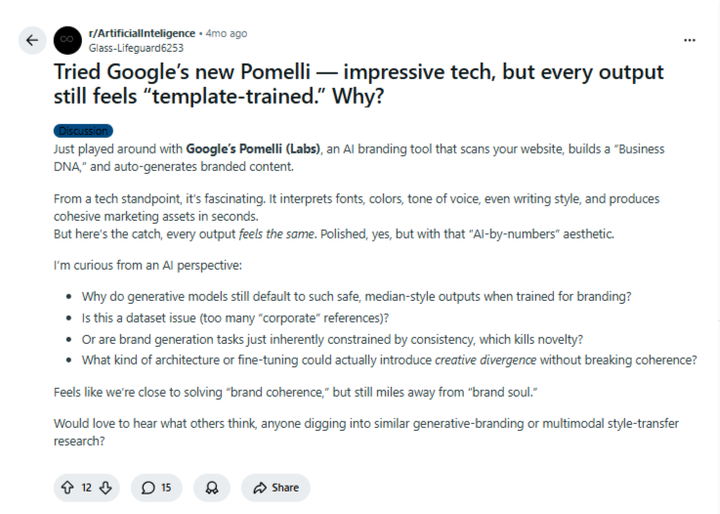
- Still a beta product: Because it’s in its experimental stage, bugs and inconsistencies can happen. Some users report occasional layout glitches or clunky fine-tuning.
- Limited region and language availability: Pomelli is currently available only in English and is limited to select countries.
- Limited design control: Users looking for pixel-perfect layouts or absolute control over lighting and composition may feel constrained. It’s not a Figma-level design tool.
- Not built specifically for ecommerce product detail accuracy, so it’s not the best for most ecommerce brands.
- Limited batch product image generation: Managing large catalogs or generating dozens of SKU variations isn’t its core strength. It’s optimized for campaigns, not scaled product creative production.
Pomelli AI Pricing (2026 Breakdown)
Pricing is a major factor if you’re evaluating whether the Pomelli AI tool is worth adopting long-term. Since it’s still in beta, the structure is relatively simple, but that could change as the product matures.
Free Plan (Beta Access)
Presently, Pomelli offers a free tier that allows users to:
- Build a Business DNA profile
- Generate a limited number of assets
- Test the AI photoshoot generator
- Explore campaign suggestions
This is ideal if you want to experiment without entering payment details. For solopreneurs and small brands, it’s a low-risk way to evaluate the tool. However, because it’s still in beta, you may encounter feature limits and unique access rules.
Pro Plan
The Pro tier unlocks higher generation limits and additional capabilities such as:
- Multi-brand support
- Team collaboration
- More export options
- Expanded campaign generation
Exact pricing may vary over time, so to get the most current numbers, you should always check Pomelli’s official site. However, based on early reports, the Pro plan is positioned to be affordable for small and medium businesses.
Who Is Pomelli AI Best for?
Not every tool is built for every type of brand. Pomelli AI shines in specific scenarios. When you understand this, it will be easier for you to decide whether it fits your workflow or not.
Solopreneurs and One-Person Marketing Teams
If you’re running a small ecommerce brand and handling marketing yourself, the tool can save serious time. Instead of brainstorming every Instagram post or ad layout from scratch, you can generate on-brand drafts quickly and refine them. For founders who don’t have a designer on call, that’s valuable.
Small Businesses Needing Campaign Drafts
Pomelli works well as a first-draft generator. You brief it once, and it produces a mini campaign across multiple channels. That makes it useful for seasonal promotions, product announcements, social content calendars, and basic ad creative testing.
Social-First Ecommerce Brands
If your primary focus is generating social visuals rather than marketplace-ready product photos, Pomelli AI product photography may be sufficient. It’s built around marketing packages and visual cohesion more than product precision.
Limitations of Pomelli AI for Ecommerce Brands
Pomelli is impressive as a marketing assistant. But ecommerce brands have very specific needs when it comes to product visuals. And this is where the gaps become clearer.
If you’re running paid ads, managing a growing SKU catalogue, or optimizing for marketplaces like Amazon, certain limitations matter more than they would for a small social-first brand. Let’s take a quick look at some areas where Pomelli doesn’t meet up to expectations.
#1: Product Detail Accuracy
Ecommerce product images aren’t just decorative; they need to be precise. Packaging text must be readable. Colors must match real-world inventory. And logos cannot warp.
Because Pomelli AI is built inside a broader marketing tool, it doesn’t focus deeply on product-level accuracy. In some cases, text clarity and micro details may feel less refined compared to dedicated AI product studios. For CPG brands, supplements, and skincare products, that level of precision is non-negotiable.
#2: Limited Lighting & Realism Control
Pomelli generates branded visuals, but it doesn’t give granular control over lighting direction, realistic shadow placement, or material rendering. If you want studio-grade reflections, natural ground shadows, or realistic packaging effects, you may hit a ceiling.
The visuals are good for marketing drafts, but not always optimized for high-conversion ecommerce photography.
#3: Batch Generation for Large Catalogues
Scaling product creatives is different from generating one campaign. If you’re managing dozens of SKUs and need multiple angles, variations, and sizes, Pomelli isn’t optimized for high-volume product creative generation. It’s built more for campaign packages than bulk SKU production.
#4: Marketplace Optimization
Ecommerce sellers often need:
- White-background compliant images
- Platform-specific dimensions
- Structured visual hierarchies
- Conversion-focused composition
Pomelli focuses on brand marketing rather than strict marketplace formatting. If Amazon, Walmart, or retail compliance is your primary channel, you may need additional tools.
#5: Beta Stability & Availability
Because Pomelli is still in beta and limited to certain regions and available only in English, there’s some uncertainty around long-term stability and scalability. For fast-growing ecommerce brands building long-term systems, reliability matters.
Best Alternative to Pomelli AI – Pikes AI
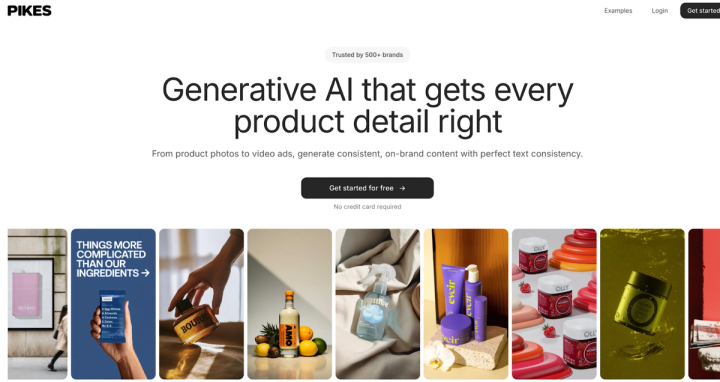
If Pomelli is primarily a marketing assistant, what should you use when product visuals are your growth engine? That’s where a dedicated AI product studio like Pikes becomes important. The tool is built specifically for ecommerce product creative generation, and here are some areas the tool wins over Pomelli.
Product detail consistency
Pikes is trained to preserve product geometry, label accuracy, and text clarity. This means no warped packaging or random typography artifacts. For supplement bottles, skincare packaging, or CPG products, that is a big deal.
Studio-grade AI product photos
Instead of generic campaign layouts, Pikes generates:
- Clean white-background marketplace images
- Realistic studio-style shots
- Lifestyle product scenes
- High-conversion ad creatives
The lighting, shadows, and reflections are designed specifically for ecommerce performance.
Bulk creation & SKU scaling
For brands with growing catalogues, Pikes allows batch generation and multi-variation outputs. You can create multiple dimensions for Amazon, Meta, TikTok, and Shopify in one workflow. That’s critical if you’re running paid ads at scale.
Custom style model training
Unlike Pomelli’s website-based DNA scan, Pikes allows you to train custom style models using reference images. This gives you more control over your product aesthetic while still maintaining brand consistency.
Built for fast-growing consumer brands
Pikes is already used by 1,000+ ecommerce and consumer brands to upgrade their product visuals and scale creative production. It’s not an experimental beta. It’s purpose-built for product-first teams.
Pomelli AI vs Pikes: Feature Comparison
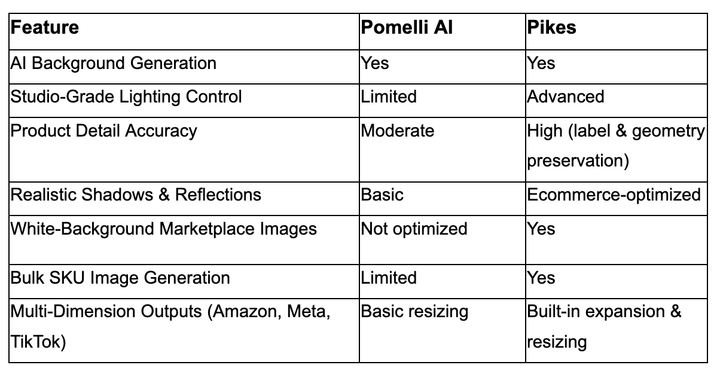
Final Verdict: Is Pomelli AI Worth It in 2026?
Pomelli AI is a smart, well-designed marketing assistant, no doubt. Its Business DNA builder is genuinely useful, and for solopreneurs or small teams trying to move fast, it can remove a lot of creative friction.
If your goal is to generate on-brand campaign drafts, social content, and lightweight visuals quickly, the Pomelli AI tool delivers solid value, especially while it remains affordable and accessible.
However, if you’re evaluating Pomelli specifically for serious ecommerce product photography, the story changes. It isn’t built as a dedicated AI product studio. Lighting control, product detail consistency, batch SKU generation, and marketplace optimization aren’t its core strengths.
For fast-growing consumer brands where product visuals drive revenue, a product-first AI platform like Pikes AI is a stronger long-term solution.
So is Pomelli worth it? Yes – for the right use case. But if product imagery is central to your ecommerce growth strategy, you’ll likely outgrow it faster than you expect.

Written by
Mike Lehman
Mike Lehman is a senior content strategist at Pikes. Before joining Pikes, Mike spent nearly a decade working with Glossier, Haus, and Athletic Brewing, leading campaigns that blended storytelling and data.