
Mike Lehman
Can You Use AI Product Images Commercially? 7 Licences, Read in Full
Usually yes, on a paid plan. But of the seven licences we read in full today, three attach a condition that never appears on the pricing page: Midjourney and Topaz Labs both cut off commercial rights once your company passes $1 million in annual revenue, and Recraft and Magnific give free-tier users no commercial rights at all.
That matters because the tool you picked on a free trial is often the tool you are still using when the brand scales. Below is what each licence actually says, quoted from the vendor's own terms, all checked on 17 August 2026.
One disclosure up front: we make Pikes AI, which competes with several tools on this list. Every claim here is a quote or a number you can check against the linked source.
Which AI image tools allow commercial use?
| Tool | Commercial use | The condition buried in the terms | Checked |
|---|---|---|---|
| Midjourney | Yes, on any paid plan | Companies over $1M/yr revenue must be on Pro ($60/mo billed monthly) or Mega ($120/mo billed monthly) to own their assets | 17 Aug 2026 |
| Topaz Labs | Only on Studio Pro | Topaz Studio is labelled "For personal use"; orgs over $1M/yr need Studio Pro at $799/yr | 17 Aug 2026 |
| Recraft | Yes, on any paid plan | Free-tier images are owned by Recraft, and you assign the rights to them irrevocably | 17 Aug 2026 |
| Runway | Yes | No plan condition stated, and no credit required | 17 Aug 2026 |
| Adobe Firefly | Yes, for non-beta features | Beta-labelled features are commercial "unless explicitly stated otherwise in the product" | 17 Aug 2026 |
| Magnific (Freepik) | Yes, for subscribers | You own the output only if your subscription was active at the time of generation | 17 Aug 2026 |
| Pikes AI | Yes | No revenue threshold or plan condition stated in our terms | 17 Aug 2026 |
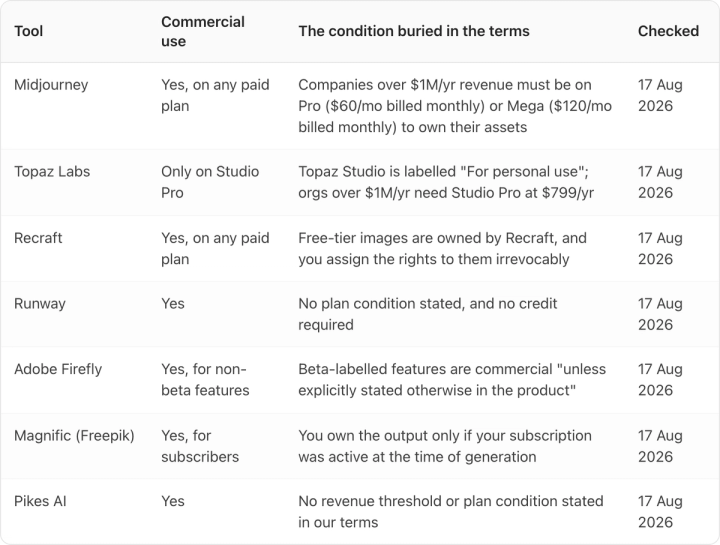
Two of these seven set a revenue threshold. Two withhold commercial rights from free accounts entirely. One ties ownership to the moment of generation rather than the moment of use. None of those five conditions is visible on the plan card you click.
Why does $1 million in revenue change your licence?
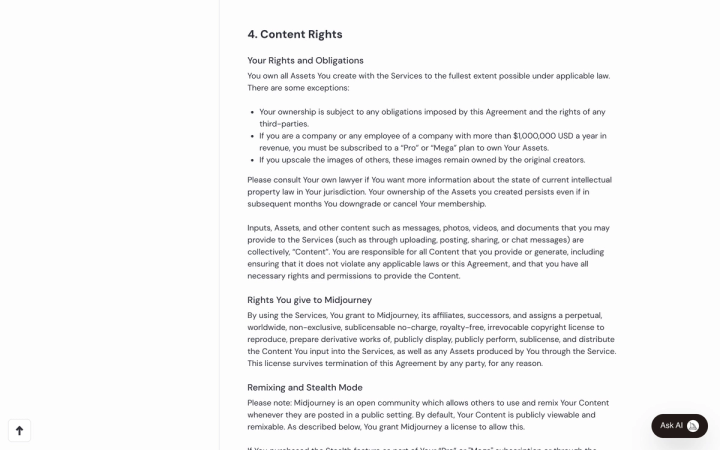
Midjourney's Terms of Service put it plainly in section 4. You own the images you make, with three exceptions, and the second one reads:
If you are a company or any employee of a company with more than $1,000,000 USD a year in revenue, you must be subscribed to a "Pro" or "Mega" plan to own Your Assets.
Read the phrase "or any employee of." It is not about who paid for the seat. A designer at a $4 million supplement brand running Midjourney on a personal Standard plan at $30/month billed monthly does not own the output, even though the invoice is personal. The fix is Pro at $60/month billed monthly, or Mega at $120/month billed monthly, which on Midjourney's published plan comparison is exactly double the Standard price.
Midjourney is generous in one respect that most vendors are not: "Your ownership of the Assets you created persists even if in subsequent months You downgrade or cancel Your membership." Cancel, and last quarter's ads stay yours.
Topaz Labs draws the same $1 million line and adds an audit right. Its EULA says the software "may not be used under a Personal License for Commercial Use by full-time or part-time employees of organizations whose consolidated annual revenue exceeds $1 million (USD $1,000,000)," and defines Commercial Use to include "advertising, publication, or printed media." That is every ad you have ever run.
The audit right sits in the same clause. Topaz "may monitor Your use of the Software," and if it decides your usage exceeds a Personal License you have 30 days to buy the Professional one before your right to use the software terminates.
What does Topaz actually charge for commercial rights?
As of 17 August 2026 the pricing page carries a banner reading "Buying Topaz for your business? You'll need Pro for full commercial rights."
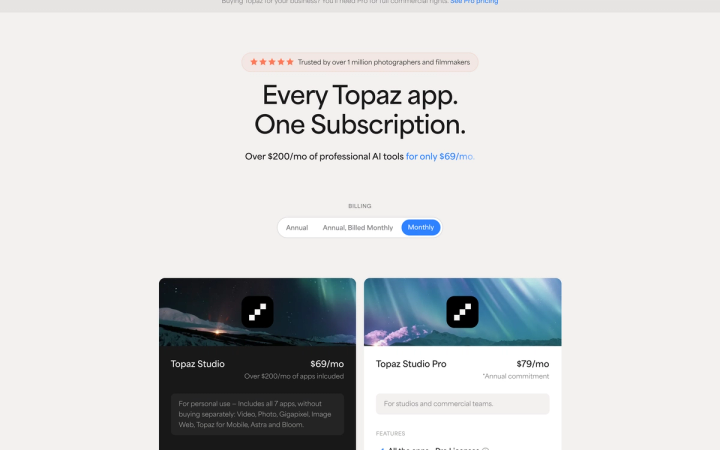
The numbers, with the billing cycle stated because it changes the answer:
- Topaz Studio, monthly billing: $69/mo. Annual: $399/yr. The card describes it as "For personal use."
- Topaz Studio Pro, annual: $799/yr. There is no true monthly option. Even with the Monthly pill selected, Studio Pro shows $79/mo marked "*Annual commitment," which is $948 a year.
So the commercial licence costs 2× the personal one on annual billing, the same multiple as the Midjourney Standard-to-Pro step. If you pay monthly you are paying $948 rather than $799, a $149 premium for the same rights.
Worth noting that Topaz now states this on the pricing card itself rather than only in the EULA. When we reviewed Topaz Labs the licence was the most surprising thing about the product, and the company appears to agree that it needs to be visible.
What happens to images you generated on a free plan?
At Recraft and Magnific, nothing you made on the free tier is yours to sell.
Recraft's terms are the strictest we read. Free Tier Assets carry three restrictions: "(i) no commercial use of Free Tier Assets is permitted; (ii) Free Tier Assets are owned by Recraft and may not be sold, licensed or transferred." The same section has you "irrevocably transfer and assign to Recraft all worldwide right, title and interest in and to the Free Tier Assets."
Upgrade and the position flips completely. On a paid plan, "You own all Assets you create with the Services and Recraft hereby assigns to you all copyright rights it may have in the Assets." The only remaining restriction is that you cannot use them to train AI models. Our Recraft review covers what you get for the money.
Upgrading does not retroactively licence the work you already did. Fifty product images generated during a free trial are, on Recraft's wording, still Recraft's.
Magnific has the same structure with a sharper timestamp. Subscribers own the output "provided that their Subscription remains active at the time of generation of the Output." Free accounts get a licence "exclusively for personal and non-commercial purposes." Ownership attaches at the moment of generation, so the free-trial images do not convert when you pay.
Runway is the clean counter-example. Its help centre answers the question directly: "Yes, the content you create using Runway is yours to use without any non-commercial restrictions from us." No plan qualifier appears in that answer, and it adds that you are "not required to credit Runway anywhere you upload Runway-made content." We measured its credit costs per model separately.
Adobe Firefly sits in the middle. Its FAQ says "For features without the beta label, you can use Firefly-generated outputs in your commercial projects," and that beta features are commercial "unless explicitly stated otherwise in the product." So the rule depends on a label in the UI rather than on your plan, which means checking each feature rather than checking once.
Do you actually own an AI-generated product image?
Owning the licence and owning the copyright are different questions, and one vendor says so out loud.
Magnific's terms state that "the Output may not be protected by intellectual property rights" under the laws of certain jurisdictions, and that Magnific "does not guarantee the exclusivity of the Output nor that it cannot be generated again by other users."
That is an accurate description of the current position in the US, and it is worth internalising before you build a brand identity on a generated asset. A vendor assigning you its rights cannot assign rights that do not exist. For a hero image on a product detail page this rarely matters. For a mascot, a signature background, or anything you would want to defend, it does.
This is separate from whether a marketplace will accept the image at all, which we cover in what the platforms say about AI-generated product images.
How do you check your own licence in ten minutes?
Four questions, in this order. Every answer above came from doing exactly this.
- Find the ownership section, not the pricing page. Search the terms for "own", "assign", and "commercial". The pricing page is marketing; the terms are the contract.
- Search for a dollar figure. Specifically "1,000,000" and "$1 million". Two of seven vendors gate on it, and neither mentions it on the plan card.
- Check whether the free tier is licensed differently. Search "free" in the ownership section. If free output is owned by the vendor, anything you made during evaluation is not yours, and upgrading will not fix it.
- Check when ownership attaches. "At the time of generation" and "while your subscription is active" are different promises from Midjourney's "persists even if you cancel." If you churn seasonally, this is the clause that decides whether last year's creative is still usable.
Keep a dated note of what you found, because terms change. Ours are dated 17 August 2026.
Does AI generation change the compliance picture?
The licences above apply the same way whether a person or a model made the image. What changes is how much you have to check.
The reason these clauses bite consumer brands specifically is volume. A brand generating a handful of images a year can absorb a licensing mistake. A brand shipping ad creative continuously across 60 SKUs has hundreds of assets in market before anyone reads a EULA, and the $1 million revenue threshold is a line most growing brands cross without noticing.
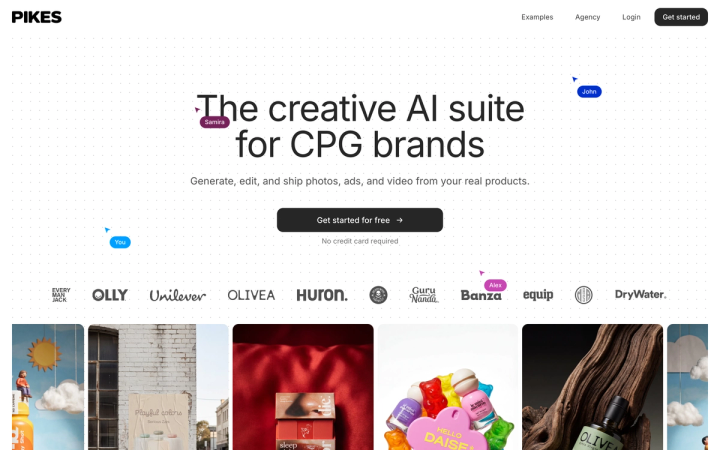
Our own terms say "You retain rights to the content you upload and to outputs generated for you, subject to any third-party rights and these Terms," with no revenue threshold and no free-versus-paid split on ownership. We wrote it that way because we built Pikes AI for brands generating at catalogue scale, and a licence that changes when you cross $1 million is a licence that breaks at exactly the moment it matters. You can see what it produces before deciding anything.
Whatever you pick, run the four checks above before you scale spend on its output. Ten minutes now is cheaper than regenerating a season of creative later.
Frequently asked questions
Can I use AI-generated images in paid ads?
On a paid plan, generally yes, with the conditions above. Midjourney and Topaz both class advertising as commercial use subject to their revenue thresholds. Topaz's EULA names "advertising, publication, or printed media" explicitly. Free tiers at Recraft and Magnific exclude commercial use entirely, which includes ads.
Does the $1 million threshold apply to my company or to me?
To your company. Midjourney's wording covers "a company or any employee of a company" over the threshold, and Topaz's covers "full-time or part-time employees of organizations" over it. Paying for the seat personally does not move you out of scope.
If I upgrade, do my free-trial images become licensed?
Not at Recraft or Magnific. Recraft's terms assign Free Tier Assets to Recraft irrevocably, and Magnific ties subscriber ownership to the subscription being active "at the time of generation." Regenerate anything you intend to publish after you have upgraded.
What happens to my images if I cancel?
It depends on the vendor and it is worth checking before you churn. Midjourney states ownership "persists even if in subsequent months You downgrade or cancel Your membership." Magnific's assignment is anchored to generation time rather than to your current status. Others are silent, and silence is not a promise.
Does Topaz really audit usage?
Its EULA reserves the right. The clause says Topaz "may monitor Your use of the Software," and if it determines your use exceeds the Personal License you have 30 days to buy the Professional one or lose access. We have no evidence about how often this is enforced, only what the contract permits.
Do I own the copyright in an AI-generated image?
Possibly not, and one vendor says so. Magnific's terms note that in some jurisdictions "the Output may not be protected by intellectual property rights," and that identical outputs may be generated by other users. A licence to use an image is not the same as an enforceable copyright in it. If a specific asset needs to be defensible, get advice on your jurisdiction rather than relying on the terms.
Prices and licence terms in this article were read from each vendor's live site and legal documents on 17 August 2026. They change; re-check before you commit.

Written by
Mike Lehman
Mike Lehman is a senior content strategist at Pikes. Before joining Pikes, Mike spent nearly a decade working with Glossier, Haus, and Athletic Brewing, leading campaigns that blended storytelling and data.