
Pontus Karlsson
Are AI-Generated Product Images Allowed? Amazon, Google and Meta Rules in 2026
Yes. Amazon, Google and Meta all allow AI-generated product images. Each one regulates disclosure instead, and the three rules are narrower, and more different from each other, than most guides suggest.
This guide quotes each platform's own documentation, checked on 31 July 2026. Where a widely repeated claim did not survive that check, we say so.
Are AI-generated product images allowed on Amazon?
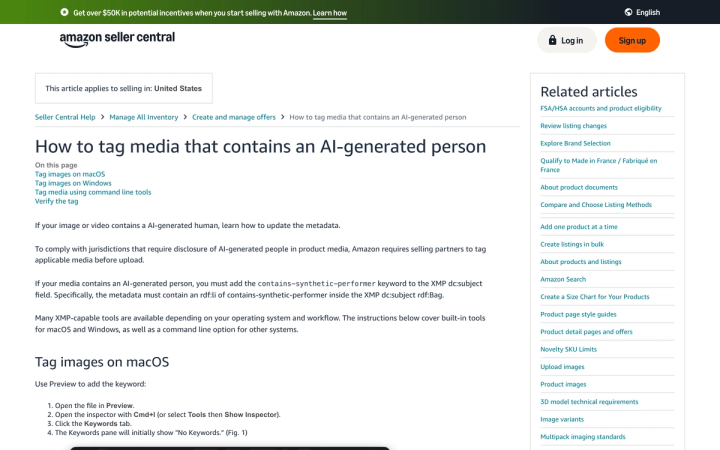
Yes. Amazon's Product image guide contains no prohibition on generating product imagery with AI. The single AI-specific rule on the page concerns people, not products:
"Some jurisdictions may require disclosure when product images contain photorealistic AI-generated people. If your image includes photorealistic AI-generated people, you must tag that image with the appropriate metadata before uploading it to Amazon."
Nothing on the page stops you generating the image itself. A generated studio shot of a serum bottle on white, a lifestyle scene of a snack box on a kitchen counter, a background swap on a real photo: none of these triggers an Amazon disclosure obligation, because none contains an AI-generated person.
What is the contains-synthetic-performer tag, and when do you actually need it?
When an image does contain a photorealistic AI-generated person, Amazon asks you to add one keyword to the file's metadata before upload. The keyword is contains-synthetic-performer, and it belongs in the XMP dc:subject field, specifically as an rdf:li inside the dc:subject rdf:Bag. Amazon then adds the shopper-facing disclosure itself.
Amazon documents three ways to write it. On macOS, open the file in Preview, press Cmd+I and add the keyword under the Keywords tab. On Windows, right-click the file, open Properties then Details, and type it into the Tags field rather than the Subject field, because those two write to different metadata locations. At catalogue scale, use the command line instead: exiftool -XMP-dc:Subject+=contains-synthetic-performer file.png. The += operator appends rather than overwrites, so existing keywords survive.
The exclusions are where this gets narrow. Amazon lists four cases where you should not apply the tag:
- The image only features real people, even if they have been altered with AI-powered tools
- The image only features characters from movies, video games or other expressive works
- The image does not feature any people
- The people in the image are not photorealistic
That first exclusion matters for consumer brands. If you shot a real model and used AI to retouch, relight or replace the background, you are outside the tag's scope. The trigger is a person who was entirely generated and is not based on a real person.
Does Google Shopping require you to label AI-generated images?
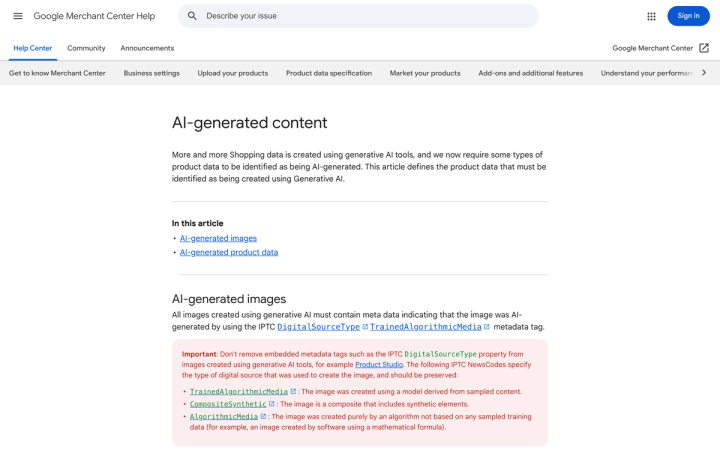
Yes, and Google's rule is far broader than Amazon's. Where Amazon regulates AI-generated people, Google regulates every AI-generated image.
From Google Merchant Center's AI-generated content policy:
"All images created using generative AI must contain meta data indicating that the image was AI-generated by using the IPTC DigitalSourceTypeTrainedAlgorithmicMedia metadata tag."
Google also tells you not to strip that metadata, and names three IPTC NewsCodes to preserve:
- TrainedAlgorithmicMedia: created using a model derived from sampled content
- CompositeSynthetic: a composite that includes synthetic elements
- AlgorithmicMedia: created purely by an algorithm, not from sampled training data
Most consumer-brand output falls under the first two. A fully generated scene is TrainedAlgorithmicMedia. A real packshot dropped into a generated background is a composite, which points at CompositeSynthetic.
The requirement covers image_link, additional_image_link and lifestyle_image_link. It also extends past images: AI-written titles must use the structured_title attribute with digital_source_type set to trained_algorithmic_media, and AI-written descriptions must use structured_description.
Your pipeline is the risk here, not the policy. Metadata gets stripped by resizing scripts, CDN transforms and some CMS uploads. If a tool writes the tag correctly and your build pipeline flattens it out, you are non-compliant without ever making a decision about it. Check a finished file, not the generator's claim.
Do you have to disclose AI in Meta ads?
A number of widely shared posts assert that Meta introduced a blanket requirement in 2026 for every advertiser to self-declare AI use on ordinary product ads, often with precise-sounding rejection statistics attached.
We could not find that requirement in Meta's own published policies as of 31 July 2026. What Meta does document is narrower:
- On labeling generally, Meta says it began adding labels "when we detected industry standard AI image indicators or when people disclosed that they were uploading AI-generated content." That is automatic detection plus voluntary self-disclosure, not an advertiser obligation.
- A mandatory advertiser disclosure does exist, but it applies exclusively to ads about social issues, elections or politics. There it covers photorealistic images, video or realistic audio made with third-party generative AI that depict a real person saying something they did not say, a realistic-looking person who does not exist, or a realistic event that did not happen.
If you sell shampoo, the second rule is not yours. Treat the first as a reason to keep provenance metadata intact rather than a reason to add a disclaimer to your creative. Policies change, so check Meta's current ad standards before a large launch.
What does New York's synthetic performer law require?
New York's synthetic performer law took effect on 9 June 2026, and it binds the advertiser rather than the platform, so it reaches you regardless of where the ad runs.
The statute defines a synthetic performer as a digitally created asset made or modified by computer using generative AI or a software algorithm, intended to create the impression that it is performing as a human who is not recognizable as any identifiable real performer. Where an advertiser has actual knowledge that an ad contains one, the ad must conspicuously disclose it.
Civil penalties run to $1,000 for a first violation and $5,000 for each subsequent one. Promotional material for expressive works, audio-only ads and language translations of human performers are carved out.
Amazon's tag and the New York statute regulate the same thing: synthetic humans in advertising, not synthetic photographs of objects. Generated imagery of a bottle does not engage either one.
Where AI product images actually get rejected
In practice, far more AI images fail on ordinary technical specs than on AI policy. Amazon's main-image requirements are unforgiving, and generative models break several of them by default:
- Background must be pure white, RGB 255,255,255. Models routinely produce off-white or a soft gradient that reads as white to the eye and fails on inspection.
- The product must fill 85% of the image, with the entire product in frame.
- No text, logos, borders, colour blocks or watermarks anywhere in the image.
- No mannequin of any kind, including clear, solid-colour, flesh-toned, framework or hanger.
- Adult-size clothing must be shown on a standing model, which rules out a generated flat lay as a main image.
- Files must be 500 to 10,000 pixels on the longest side, with JPEG recommended.
Amazon's enforcement is graded. Images failing technical requirements cannot be uploaded at all. Images failing the product-image requirements "may be removed." If no compliant main image exists, Amazon says it "may suppress the product listing from search," which is the expensive outcome.
Above all of these, Amazon requires that the main image accurately represent the real scale, quantity and colour of the product. That is where generated imagery carries genuine risk. A model that quietly reshapes a label, shifts a brand colour or renders a 50ml jar with the proportions of a 200ml one has produced a misrepresentation, and misrepresentation is a policy problem on every platform and a consumer-protection problem beyond them. Our guide to Amazon product image requirements covers the full specification, and Amazon versus DTC product photography covers how the two destinations diverge.
How do you keep an AI product-image workflow compliant?
Five checks, in the order they matter:
- Decide whether a person appears. No generated humans means no Amazon tag and no New York exposure. Most catalogue photography needs none.
- Preserve provenance metadata end to end. Google's requirement is on the file that reaches Merchant Center, not on the file your tool produced. Inspect a shipped asset.
- Check fidelity against the physical product. Label text, brand colour, proportions, finish. This is the check that protects you legally and commercially, and it is the one models fail most often.
- Run the platform spec before upload, not after rejection. White point, 85% fill, no props that are not in the box.
- Keep a record of which assets were generated. When a policy shifts, you want to query your library rather than re-audit it by eye.
Point three is where the money goes. Keeping label text legible and brand colour correct across hundreds of SKUs is where general-purpose image models drift, and it is the failure the rules above care about most, because a distorted label is a misrepresentation before it is anything else. If you are evaluating tools for catalogue-scale work, judge them on one test: does the output still look like your product at 100% zoom? That test is why we built Pikes AI to generate from a brand's actual SKUs rather than from a text prompt. Whatever you pick, verify the metadata on a finished file yourself rather than assuming the vendor writes it.
For the wider picture on what changed this year, see our roundup of e-commerce product photography trends and how many product photos you need per SKU.
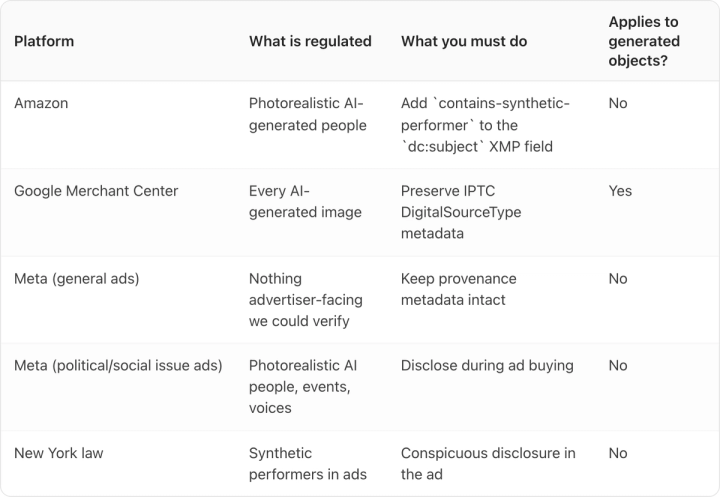
Platform rules at a glance
| Platform | What is regulated | What you must do | Applies to generated objects? |
|---|---|---|---|
| Amazon | Photorealistic AI-generated people | Add `contains-synthetic-performer` to the `dc:subject` XMP field | No |
| Google Merchant Center | Every AI-generated image | Preserve IPTC DigitalSourceType metadata | Yes |
| Meta (general ads) | Nothing advertiser-facing we could verify | Keep provenance metadata intact | No |
| Meta (political/social issue ads) | Photorealistic AI people, events, voices | Disclose during ad buying | No |
| New York law | Synthetic performers in ads | Conspicuous disclosure in the ad | No |
FAQ
Can I use AI-generated images as my Amazon main image?
Yes. Amazon sets no AI-specific restriction on main images. The main image must still meet every standard requirement: pure white RGB 255,255,255 background, product at 85% of the frame, no text or props, accurate scale and colour.
Do I need to disclose AI if I only replaced the background?
Not to Amazon, provided the image contains no AI-generated person. Amazon explicitly excludes images of real people altered with AI tools. For Google Merchant Center, a real product composited into a generated scene is still an AI-generated image and needs the IPTC metadata.
What happens if I skip Google's IPTC metadata?
Google states the requirement as mandatory for product data submitted to Merchant Center. The bigger operational risk is silent stripping: if your pipeline removes the tag after generation, your listings can drift out of compliance without anyone making a decision. Audit a finished file.
Does the New York law apply to my brand if I am not in New York?
The obligation attaches to advertising reaching a New York audience, so a brand headquartered elsewhere can be in scope. It is also limited to synthetic performers, so generated imagery of products alone does not engage it. Take specific legal advice for your situation; this article is not legal advice.
Are AI-generated images bad for conversion?
The measurable risk is misrepresentation rather than detection. An image that overstates size or shifts colour drives returns, which is what Amazon's accuracy requirement targets. An image showing real scale, quantity and colour performs.
Which is stricter, Amazon or Google?
Google, by a wide margin. Amazon regulates one narrow case, photorealistic generated people. Google requires metadata on every image made with generative AI, plus structured attributes for AI-written titles and descriptions.
Platform policies quoted in this article were checked against each company's own documentation on 31 July 2026. Policies change; verify before a major launch.
Turn your product photos into ad concepts
Create image and video variations from your product references in Pikes, then review the assets for your campaign.
AI ad creatives with PikesCompare plans and generation credits