Pontus Karlsson
AI Image Generator Indemnification: Who Pays If Your Output Draws a Copyright Claim?
Only one of the eight AI image tools we checked will defend you if your generated image draws a third-party IP claim: Adobe Firefly, and only if your organisation buys a specific enterprise entitlement. Six of the eight require you to indemnify them instead. Freepik's Magnific does indemnify users, but its terms exclude AI output by name.
Disclosure: we make Pikes AI, which competes with most of the tools below. Every clause here is quoted from the vendor's own live terms, read on 24 August 2026, and linked so you can check it yourself.
What does indemnification actually mean on an AI image tool?
An indemnity is a promise about who pays when a third party sues. If a rights holder claims the image on your product page infringes their copyright, trademark, or someone's likeness, the indemnity clause decides whether you fight that alone.
The assumption is usually that the tool generated the image, so the tool carries the risk. In the terms we read, the opposite is standard: you carry the risk, and you agree to carry the vendor's risk too.
That is not a scandal. One-way indemnities are ordinary in software contracts. It is worth knowing before you put AI output on 400 product pages.
Which AI image tools indemnify you?
| Tool | Which way the indemnity runs | Covers AI-generated output? | Clause read |
|---|---|---|---|
| Adobe Firefly | Adobe indemnifies you | Yes, for "select Firefly outputs" | Firefly business FAQ |
| Freepik / Magnific | Company indemnifies you | No. AI output expressly excluded | §6.2 |
| Midjourney | You indemnify Midjourney | Not offered | Terms of Service |
| Recraft | You indemnify Recraft | Not offered | §17 |
| Runway | You indemnify Runway | Not offered | §9 |
| Canva | You indemnify Canva | Not offered | §13 |
| Photoroom | You indemnify Photoroom | Not offered | §8 |
| Pikes AI (ours) | Neither; the terms are silent | Not offered | None |
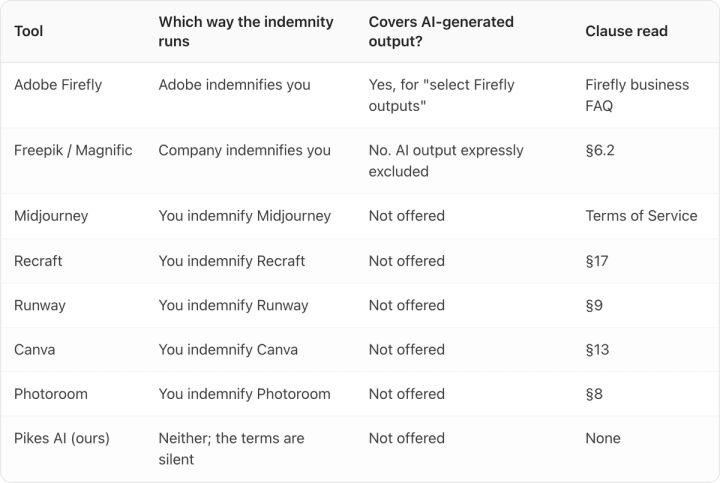
Two of eight point the indemnity at the customer. Only one of those two covers what the tool generates.
Why Freepik's indemnity does not cover what you generate
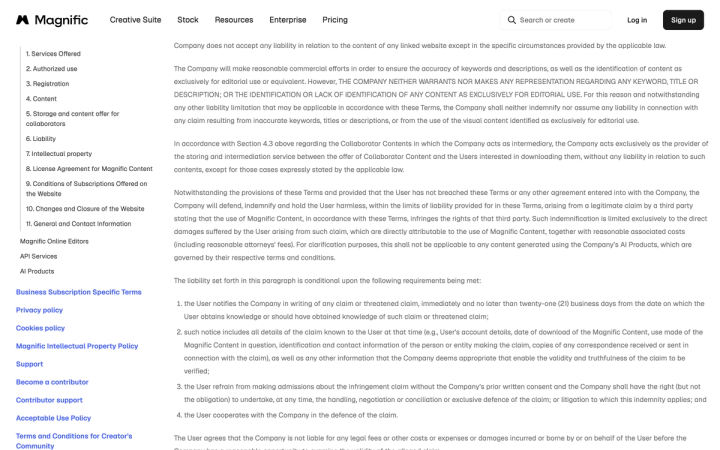
Magnific's terms carry a real, unusually generous user-facing indemnity. Section 6.2 says the Company "will defend, indemnify and hold the User harmless" against a legitimate third-party claim that the use of Magnific Content infringes that party's rights.
Then, in the same paragraph:
"For clarification purposes, this shall not be applicable to any content generated using the Company's AI Products, which are governed by their respective terms and conditions."
The reason is in the definitions. Magnific's terms name three separate categories: content owned by the Company ("Magnific Content"), content from third parties ("Third Party Content"), and content generated by AI ("AI Generated Content"). The indemnity attaches to the first one, the stock library. What you generate falls under a separate AI Products document.
So the €50,000 figure people quote from this page is real, and it is about stock downloads, not generations.
The cap itself is worth reading anyway, because it is tiered by what you were paying at the time you first downloaded the file: up to €100 for free and Essential users, €10,000 on Premium, €50,000 on Premium+ or Pro.
There are four conditions attached, including notifying the Company in writing within 21 business days of learning about a claim, and not making admissions without their written consent.
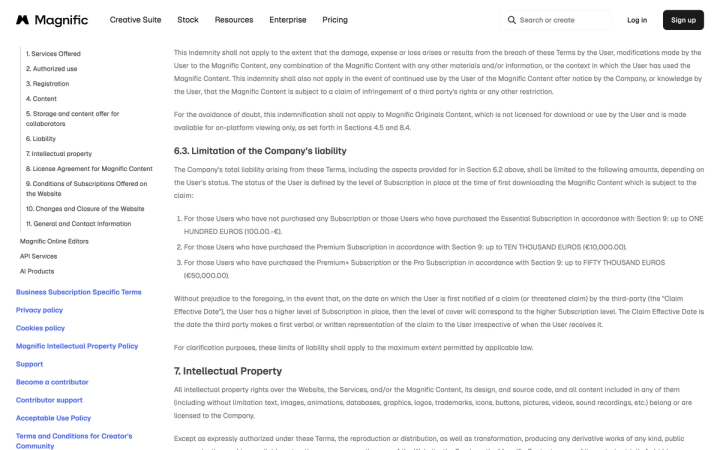
Miss the 21-day window and the cover lapses whatever tier you are on. If you rely on this, put the notice obligation somewhere your legal contact will actually see it.
What does Adobe's Firefly indemnity actually require?
Adobe is the only vendor in this set that indemnifies customers for generated output, and its own page is careful about the conditions.
The business page states that "Customers on qualifying plans are eligible for IP indemnification for generated content (terms apply)." Its FAQ is more specific. Asked whether Adobe will indemnify enterprise customers over an IP claim involving a Firefly output, the answer is: "Yes, if the organization has purchased the appropriate entitlement, which will require a new contracting event, subject to the applicable terms, conditions, and exclusions."
Three qualifiers matter there, and none of them are hidden:
- It is a purchase, not a default. The entitlement comes through the Adobe Express and Firefly site license, or certain Creative Cloud for enterprise plans.
- It needs a new contract. An existing Creative Cloud subscription does not carry it.
- It covers "select" outputs. Not everything the model produces.
If indemnity is genuinely a procurement requirement for you, this is the honest answer in the category, and it is a sales conversation rather than a checkout. Our Adobe Firefly review covers how the tool performs on actual product shots, which is a separate question from how the contract reads.
What are you agreeing to when the indemnity runs the other way?
The six one-way clauses are not identical, and Recraft's §17 is the one worth reading closely if you generate branded work.
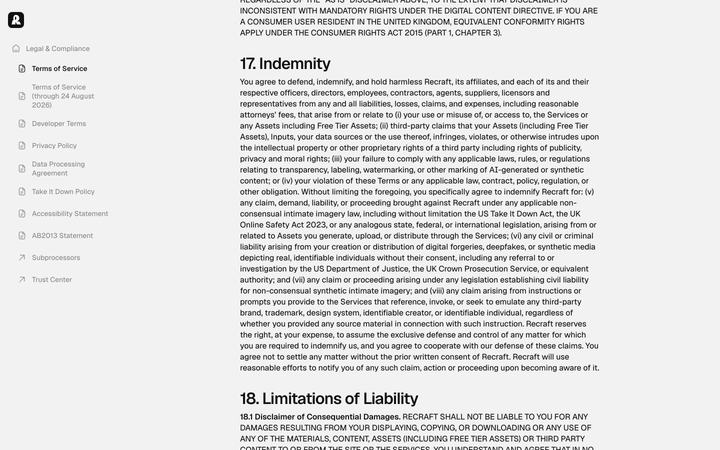
Alongside the usual items, it asks you to indemnify Recraft for claims arising from "instructions or prompts you provide to the Services that reference, invoke, or seek to emulate any third-party brand, trademark, design system, identifiable creator, or identifiable individual, regardless of whether you provided any source material in connection with such instruction."
Typing a competitor's name into a prompt moves the risk onto you even if you uploaded your own product photo to work from. For a creative team that routinely writes "in the style of" into a prompt box, that is a real operational rule, not boilerplate.
Recraft's clause also covers your failure to comply with laws "relating to transparency, labeling, watermarking, or other marking of AI-generated or synthetic content", an obligation we looked at separately in whether AI-generated product images are allowed.
Two more details from the same set. Recraft reserves the right to take over the defence of any claim you are indemnifying, at your expense, and you may not settle without its written consent. Canva caps its own liability at the greater of $100 or twelve months of subscription fees, and expressly exempts your indemnity obligations from that cap. The ceiling protects Canva, not you. Midjourney's cap is the amount you paid in the twelve months before the claim.
Runway's is the mildest of the six: it carves out an exception so you are not required to indemnify Runway for its own "fraud, deception, false promise, misrepresentation or concealment."
Does Pikes AI indemnify you?
No. Our terms of service contain no indemnification clause in either direction. We do not promise to defend you, and unlike the six above we do not ask you to defend us. That is the accurate answer, and if contractual IP indemnity is a hard requirement for your legal team, Adobe's enterprise entitlement is the one in this comparison that meets it.
What we do argue is that indemnity is a backstop for a risk you can mostly design out. Most infringement exposure in AI product imagery comes from one behaviour: prompting a model to invent something it was never given. A model asked for "a matte black serum bottle with gold lettering" will produce a plausible bottle assembled from what it learned, and neither you nor the vendor can say whose bottle it resembles. A model working from your own product file has far less room to borrow.
That is why we built Pikes to generate from a brand's real SKUs rather than from a text description of them. The same logic applies to whatever tool you pick: the fewer invented elements in the frame, the smaller the surface for a claim.
What should a consumer brand actually do about this?
Indemnity is worth about as much as the conditions attached to it, so treat it as one line in a risk process rather than the whole answer.
- Check which document governs generations. As Magnific shows, a vendor can carry a strong indemnity that its AI products sit outside. Find the AI-specific terms.
- Write down the notice window. A 21-business-day obligation is worthless if the email lands with someone who does not know it exists.
- Keep brand names out of prompts unless the brand is yours. This is the cheapest risk reduction available and it costs nothing.
- Log what generated what. If a claim arrives eighteen months from now, the tool, the date, and the source file are what your lawyer will ask for first.
- Read the ownership clause too. Indemnity and ownership are separate axes, and some vendors are permissive on one and aggressive on the other. We compared those in AI image commercial-use licences.
If you want to compare tools on more than the contract, try Pikes free and run your own SKU through it. A terms page will not tell you how the output holds up.
FAQ
Does any AI image generator indemnify free users? None in this set. Adobe's indemnity requires a purchased enterprise entitlement. Magnific's user-facing indemnity caps free and Essential accounts at €100 and excludes AI output entirely.
If the AI tool trained on copyrighted images, is that my problem? Under six of these eight contracts, yes. You agree to cover the vendor against claims arising from your use of the output. Training-data provenance is a related but separate question, and we broke down which tools train on your uploads in AI image tools and training-data opt-outs.
Does an indemnity mean the output is safe to use commercially? No. Indemnity is about who pays for a claim, not whether a claim is likely, and not whether you own the image. Those are three separate clauses and vendors take different positions on each.
What is the difference between Adobe's indemnity and a stock library's? Mostly scope and price. Stock libraries indemnify because they licensed the source material and can trace it. Adobe's argument is the same one applied to a model: it trains on content it has rights to, so it can stand behind select outputs. Both are contractual promises, not legal immunity.
Can I negotiate an indemnity into a smaller vendor's contract? Sometimes, on an annual or enterprise agreement. Self-serve checkout terms are almost never negotiable, which is why the plan you buy on a pricing page rarely comes with cover.
How often do these terms change? Often enough that a date matters more than the clause. Recraft's terms page currently shows a superseded version labelled "through 24 August 2026" alongside the live one. Every quote here was read on 24 August 2026; check the vendor's page before relying on any of it.