
Mike Lehman
Which AI Image Tools Watermark Your Product Photos?
Almost no AI image tool stamps a visible watermark on paid output any more. The marking that actually ships with your product photo is invisible: provenance metadata and imperceptible watermarks written into the file at generation time. Adobe and Google both do it automatically. Most of the rest say nothing about it at all.
That gap matters if you are putting generated packshots on a marketplace listing or into a paid social account, because the metadata travels with the file and outlives your export pipeline.
Here is what eight tools actually do, read from their own live documentation on 25 August 2026.
Disclosure: we make Pikes AI, which competes with most of the tools below. Every claim here comes from the vendor's own page, linked so you can check it.
Do AI image generators watermark your product photos?
Two different things get called "watermarking" and they behave nothing alike.
A visible watermark is a logo or diagonal band burned into the pixels, usually on a free tier to push you to upgrade. It is obvious, and you can see whether you have one by looking at the file.
Invisible marking is the one that catches people out. It comes in two forms:
- Provenance metadata — a signed record of how the file was made, attached to the file itself. The open standard is C2PA, branded as Content Credentials.
- Imperceptible watermarks — a pattern written into the pixel data that a detector can read but you cannot see. Google's SynthID is the best-known.
You can crop a visible watermark off. You cannot crop off either of the other two, and in at least one case you have agreed in writing not to try.
Which tools mark your output, and which say nothing?
Read from each vendor's live terms or help documentation on 25 August 2026. "Not addressed" means the word does not appear in the document — it is a statement about the document, not proof the product does nothing.
| Tool | Documented marking of your output | What it embeds | Removing it under the terms |
|---|---|---|---|
| Adobe Firefly | Yes, automatic | Content Credentials, when 100% of pixels are Firefly-generated | Not prohibited in the help doc |
| Google (Gemini) | Yes, automatic | SynthID invisible watermark | Not addressed |
| Recraft | Reserved right, §8.2 | "machine-readable metadata, watermarks, or other provenance information" | Expressly prohibited |
| Freepik / Magnific | No commitment for AI output | — | Anti-stripping clause covers stock content only |
| Midjourney | Not addressed in Terms of Service | — | Not addressed |
| Canva | Not addressed in Terms of Use | — | Not addressed |
| Photoroom | Not addressed in Terms & Conditions | — | Not addressed |
| Pikes AI | Not addressed in our terms | — | Not addressed |
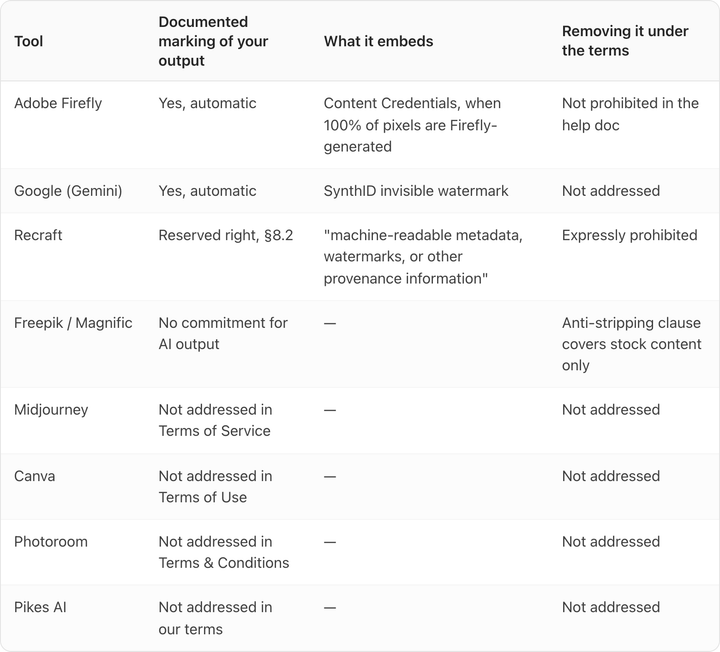
Two of eight commit to marking your output. One reserves the right and forbids you from undoing it. Five, including us, say nothing.
What does Adobe actually attach, and when?
Adobe is the most specific vendor in the set, and the detail that matters is a threshold buried in one sentence.
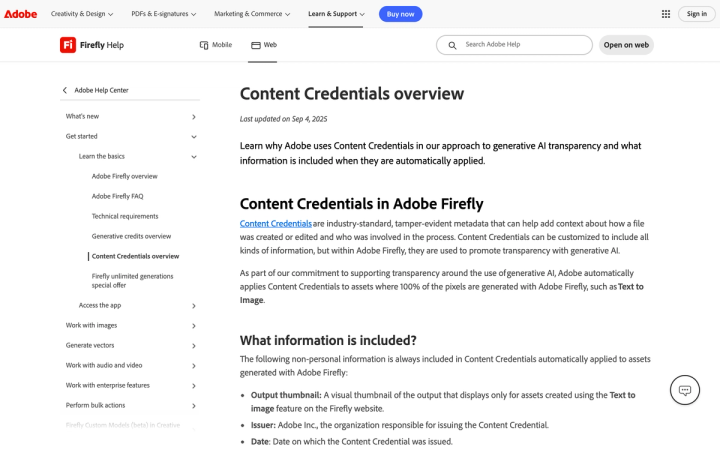
Adobe "automatically applies Content Credentials to assets where 100% of the pixels are generated with Adobe Firefly, such as Text to Image."
That threshold works backwards from how most brands use the tool. A fully generated lifestyle scene gets credentials. A Generative Fill edit on a photo of your own bottle does not hit 100% generated pixels, so it falls outside the automatic rule. The workflow that feels closer to real photography is the one that ships without the disclosure metadata.
What gets written in is short: an output thumbnail, the issuer (Adobe Inc.), the date, the app or device used, the AI tool used, and the general actions taken. Adobe also notes the credentials "may be stored in Adobe's public Content Credentials cloud," which makes them recoverable through Adobe's Inspect tool even when the copy in your file is gone.
So the record is not only in your file.
How is SynthID different from Content Credentials?
They solve the same problem from opposite ends.
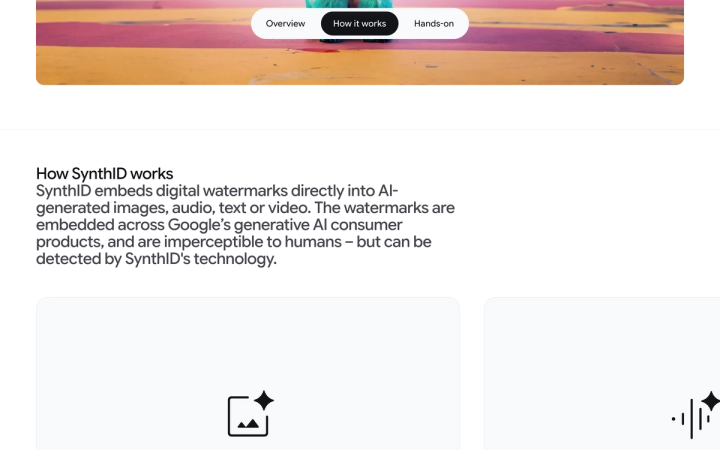
Content Credentials are metadata sitting alongside the pixels. SynthID is written into the pixels. Google describes it as embedding "digital watermarks directly into AI-generated images, audio, text or video," which are "imperceptible to humans – but can be detected by SynthID's technology."
Durability is where the two diverge. Google says the watermark is "added the moment content is created, and designed to stand up to modifications like cropping, adding filters, changing frame rates, or lossy compression."
Every one of those four is a normal step in a product-photo pipeline. You crop to square for a marketplace, you resize, you save as JPEG at quality 80. Metadata frequently does not survive that. A pixel-domain watermark is built to.
Can you legally remove an AI watermark from your own image?
At one vendor in this set, no. Recraft's Terms of Service — last updated 11 August 2026 and effective for existing accounts as of today, 25 August 2026 — put it in writing.
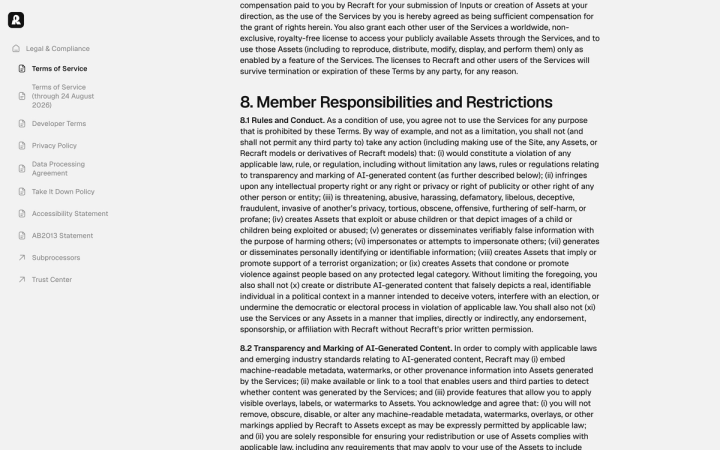
Section 8.2 says Recraft may "embed machine-readable metadata, watermarks, or other provenance information into Assets generated by the Services," and then that you agree "you will not remove, obscure, disable, or alter any machine-readable metadata, watermarks, overlays, or other markings applied by Recraft to Assets except as may be expressly permitted by applicable law."
You own the paid output under Recraft's §7.2. You have separately agreed not to strip its provenance. Those are not in conflict, but plenty of people would assume owning the file settles the question.
Recraft also discloses, citing the EU AI Act (Regulation (EU) 2024/1689) by name, "that content generated by the Services is produced by an AI system." It is the only vendor in this set to name the regulation in its terms.
Freepik shows the opposite pattern, and it is the same trap we found in their indemnity clause. Freepik's terms do forbid removing "any AI-content label, watermark, provenance metadata, copyright notice, trademark or attribution" — but that clause attaches to Magnific Originals Content, the company's own stock library. "AI Generated Content" is a separate defined term with separate terms attached. The anti-stripping rule does not reach the thing you generated.
On any vendor legal claim, find which defined term the clause attaches to before you rely on it.
Does stripping the metadata actually work?
Mostly not. The C2PA specification anticipates exactly this. Its own FAQ says manifests "can be separated" from the asset, and that the standard therefore "supports durable credentials via soft bindings—such as invisible watermarking or fingerprinting—that can help rediscover the associated Content Credential even if it's removed from the file."
Stack that up:
- The metadata copy in your file can be stripped by a resize or a re-save.
- Adobe may hold a second copy in its cloud, matchable with the Inspect tool.
- A soft binding in the pixels can point back to that copy.
- SynthID survives crop, filter and lossy compression by design.
So the honest answer to "can I get rid of it" is that you can probably remove the visible metadata and probably not remove the evidence. A workflow that depends on scrubbing provenance will not hold, and the platform disclosure rules it is usually meant to dodge are covered separately in our guide to whether AI-generated product images are allowed.
What should a consumer brand actually do about this?
Treat provenance as a property of your files that you need to know about.
Check what you are shipping. Open a finished export in Adobe's Content Authenticity Inspect tool, or ask Gemini whether an image carries a SynthID watermark. Do this once per tool you use, not once per image. You are establishing what your pipeline produces.
Know where it gets dropped. Most resize and compression steps discard metadata silently. If you rely on Content Credentials as your disclosure mechanism, verify they survive your actual export path before you count on them.
Never strip marks you agreed to keep. If you are on Recraft, §8.2 is binding regardless of who owns the output.
Read the defined terms. Freepik is the worked example: a clause that looks like it covers your generated image covers the stock library instead.
Provenance metadata only records that a machine made the picture. It says nothing about whether the picture is accurate: whether the label text is right, the cap is the correct colour, the fill line sits where it does on the real bottle. A misrepresentation is a bigger problem for a CPG brand than an undisclosed generation, and no watermark catches it.
That is the failure mode we built Pikes AI around: generating from a brand's actual SKUs so the packaging in the output is the packaging on the shelf. Our terms carry no watermarking clause either way, which the table above says plainly.
Whatever tool you land on, the test that matters is the one you can run yourself. Open the output at 100% zoom and read the label. If it does not match the product, the provenance metadata is the least of your problems. We go into that test properly in our guide to product label text legibility.
FAQ
Do AI-generated images have hidden watermarks? Often yes. Google embeds a SynthID watermark in images from its consumer AI products, and Adobe attaches Content Credentials to assets where 100% of the pixels came from Firefly. Midjourney, Canva, Photoroom, Freepik and Pikes do not address marking in the terms we read on 25 August 2026.
Is it illegal to remove an AI watermark? It depends on the vendor and your jurisdiction. Recraft's §8.2 contractually prohibits removing markings it applies. Separate transparency laws may also apply to you as the publisher — Recraft's indemnity clause specifically covers your failure to comply with laws "relating to transparency, labeling, watermarking, or other marking of AI-generated or synthetic content."
Does resizing an image remove Content Credentials? It can. C2PA manifests are typically embedded in the file and many export pipelines discard them. C2PA's answer is durable credentials using soft bindings, so a removed manifest may still be rediscoverable.
Does Midjourney watermark images? The word "watermark" does not appear in Midjourney's Terms of Service, read 25 August 2026. That means Midjourney makes no commitment either way in that document, not that the product definitely adds nothing.
Will Amazon or Meta reject an image because it carries Content Credentials? Neither platform's image documentation treats provenance metadata as a rejection reason. Their AI rules are about disclosure obligations, which we cover in our post on AI image platform rules.
Should I pick a tool based on whether it watermarks? Rarely. It is a tie-breaker, not a primary criterion. Commercial licence terms and training-data defaults will affect your business more, and output fidelity on your actual SKUs will affect it most.

Written by
Mike Lehman
Mike Lehman is a senior content strategist at Pikes. Before joining Pikes, Mike spent nearly a decade working with Glossier, Haus, and Athletic Brewing, leading campaigns that blended storytelling and data.