
Pontus Karlsson
Amazon Shoppable Video Requirements in 2026: Specs and Limits
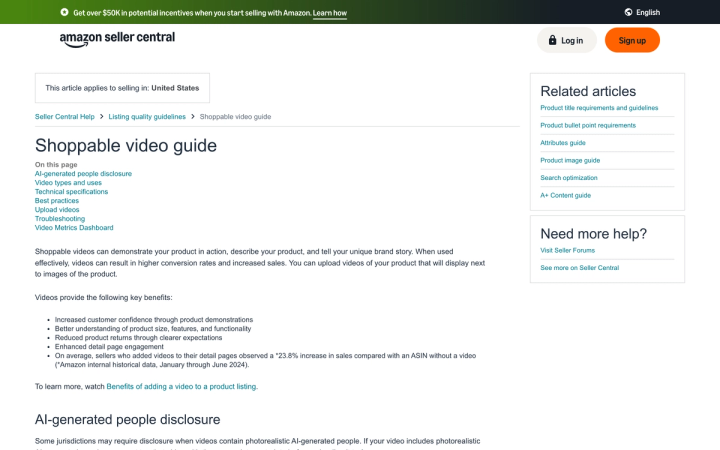
Amazon shoppable videos must be MOV or MP4, under 5 GB, up to 1080p, either 16:9 or 9:16, and between one and twelve minutes long. The thumbnail is JPEG, PNG, GIF or BMP under 5 MB. Your account must have been active for more than three months. Review takes one to seven business days.
The one-minute minimum is the specification that blocks reuse: the video you already made for paid social cannot be uploaded.
What are Amazon's shoppable video specs?
Every number below is from Amazon's Shoppable video guide in Seller Central, read on 13 August 2026.
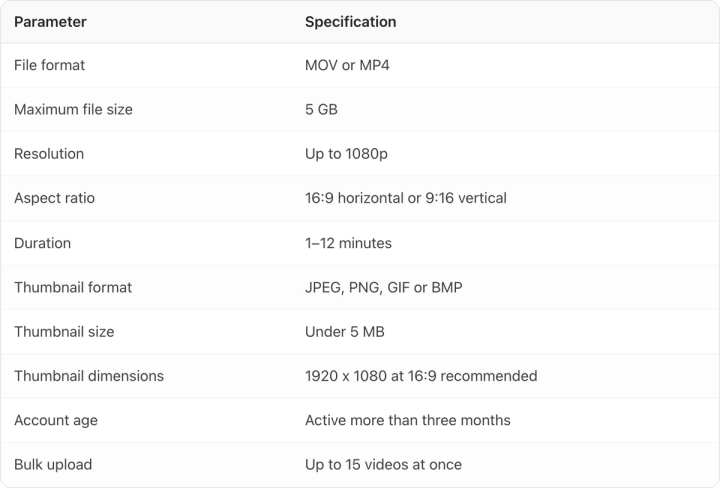
| Parameter | Specification |
|---|---|
| File format | MOV or MP4 |
| Maximum file size | 5 GB |
| Resolution | Up to 1080p |
| Aspect ratio | 16:9 horizontal or 9:16 vertical |
| Duration | 1–12 minutes |
| Thumbnail format | JPEG, PNG, GIF or BMP |
| Thumbnail size | Under 5 MB |
| Thumbnail dimensions | 1920 x 1080 at 16:9 recommended |
| Account age | Active more than three months |
| Bulk upload | Up to 15 videos at once |
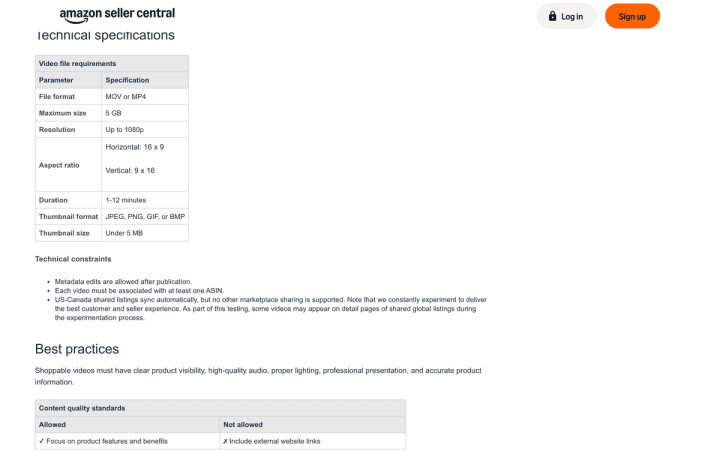
Three constraints sit outside that table and are easy to miss. Each video must be associated with at least one ASIN. Metadata edits are allowed after publication, so a wrong title is fixable without a re-upload. US-Canada shared listings sync automatically, but no other marketplace sharing is supported, so a video live in the US will not appear on your UK detail page.
Why can't you upload your Meta ad?
Because it fails on three separate rules at once, and the duration one is unfixable by editing.
Your paid-social library is full of six-, fifteen- and thirty-second cutdowns. Amazon's floor is sixty seconds. There is no way to trim your way into compliance. You have to shoot or assemble more footage.
Then the content rules disqualify the rest of it. Amazon's "not allowed" column explicitly bars external website links and promotional calls to action. A social edit that ends on "shop now, link in bio" or shows a discount code breaks both. Visible third-party branding is also barred, which rules out anything featuring a retailer's logo or a creator's channel furniture.
So Amazon video is its own production line. If you are budgeting a quarter's creative, it needs its own row. We covered the adjacent problem of turning existing product photography into short-form ad video for social in product photos to video ads, but the specs there and the specs here barely overlap.
Why is your video not showing on the detail page?
The most consequential rule on the page is buried in its troubleshooting table.
For softlines products (apparel, shoes, accessories) Amazon states: "If your listing has six or more images, the video will be suppressed on the desktop view. Remove excess images to enable the video."
Now read Amazon's own Product image guide, which we re-checked live on the same day. It says: "We recommend that you upload at least six additional images and one video to help customers evaluate products effectively."
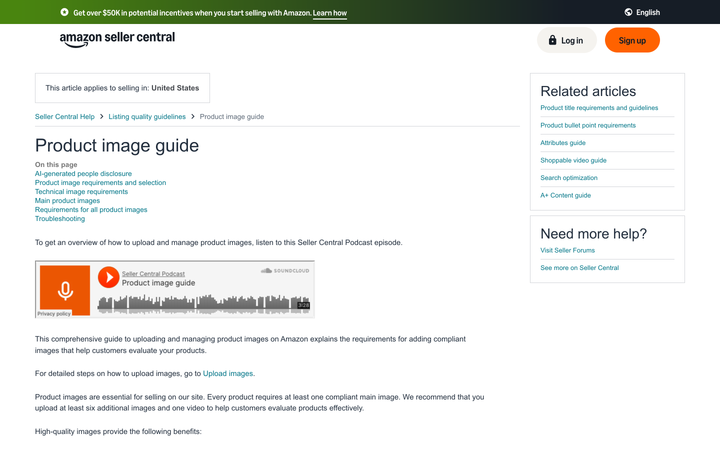
Those two pages are in direct tension. Follow the image guide's recommendation on an apparel listing (one main image plus at least six additional, so seven) and you have satisfied the image recommendation while suppressing the video on desktop. Nothing errors and no rejection notice arrives. The video sits in Published status and does not render for desktop shoppers.
If you sell softlines and your video is approved but invisible, count your images first. Before you count, check the video has been in Published status for at least three days and that the ASINs tagged on the video match the ASINs actually shown in it. Amazon lists both as prerequisites.
We wrote about the image side of this trade-off in how many product photos per SKU, which does not cover this suppression rule. On apparel, the answer is constrained by whether you want the video to appear.
What content does Amazon reject?
The guide publishes an explicit two-column standard. Allowed: focus on product features and benefits, show the product in use, demonstrate size and scale, include setup and assembly instructions, address common customer questions, use up to 1080p, ensure clear audio, maintain proper lighting, create engaging thumbnails, use professional on-screen talent where applicable.
Not allowed: external website links, promotional calls to action, unauthorized music or artwork, visible third-party branding, misleading claims or incorrect information, blurry or low-quality content, external branding, promotional content, poor-quality thumbnails.
The music rule is easy to break without noticing. Amazon's rights section says that unless you have permission from all relevant third parties, do not play music or include images, artwork, or other audiovisual works in your videos. A licensed-for-social track is not automatically licensed for a retail detail page.
Amazon also reserves the right to remove content or deactivate an account for anything that "negatively affects customer experience, even if not expressly prohibited by these guidelines", so treat the list above as a minimum.
Rejected videos are handled in Upload and Manage Videos: find the video, click Manage, read the rejection reason, fix it, and upload a new compliant version. The documented path is to fix and re-upload rather than to appeal, so a rejection costs you another full review cycle.
Which video types does Amazon expect?
Seven, and picking the right one shapes the brief:
- Product overview: features, physical characteristics, real-life use cases
- Unboxing: removal from packaging, size and scale, all box contents
- Product operation and how-to: specific tasks, multiple use cases
- Setup: step-by-step assembly, tools needed
- Troubleshooting: common issues, preventive maintenance
- Brand story: vision, mission, company journey, product line
- Other: anything outside the above
For most CPG catalogs the useful pairing is a product overview per hero SKU and one brand story reused across the range. Unboxing carries extra weight wherever physical size surprises people, which covers most supplements and most refill formats.
Do you have to disclose AI-generated people?
Sometimes. The rule is narrow.
If your video features photorealistic people who were entirely generated by AI and are not based on a real person, Amazon requires you to add the keyword contains-synthetic-performer to the dc:subject (XMP) field of the video file using an IPTC-compatible metadata editor. Include it and Amazon adds a disclosure for viewers where applicable.
You do not provide the tag if your video only features real people (even if they have been altered with AI-powered tools), or only features characters from movies or video games, or features no people at all, or the people in it are not photorealistic.
Note the asymmetry with A+ Content, where ticking a box in Creative Assets makes Amazon write the metadata for you. For shoppable video you edit the file yourself before upload. We covered the wider disclosure picture across platforms in are AI-generated product images allowed, and the A+ side in Amazon A+ Content image requirements.
The rule covers synthetic people. It does not touch AI-generated backgrounds, scenes or props.
How long does approval take?
Initial review is one to seven business days. Publication to the detail page happens within three days after approval. ASIN variation updates take up to three days. Amazon warns that review and publication timelines may be longer before and during holiday shopping seasons.
Seven business days of review plus three days to publish is about two weeks in the best case, so budget three weeks into Q4 and more if a rejection sends you round again. At one to seven business days per review cycle, a banned promotional call-to-action baked into your footage costs most of a fortnight.
Is shoppable video worth producing?
Amazon publishes one number on this, and it is worth quoting exactly rather than rounding: "On average, sellers who added videos to their detail pages observed a 23.8% increase in sales compared with an ASIN without a video (Amazon internal historical data, January through June 2024)."
Treat it as what it is: the platform's own historical data, self-reported, carrying the asterisk Amazon itself attaches. It is not independent, and averages hide the spread. But the qualitative benefits it lists are the ones sellers consistently describe: better understanding of product size and functionality, and fewer returns from clearer expectations.
The production reality is that a compliant Amazon video is a minute of real footage per hero SKU, with no promotional language and no borrowed music. For a forty-SKU catalog that is a genuine shoot, not an afternoon. Where AI helps is the surrounding asset load rather than the video itself: the scenes, the packshots, the variant imagery. That is where we point Pikes AI, generating from a brand's actual SKUs so the still assets stay consistent with what the video shows.
Whatever produces the footage, the test before upload is the same: play it muted at phone size and check the product is still identifiable, then confirm your minute of runtime says something a still image could not.
FAQ
What are the video requirements for Amazon listings? MOV or MP4, maximum 5 GB, up to 1080p resolution, 16:9 or 9:16 aspect ratio, and one to twelve minutes long. Thumbnails are JPEG, PNG, GIF or BMP under 5 MB, with 1920 x 1080 at 16:9 recommended. Verified 13 August 2026.
What is the minimum length for an Amazon shoppable video? One minute. This is the specification that most often blocks brands, because standard paid-social edits are six to thirty seconds and cannot be trimmed into compliance.
Why is my Amazon video not showing? Check it has been in Published status for at least three days, and that the tagged ASINs match the products in the video. For softlines listings specifically, Amazon suppresses the video on desktop when the listing has six or more images.
Who can upload shoppable videos on Amazon? Sellers whose account has been active for more than three months, with ASINs already created and listed. Uploads go through Upload and Manage Videos or through Image Manager, and up to 15 videos can be uploaded at once.
Can you use AI-generated video on Amazon? Yes, with one disclosure obligation. If the video contains photorealistic people generated entirely by AI, add contains-synthetic-performer to the dc:subject XMP field before uploading. No tag is required for AI-altered real people, non-photorealistic people, or videos with no people in them.
How long does Amazon take to approve a video? One to seven business days for initial review, then publication within three days of approval. Amazon warns both windows stretch before and during holiday shopping periods.
Turn your product photos into ad concepts
Create image and video variations from your product references in Pikes, then review the assets for your campaign.
AI ad creatives with PikesCompare plans and generation credits