Pontus Karlsson
Best Freepik Alternatives in 2026 (Freepik Is Now Magnific)
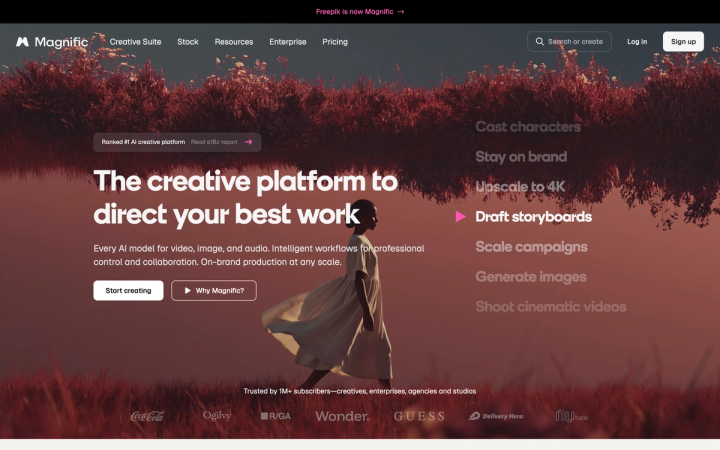
If you are looking for a Freepik alternative in 2026, start with the fact that Freepik no longer exists under that name. The company retired the Freepik brand on April 28, 2026 and relaunched as Magnific. For consumer brands, the more useful question is whether a general-purpose creative platform was ever the right tool for product photography.
What happened to Freepik?
Freepik became Magnific on April 28, 2026. The company retired the Freepik name entirely and consolidated a fragmented portfolio into one platform: the Freepik stock asset library, the Magnific AI upscaler it acquired in 2024, and several separately branded AI tools.
Both freepik.com and freepik.com/pricing now permanently redirect to Magnific.
The company reported $230 million in annual recurring revenue and more than one million paying subscribers at the time of the rebrand, with over 250 million stock assets and enterprise adoption at teams including Guess, R/GA and the BBC. The business is large and growing.
If your Freepik login still works and your workflow is unchanged, nothing is broken. But a rebrand is a natural moment to ask whether the tool still fits. For a lot of consumer brands, it never quite did.
Why do brands look for a Freepik alternative?
Freepik was built as a stock asset library that added AI generation. That lineage still shows, and it creates three recurring problems for brands with a real SKU catalog.
Product fidelity drifts. General-purpose image models are optimized for plausible, attractive images. They are not optimized for keeping the text on your label readable, your packaging geometry correct, or your brand color consistent across fifty outputs. Small label text is where this breaks first and most visibly.
Credits get confusing at volume. Magnific's pricing is credit-based, and different models consume very different amounts. Some outputs cost 50 to 75 credits, while higher-end models can cost 400 or more. Forecasting a monthly budget for a catalog shoot means modeling which model you will use for what, which is a planning problem you did not have with a photographer.
Brand consistency is manual. If your creative needs to look like your brand across every generation, you end up re-describing your aesthetic in every prompt. That works for a handful of images and falls apart across a catalog.
Magnific is a capable general creative platform. These problems come from using it for a job it was not designed around.
What are the best Freepik alternatives in 2026?
| Tool | Best for | Product fidelity | Pricing verified July 2026 |
|---|---|---|---|
| Magnific | Breadth: stock, video, 3D and images in one place | Moderate | $14.50 to $210/mo annual |
| Pikes AI | Product fidelity across a large SKU catalog | Strong | Check site |
| Photoroom | Background removal and clean catalog shots at volume | Strong but narrow | Not verified |
| Kive AI | Generation plus asset organization and tagging | Moderate | Not verified |
| Claid AI | API-driven enhancement inside an existing pipeline | Moderate | Not verified |
| Canva | Teams with no design resource | Low | Not verified |
| Midjourney | Aesthetic exploration, moodboards, concepting | Low | Not verified |
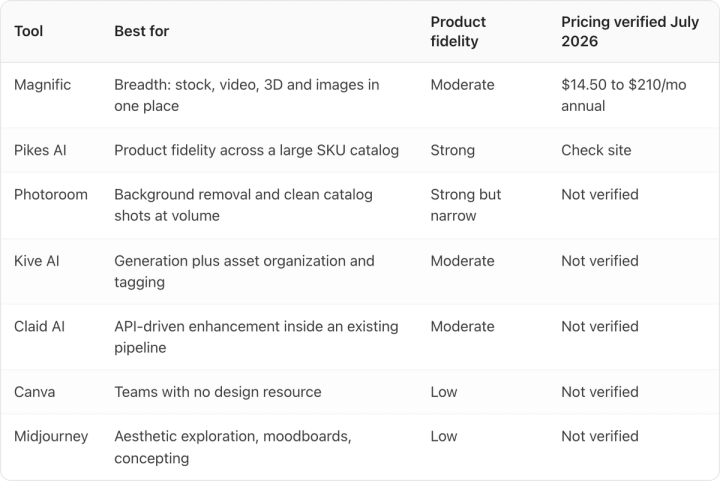
A note on pricing before the list: the figures below for Magnific were checked against its live pricing page in July 2026. For the other tools, pricing and plan structures change frequently enough that we have deliberately not quoted numbers we could not verify the same day. Check each vendor's current page before you budget.
Magnific (the incumbent)
Best for: teams that also need stock assets, video, 3D and audio in one place.
As of July 2026, Magnific's published plans are Premium at $14.50 per month billed annually, Premium+ at $33.75, Pro at $210, and Business at $55 per seat per month, with a free tier offering roughly 10 to 20 AI generations monthly. Month-to-month rates run higher (Premium is $20), and the company was running a promotional discount on annual Premium at the time of writing.
If your bottleneck is breadth rather than product accuracy, switching away may cost you more than it saves. Be honest about which problem you actually have.
Pikes AI
Best for: consumer and CPG brands generating product photography and ad creative at catalog scale.
Pikes is built around the problem general platforms struggle with: keeping label text, packaging detail and brand color correct across many SKUs and many outputs. Brand context persists between generations, so your aesthetic is not re-litigated in every prompt, and your own products live in a library you can generate against directly. It also covers lifestyle scenes, ad creative with Meta ads integration, and image-to-video.
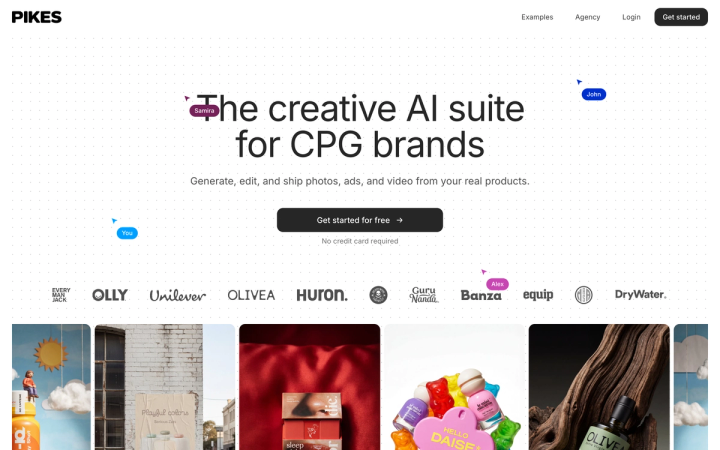
The tradeoff is scope. It does not include a stock library or 3D asset generation.
Photoroom
Best for: fast background removal and clean catalog images at volume.
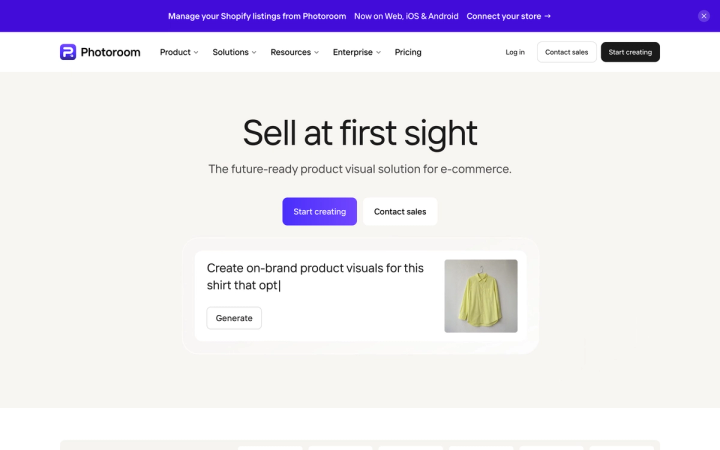
Photoroom is genuinely excellent at the narrow job of isolating a product and placing it on a clean or simple background, with strong batch tooling and a good mobile app. It is less suited to rich lifestyle scenes or campaign creative. We have compared it in more depth in our Photoroom alternatives guide.
Kive AI
Best for: creative teams that need asset organization alongside generation.
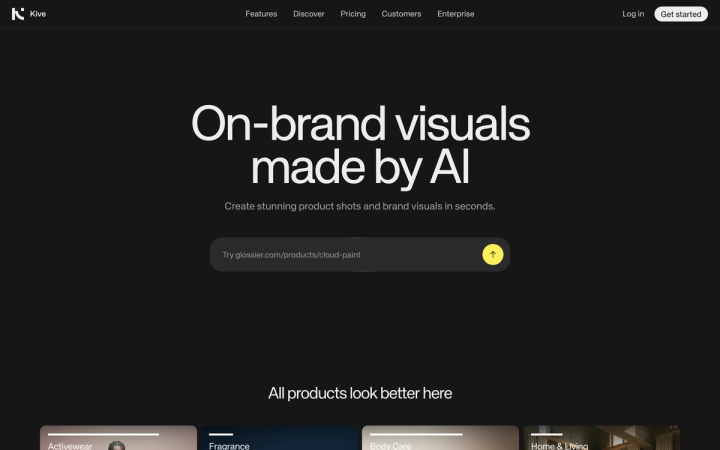
Kive's strength is the library and tagging layer, which helps if your problem is finding and reusing creative as much as making it. Generation quality is solid. Our full assessment is in the Kive AI review.
Claid AI
Best for: automated image enhancement inside an existing pipeline.
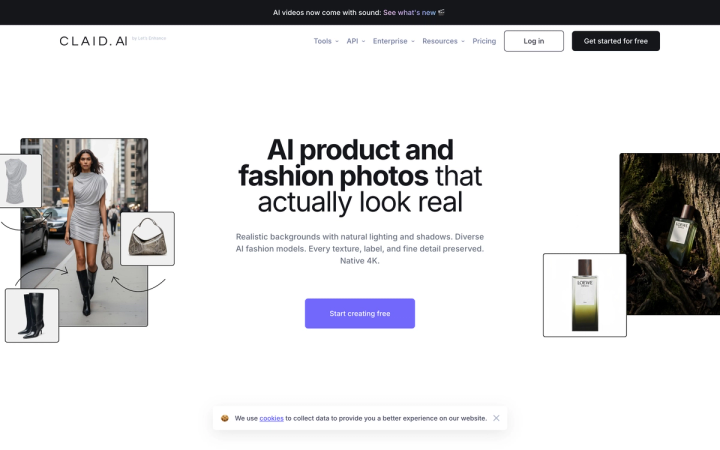
Claid leans toward API-driven enhancement and standardization rather than creative generation, which suits marketplaces and teams with engineering resource. See the Claid AI review for where it holds up.
Canva
Best for: teams with no design resource who need something usable today.
Canva is the easiest tool on this list by a wide margin, and for social graphics and simple composites that matters more than raw output quality. Its limits show when you need genuine product photography rather than a layout. We covered exactly where that line falls in Canva product photos: limitations.
Midjourney
Best for: aesthetic exploration, moodboards and campaign concepting.
Midjourney produces the most beautiful images of anything here. It is also the least controllable for product work, and it will happily reinvent your packaging. Use it to explore a direction, not to produce a shippable product shot. More detail in Midjourney for product photography.
How should you choose?
Pick based on the constraint that actually hurts, not the longest feature list.
- If your problem is product accuracy (labels going illegible, colors shifting, packaging warping), you need a tool built for fidelity. This is the most common failure mode for brands and the least fixable with better prompting.
- If your problem is volume (hundreds of SKUs, weekly ad refreshes), prioritize batch workflows, a persistent brand context and predictable pricing over per-image quality ceilings.
- If your problem is breadth (stock, video, 3D and images in one subscription), staying on Magnific is probably correct.
- If your problem is skill (nobody on the team is a designer), Canva will get you further than a more powerful tool nobody can drive.
Run the same three real SKUs through any tool you are evaluating, including one with dense small label text. Fidelity problems are invisible on a shampoo bottle with a clean logo and obvious on a supplement label with an ingredients panel.
If product fidelity at catalog scale is your constraint, try Pikes AI on your own SKUs and compare the label text against whatever you are using now.
Frequently asked questions
Is Freepik shutting down?
No. Freepik rebranded to Magnific on April 28, 2026. The company reported $230 million in ARR and over a million paying subscribers at the time. Existing accounts and subscriptions continue to work; the name and domain changed.
Do I need to do anything if I have a Freepik subscription?
No action is required. freepik.com redirects to magnific.com and accounts carry over. You may want to update bookmarks, saved payment descriptors and any internal documentation that references the old brand.
Is there a free Freepik alternative?
Magnific itself retains a free tier of roughly 10 to 20 AI generations per month, and most tools in this category offer trials. For ongoing commercial product photography, free tiers are generally too limited on volume and commercial usage rights to build a workflow on. Check the license terms before using output in paid ads.
Which Freepik alternative is best for product photography specifically?
For product photography where label and packaging accuracy matter, a purpose-built tool will outperform a general creative platform. That is the specific gap Pikes AI is built for. For pure background removal at volume, Photoroom is the more focused choice.
How does Magnific pricing compare to alternatives?
Magnific's published annual rates as of July 2026 run from $14.50 to $210 per month depending on tier, plus a per-seat Business plan at $55. Because it is credit-based and models consume credits at very different rates, the effective cost depends heavily on which models you use. Compare on cost per usable output for your actual use case, not on headline subscription price.
Can I use AI-generated product images in Amazon listings?
Generally yes, provided the image accurately represents the product and meets Amazon's technical requirements for the main image. Accuracy is the constraint that matters, because misrepresenting a product creates a listing compliance problem regardless of how the image was made. Our Amazon product images guide covers the current specs.