
Mike Lehman
Grok Imagine vs Midjourney vs DALL·E for Product Photography
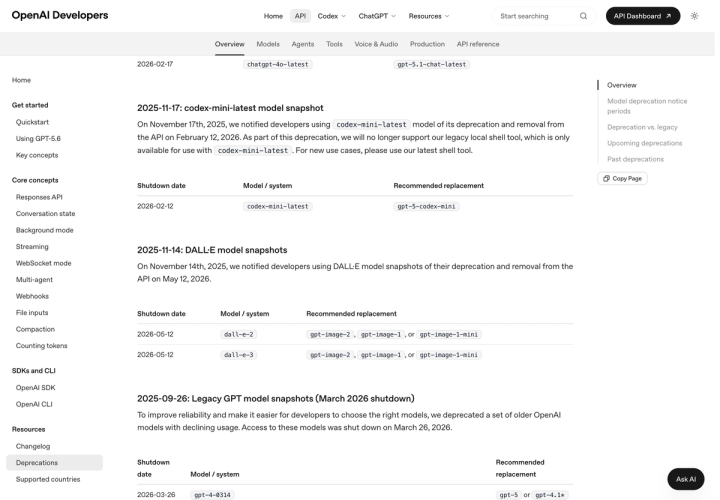
DALL·E is no longer an option. OpenAI shut down dall-e-2 and dall-e-3 on 12 May 2026 and now points developers at gpt-image-2. So the three-way comparison people are still searching for is really a two-way plus a replacement: Grok Imagine, Midjourney, or OpenAI's GPT Image line.
All three make good-looking images. None of them was built to keep your label text correct. Below is what each one costs as of 7 August 2026, verified on the vendors' own pages the day this was written, and where each one breaks on a real SKU.
One disclosure up front: we make Pikes AI, which competes with these tools. Every price and quote here is linked to the vendor's own documentation so you can check it yourself.
Is DALL·E still available in 2026?
No. OpenAI's deprecations page states it plainly:
On November 14th, 2025, we notified developers using DALL·E model snapshots of their deprecation and removal from the API on May 12, 2026.
Both dall-e-2 and dall-e-3 carry a shutdown date of 2026-05-12, with gpt-image-2, gpt-image-1, or gpt-image-1-mini listed as the recommended replacements. The name is gone from OpenAI's image-generation guide entirely. That guide now documents gpt-image-2, gpt-image-1.5, gpt-image-1 and gpt-image-1-mini.
If you generate images inside ChatGPT rather than through the API, you are also no longer using DALL·E. The same deprecation table lists chatgpt-image-latest among the models being replaced by gpt-image-2.
What replaced DALL·E, and how long will that last?
gpt-image-2 is the current recommendation. The replacement is already on a clock of its own. From the same page, OpenAI notified developers on 2 June 2026 that older GPT Image models would be removed from the API on 1 December 2026. That covers gpt-image-1-mini, gpt-image-1.5 and chatgpt-image-latest, all replaced by gpt-image-2. gpt-image-1 has a shutdown date of 23 October 2026.
If you build a catalog pipeline against a specific model ID, you are re-testing your prompts and re-checking your output roughly every two quarters. Budget for that, or use a layer that absorbs model changes for you.
How do the three compare?
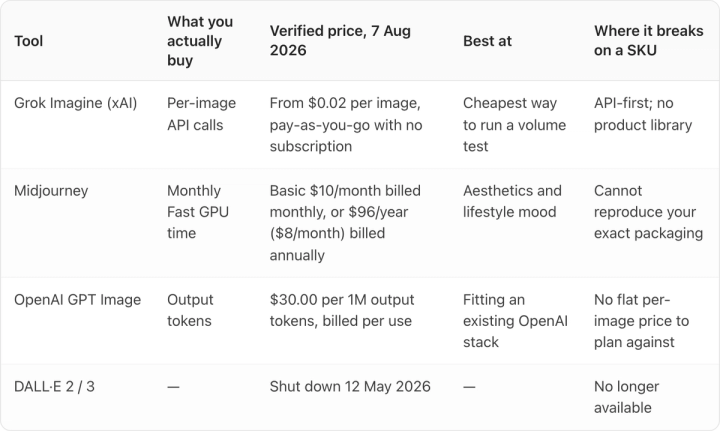
| Tool | What you actually buy | Verified price, 7 Aug 2026 | Best at | Where it breaks on a SKU |
|---|---|---|---|---|
| Grok Imagine (xAI) | Per-image API calls | From $0.02 per image, pay-as-you-go with no subscription | Cheapest way to run a volume test | API-first; no product library |
| Midjourney | Monthly Fast GPU time | Basic $10/month billed monthly, or $96/year ($8/month) billed annually | Aesthetics and lifestyle mood | Cannot reproduce your exact packaging |
| OpenAI GPT Image | Output tokens | $30.00 per 1M output tokens, billed per use | Fitting an existing OpenAI stack | No flat per-image price to plan against |
| DALL·E 2 / 3 | — | Shut down 12 May 2026 | — | No longer available |
Why can't you compare the prices directly?
Because all three sell a different unit, and only one of them is an image.
Grok Imagine sells images. xAI's own models page lists image generation at "Starting at $0.02 / image" for 1K and 2K output, and video at "Starting at $0.05 / sec". There is no monthly minimum, so a 200-image test costs about $4 and nothing after that.
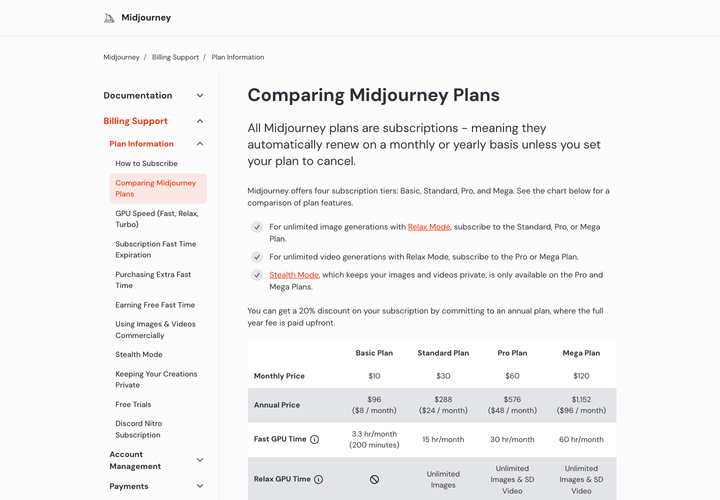
Midjourney sells time. You are buying Fast GPU minutes, not pictures, so your real cost per image depends on how long your jobs run and how many outputs you throw away. Its plan comparison gives Basic 3.3 hr/month (200 minutes), Standard 15 hr/month, Pro 30 hr/month and Mega 60 hr/month.
The division is worth doing. Basic at $10/month billed monthly works out to $0.050 per minute of Fast GPU time. Standard, Pro and Mega all land on exactly $0.033, all billed monthly: $30 for 900 minutes, $60 for 1,800, $120 for 3,600. The entry tier is 50% more expensive per minute than every tier above it. On annual billing the same pattern holds at $0.040 versus $0.027. Extra Fast time is $4/hr on every plan, or $0.067 a minute, which is double the Standard rate.
OpenAI sells tokens. gpt-image-2 is billed at $8.00 per 1M image input tokens, $2.00 cached, and $30.00 per 1M output tokens. OpenAI publishes a token table only for the models before gpt-image-2, where a high-quality 1024×1024 image was 4,160 output tokens. It does not publish a flat per-image figure for gpt-image-2 itself, so any per-image number you see quoted for it is someone's estimate, including ours if we tried. We would rather say that than guess.
If you want the cross-vendor arithmetic done properly, we worked through it for the dedicated product-photography tools in AI product photography cost per image.
Does Midjourney's $10 plan actually apply to a brand?
Probably not. Midjourney's plan page carries this condition on usage rights:
You must purchase the Pro or Mega plan if you are a company making more than $1,000,000 USD in gross revenue per year.
If your brand clears $1M in gross revenue, your entry price is the Pro plan at $60/month billed monthly, or $576/year ($48/month) billed annually, rather than the $10 on the front of the pricing table. That is a 6× difference between the advertised entry point and the one that applies to you.
Two more things to check before you subscribe. Unlimited Relax-mode image generation starts at Standard, so Basic has no unlimited lane at all. And Stealth Mode, which keeps your generations private, exists only on Pro and Mega. On the cheaper tiers your product explorations are visible to other users. For a brand working on unreleased packaging, that alone decides the tier.
Which one is best at product photography?
None of them, if "product photography" means your product.
Midjourney is the strongest of the three on pure image quality. For a moodboard, a campaign direction, or a background plate you will composite onto later, it is better than the alternatives and we have said so before in our Midjourney review. Grok Imagine is the cheapest way to run a hundred variations and see whether an angle works. GPT Image is the sensible pick if your team already builds on OpenAI and wants one vendor.
All three generate a plausible product rather than yours. Ask any of them for "a matte green serum bottle on a linen surface" and you get a beautiful bottle that is not your bottle: the cap profile drifts, the label type turns into letter-shaped marks, and your ingredient line falls apart at 100% zoom.
There is a two-minute test for this that works on any tool, including ours. Generate one image of your best-known SKU, open it at 100%, and read the label out loud. If you cannot read it, or it reads slightly wrong, that output cannot go on a product detail page. Amazon requires images to "accurately represent the product that you're selling," and a garbled ingredient panel fails that before anyone argues about aesthetics. We covered where those lines actually sit in are AI-generated product images allowed.
That test is why we built Pikes AI to generate from a brand's real SKUs rather than from a text description of them. It is also where the general-purpose models lose this particular job while winning most others.
If you want to run that zoom test on your own catalog, Pikes AI is free to start with no credit card. Run the same test on every tool you are evaluating, including the three above.
Which should you pick?
- Moodboards, campaign concepts, background plates. Midjourney, on Pro if your brand is over $1M in revenue.
- Cheap, high-volume experimentation, and you have someone who can call an API. Grok Imagine at $0.02 an image.
- You are already standardised on OpenAI.
gpt-image-2, with a note in your calendar for the next deprecation. - Listing images that have to survive a zoom. None of the three. Use a tool that starts from your product photo, and check the output at 100% before it ships.
For a wider view of the general-purpose models on this job, we compared the assistant tools in Claude vs ChatGPT vs Gemini for product image generation, and dug into where Midjourney specifically struggles in Midjourney for product photography.
FAQ
Is DALL·E 3 still available?
No. OpenAI shut down dall-e-2 and dall-e-3 on 12 May 2026, after notifying developers on 14 November 2025. The recommended replacements are gpt-image-2, gpt-image-1 or gpt-image-1-mini.
Can I still generate images with DALL·E inside ChatGPT?
You can still generate images in ChatGPT, but not with DALL·E. OpenAI's deprecation table lists chatgpt-image-latest among the models being replaced by gpt-image-2, so image generation in ChatGPT now runs on the GPT Image line.
Which of these is cheapest for product images?
Grok Imagine has the lowest entry cost, from $0.02 per image with no subscription, so a small test costs a few dollars. Midjourney's Basic plan is $10/month billed monthly but is restricted for companies over $1M in revenue, and OpenAI charges per token rather than per image.
Can a brand over $1M in revenue use Midjourney's Basic plan?
Not under Midjourney's stated terms. Its plan page says you must purchase Pro or Mega if your company makes more than $1,000,000 USD in gross revenue per year. Pro is $60/month billed monthly or $576/year ($48/month) billed annually.
Can any of these generate an image of my actual product?
Not reliably from a text prompt alone. All three generate from a description, so they produce a product that matches your words rather than your SKU. Label text is where this shows first, so check any output at 100% zoom before it goes near a listing.
How often do these models change?
Frequently enough to plan for. OpenAI retired DALL·E in May 2026 and has already scheduled gpt-image-1 for 23 October 2026 and three more image models for 1 December 2026. If your image pipeline names a model, expect to revisit it roughly twice a year.

Written by
Mike Lehman
Mike Lehman is a senior content strategist at Pikes. Before joining Pikes, Mike spent nearly a decade working with Glossier, Haus, and Athletic Brewing, leading campaigns that blended storytelling and data.