

Mike Lehman
Flat Lay Product Photography: A Practical Guide for Consumer Brands

A flat lay is shot with the camera pointing straight down, square to the surface. That single constraint removes depth from the frame, so outline, colour, texture and arrangement have to carry the whole image. It suits sets, multiples and low-relief products, and it is the wrong choice for anything whose shape is the selling point.
It is also the format most often shot badly, because it looks like the easy one. Two things go wrong more than anything else: the camera is not actually square, and the light is too flat to give the objects any form.
When is a flat lay the right choice?
Flat lay earns its place when the product is either flat, or plural, or both.
Sachets, bars, pouches, palettes, stationery, jewellery, flat-packed apparel and anything sold as a set all photograph well from directly above, because the view from above is close to how the product actually presents itself. A six-piece supplement sampler laid out in a grid communicates the range in one frame in a way six separate hero shots cannot.
It works against you when height or three-dimensional form is what you are selling. A bottle with shaped shoulders, a tub with a domed lid, a pump dispenser, a candle in a vessel: shot from above, all of these collapse into a circle. You lose the silhouette, and the front label, which is usually the most designed surface on the pack, disappears entirely.
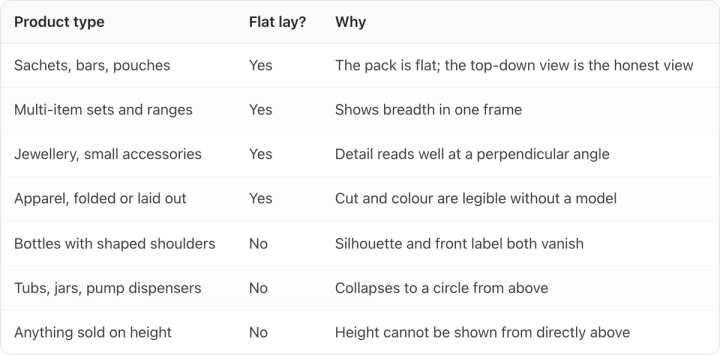
| Product type | Flat lay? | Why |
|---|---|---|
| Sachets, bars, pouches | Yes | The pack is flat; the top-down view is the honest view |
| Multi-item sets and ranges | Yes | Shows breadth in one frame |
| Jewellery, small accessories | Yes | Detail reads well at a perpendicular angle |
| Apparel, folded or laid out | Yes | Cut and colour are legible without a model |
| Bottles with shaped shoulders | No | Silhouette and front label both vanish |
| Tubs, jars, pump dispensers | No | Collapses to a circle from above |
| Anything sold on height | No | Height cannot be shown from directly above |
How do you get the camera genuinely square to the surface?
Put a right angle inside the frame and check it there. You cannot judge this from the tripod.
Put a rectangular object in the shot, a box, a book, a card, and look at its opposite edges. If the camera is square, those edges stay parallel. If they converge towards one side of the frame, the camera is tilted, and every object in the shot will lean the same way. This is the single most common flat lay error and it is invisible until you put a straight edge against the screen.
A tripod with a lateral arm or a copy stand makes this repeatable. A phone clamped to a shelf edge does not, because you cannot correct pitch in small increments.
On focal length, stay between roughly 50mm and 85mm full-frame equivalent. Anything wider than about 35mm bows the edges of the frame outwards, which reads as distortion on a straight-edged pack and is difficult to fix later. Longer than 85mm and you need a step ladder to fit a set in frame.
Shoot 20 to 30 percent wider than your final crop. A flat lay composed tightly for a square feed post cannot be re-cropped to 9:16 for Reels without cutting the arrangement in half, and re-shooting a styled set is far more expensive than leaving margin.
What lighting makes a flat lay look three-dimensional?
Light it from one side and let a shadow fall.
The instinct is to light a flat lay evenly so nothing is in shadow. That produces the characteristic dead flat lay: technically correct, no form, everything looking like a cut-out pasted onto a background. Because you have already removed depth by shooting from above, shadow is the only tool left that can put it back.
Use one large soft source at roughly 45 degrees to one side of the set, and bounce a little light back from the opposite side with white card so the shadow side does not go black. The size of the source relative to the product controls how hard the shadow edge is. A window with a sheer curtain is a large source and gives a soft, graduated shadow. A bare bulb or direct sun is a small source and gives a hard edge, which reads as outdoors and daylight.
Pick one and commit. Half-hard shadows with a soft fill on top look like a mistake rather than a decision. If you want the reasoning behind shadow choices in more depth, we cover it in our guide to product photo drop shadows.
Keep every light in the set the same colour temperature. Mixing a window with a warm room lamp puts a colour cast across half the frame that is hard to correct afterwards without shifting the product's own colour, which matters more than it sounds when the pack colour is a brand asset. Our notes on product photo colour accuracy go through how to hold that line.
Which surface should you shoot on?
Shoot on a real material, in a texture that does not compete with the pack.
In a flat lay the surface is both the background and roughly half the styling, because it occupies most of the frame. Real materials photograph better than printed backdrops, because printed texture has no actual relief and picks up an even sheen under a soft source that reads as fake at full zoom.
Good defaults: linen or cotton for softness, unfinished wood or stone for weight, plain paper or card for a clean editorial look. Match the surface's visual volume to the pack. A busy woven texture behind a busy label produces an image where the eye has nowhere to rest.
Colour contrast does the practical work. A pale pack on a pale surface loses its outline and the product stops reading at thumbnail size, which is the size most people will see it at first.
How do you arrange the frame without it looking cluttered?
Decide whether you are shooting a grid or a scene, and do not blend them.
A grid is aligned, evenly spaced and deliberately mechanical. It suits range shots, colourway line-ups and anything where the point is completeness. Alignment has to be exact, because a grid that is nearly aligned looks like a failed grid.
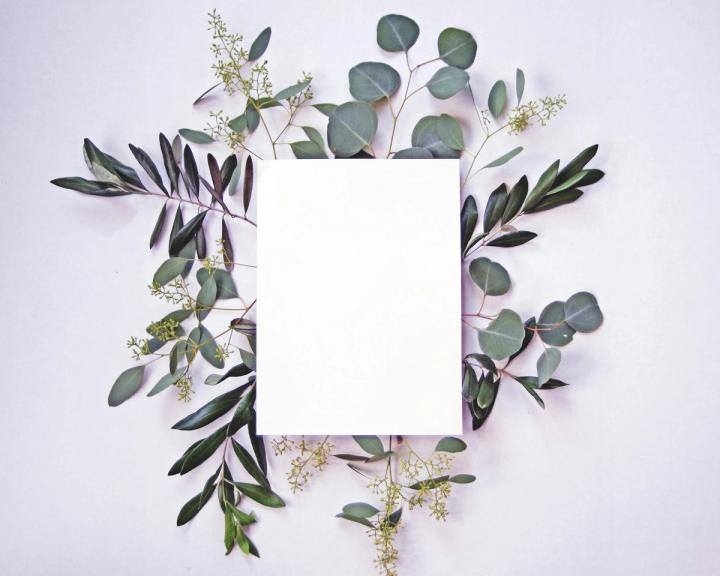
A scene is loose, overlapping and asymmetric, and it suits single products with supporting props. The useful discipline here is to keep props subordinate: they should sit at the edges, be partially cropped, and never be more visually interesting than the product. If a reader's eye goes to the eucalyptus before the pack, the shot has failed at its job.
Leave deliberate negative space. Ad crops need somewhere for a headline to sit, and a flat lay filled corner to corner cannot be used for paid social without covering the product. Empty surface is the part of the image your marketing team will use.
Can you use a flat lay as your Amazon main image?
Almost certainly not, and this is where brands get caught.
Amazon's product image requirements, read on 26 August 2026, say the main image must have "a pure white background (RGB color values: 255, 255, 255)", must "Show the product as 85% of the image", and that "Only a limited number of product types are allowed to have a lifestyle image as a main image". A styled flat lay on linen fails the first rule outright.
The rule that specifically kills flat lay styling is the one about props: "Don't show accessories or any props that aren't included with the product and could confuse the customer." The eucalyptus, the linen, the coffee cup, the scattered ingredients, none of them are in the box. On a main image, they are a compliance problem.
So treat flat lay as a secondary image. Amazon's guidance on the same page is that every product needs at least one compliant main image and recommends "at least six additional images and one video", which is seven images minimum. Your flat lay belongs in those additional slots, where styling is allowed and where a range shot does real work. Shoot the white-background hero separately. The specs differ across marketplaces, and we have collected them in one place in our guide to product image requirements on every marketplace.
Where does AI fit into flat lay production?
AI earns its place in the surfaces and the variations rather than in the product itself.
The cost of a flat lay sits in sourcing props and surfaces, styling the set, and then re-styling it four more times because you need a linen version, a stone version, a seasonal version and one with room for a headline on the left. That is a production cost, and it scales badly across a catalogue.
Generating the scene around a real product shot is where the current tools earn their keep. Generating the product itself is riskier, because top-down shots put label text at its most legible and least forgiving, and general-purpose image models drift on small type. That drift is why we built Pikes AI to generate from a brand's own product library rather than from a description of the pack.

Whatever tool you use, run the same test before anything reaches a product page: open the output at 100 percent zoom and read the label. If the ingredient list has turned into approximate lettering, the image is not usable, regardless of how good the styling looks at thumbnail size. We go through that check in detail in our guide to product label text legibility, and the technique for placing a real product into a generated surface is covered in compositing a product into a scene.
Frequently asked questions
What is flat lay product photography?
It is product photography shot with the camera perpendicular to the surface, looking straight down. Because the top-down angle removes depth, the image relies on outline, colour, texture and arrangement rather than on form and perspective.
What lens should I use for flat lay?
Something in the range of 50mm to 85mm full-frame equivalent. Wider than about 35mm and the frame edges bow outwards, which shows up as visible distortion on straight-edged packaging. Longer than 85mm and you need excessive height to fit a multi-product set in frame.
Why does my flat lay look flat and lifeless?
Usually because the light is too even. Shooting from above already removes depth, so if you also light the set evenly there is nothing left to describe form. Use one large soft source at about 45 degrees to one side and let a shadow fall.
Can I shoot a flat lay on a phone?
Yes, provided you can hold the phone genuinely square to the surface, which handheld you cannot. Use a clamp or a copy stand, and check that the opposite edges of a rectangular object in the frame stay parallel. Phone wide lenses also distort more, so avoid the ultra-wide setting.
Can a flat lay be my Amazon main image?
Only for the limited set of product types Amazon permits a lifestyle main image for. The main image requires a pure white background at RGB 255, 255, 255, the product filling 85% of the frame, and no props that are not included with the product. A styled flat lay fails all three. Use it as an additional image instead.
How many props should be in a flat lay?
Fewer than feels right while you are styling it. Props should sit at the frame edges, be partly cropped, and stay less visually interesting than the product. If you cannot remove a prop without the composition collapsing, the composition is depending on the wrong element.
Amazon's product image requirements were read on 26 August 2026 at Seller Central's Product image requirements page. Platform specifications change; check the current version before you shoot to spec.
Create your next product image set
Use your product photos and brand context to create studio-style and lifestyle variations in Pikes.
AI product photography with PikesCompare plans and generation credits

Written by
Mike Lehman
Mike Lehman is a senior content strategist at Pikes. Before joining Pikes, Mike spent nearly a decade working with Glossier, Haus, and Athletic Brewing, leading campaigns that blended storytelling and data.