

Mike Lehman
Product Image Requirements: One File That Passes Amazon, Shopify, Google and Instacart

One file clears all four. A 2000 × 2000 pixel JPEG on a pure white background, saved under 3 MB satisfies Amazon, Shopify, Google Shopping and Instacart at the same time. The constraints that decide that spec are Instacart's: a 3 MB file cap and a 4,000-pixel ceiling. Most brands assume the tightest rules are Amazon's.
Every number below was read from the platform's own documentation on 14 August 2026. Specs change; the date matters.
What image size works on every marketplace?
Here is the full grid. Where a platform publishes nothing for a row, the cell says so rather than guessing.
| Constraint | Amazon | Shopify | Google Shopping | Instacart |
|---|---|---|---|---|
| Minimum size | 500 px longest side | Not published | 500 × 500 px | 600 × 600 px |
| Maximum size | 10,000 px longest side | 5000 × 5000 px / 25 MP | 64 megapixels | 4000 × 4000 px |
| Maximum file size | Not published | 20 MB | 16 MB | 3 MB |
| Accepted formats | JPEG (recommended), TIFF, PNG, GIF | PNG (best), JPEG, and others | JPEG, PNG, GIF, BMP, TIFF, WebP | JPEG, JPG, PNG |
| Recommended size | Not published | 2048 × 2048 px square | Around 1500 × 1500 px | 1000 × 1000 px at 300 ppi |
| Background (main image) | Pure white, RGB 255,255,255 | Not specified | Not specified | Pure white or transparent |
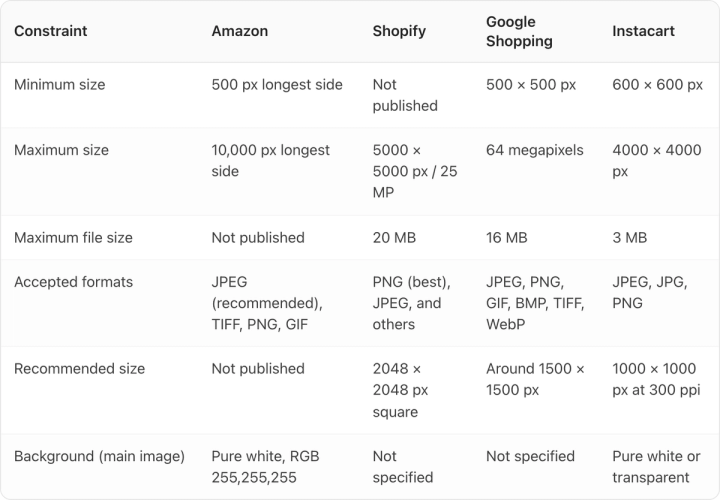
A 2000 × 2000 JPEG sits inside every one of those ranges. It clears Instacart's 600-pixel floor and stays under its 4,000-pixel ceiling, comes in below Shopify's 5000 × 5000 and 25-megapixel limits, is well under Google's 64 megapixels, and lands between Google's 1500-pixel recommendation and Shopify's 2048-pixel ideal.
Which platform sets the binding constraint?
Instacart, on three of the six rows. It is the least likely answer if you have only ever optimized for Amazon.
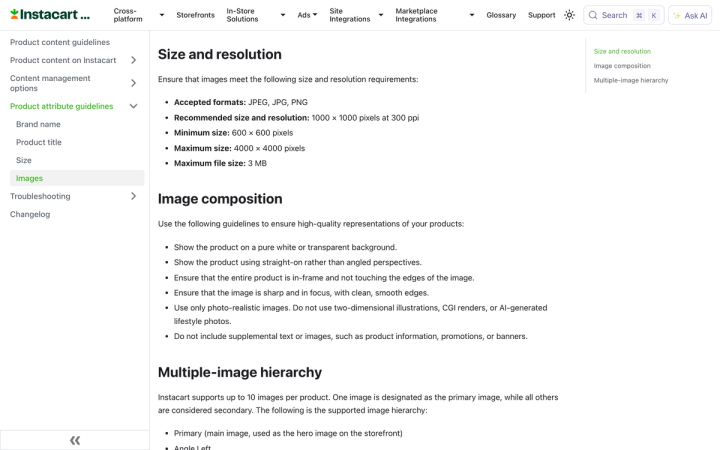
- File size: 3 MB. Shopify allows 20 MB and Google 16 MB. Amazon publishes no cap at all on its Product image guide. We checked the rendered page for any megabyte figure and there is none. So Instacart's 3 MB is nearly seven times tighter than the next constraint.
- Maximum dimensions: 4000 × 4000 px. Amazon permits 10,000 pixels on the longest side. Export a 6000-pixel master for Amazon and Instacart rejects it.
- Minimum dimensions: 600 × 600 px. The highest floor of the four.
The practical consequence is that if you build your export preset around Amazon, the platform with the loosest technical limits in this set, you will produce files that fail on Instacart. The reverse is not true. Build to Instacart's limits and everything else accepts the file. We covered each platform's rules individually in our guides to Instacart's product image requirements and Google Shopping's image requirements.
Should the file be JPEG or PNG?
JPEG, and this is the one place where following a platform's own advice will get you into trouble.
Shopify states plainly that "the best file type for most product images is PNG, followed by JPEG." That is good advice inside Shopify, where the ceiling is 20 MB. It is risky as a cross-platform default, because PNG is lossless and a 2000 × 2000 PNG can run past Instacart's 3 MB cap depending on how much detail and gradient the shot carries. A flat product on pure white may compress fine; a textured pouch or a shot with a soft gradient shadow may not.
JPEG avoids the question. It is the only format on all four accepted-format lists that also holds a 2000-pixel square comfortably under 3 MB at a normal quality setting, and it is the format Amazon explicitly recommends. Export JPEG, then check the byte size before it goes anywhere near Instacart.
One detail worth knowing if you feed Google from a URL: Google requires the image link to be ASCII-only, RFC 3986 compliant, and between 1 and 2,000 characters. Modern image CDNs that append transformation parameters can break that quietly.
How do the composition rules differ?
The technical specs are where files get rejected. The composition rules are where listings get suppressed, which is worse because it is silent.
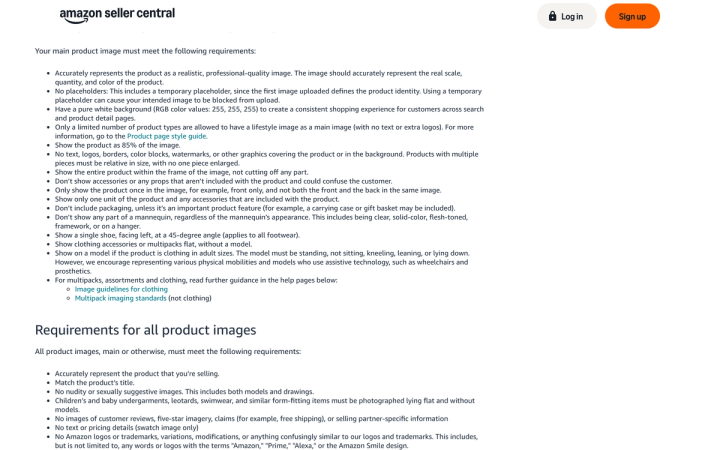
Amazon's main image must have a pure white background at RGB 255,255,255 and must "show the product as 85% of the image", with the entire product inside the frame and no text, logos, borders, watermarks or graphics. If there is no compliant main image, Amazon says it may suppress the listing from search until one is provided.
Instacart wants a pure white or transparent background, a straight-on rather than angled perspective, and the entire product in-frame and not touching the edges of the image.
Those two coexist, but not with much room. Filling 85% of a square frame leaves roughly 7.5% of the width as margin on each side. That satisfies Instacart's no-touching rule, and it is not enough room to be careless about. On a wide product shot to Amazon's 85% guidance, the left and right edges are the first thing to check.
Amazon also recommends at least six additional images and one video beyond the main image, which is seven images in total. Instacart supports up to 10 images per product with a fixed hierarchy: primary, then angle left, right, back and top, then lifestyle, ingredients, nutrition, drugs and supplements. If you are shooting once for both, seven to ten shots per SKU covers it. The arithmetic for a whole catalog is in our guide to product photography for large catalogs.
What changes on 31 January 2027?
Google's minimum. Its Merchant Center documentation currently carries a note that new image size requirements of at least 500 × 500 pixels apply to all products beginning 31 January 2027.
If you are already exporting 2000 × 2000, this changes nothing for you. It matters for legacy catalog images. Brands carrying old 250-pixel or 300-pixel thumbnails from a previous platform migration have until the end of January 2027 to replace them or lose the listings. That is a re-shoot or a re-export decision worth making before the deadline rather than during it.
Where do AI-generated images stand on each platform?
The four platforms have genuinely different mechanisms, and it is worth being precise because "is AI allowed" has four answers.
Instacart is the strictest, and it restricts by category rather than by disclosure. Its product content guidelines say: "Use only photo-realistic images. Do not use two-dimensional illustrations, CGI renders, or AI-generated lifestyle photos." On Instacart product content, Instacart disallows an AI-generated lifestyle scene outright rather than asking you to disclose it.
Amazon's mechanism is a metadata tag, and it is narrow. If an image contains photorealistic AI-generated people, you add the keyword contains-synthetic-performer to the dc:subject XMP field using an IPTC-compatible editor, and Amazon adds a disclosure. It applies to fully AI-generated people only, not to real people edited with AI tools, and not to images with no people in them.
Shopify and Google publish no equivalent restriction in the documentation covered here.
So the honest answer is that the same generated asset can be fine on your Shopify store and disallowed on Instacart. We went deeper into the disclosure question in are AI-generated product images allowed.
That split is the practical case for generating from your real product rather than prompting a plausible-looking one, and it is why we built Pikes AI to work from a brand's actual SKUs. A pack shot that is a true representation of the product is a photo-realistic image of the thing you sell, which is the test Instacart is applying. This holds whatever tool you use: before a generated file goes into a catalog feed, open it at 100% and read the label. If the text has drifted, it is a misrepresentation of the product before it is anything else, and no marketplace rule saves you from that.
What about Walmart?
We left Walmart out of the table on purpose. Its Marketplace Learn image-guidelines page returned "No Data found" on 14 August 2026, and the alternative seller-help route sits behind a bot check we will not work around. Our Walmart marketplace image requirements guide carries the specs as verified on 10 August 2026, including a 5 MB file cap, which is comfortably satisfied by a file already built to Instacart's 3 MB limit. Treat those figures as dated rather than current until Walmart's documentation is readable again.
Frequently asked questions
What is the best image size for e-commerce product photos?
2000 × 2000 pixels. It clears the minimum on all four platforms covered here, stays under Instacart's 4,000-pixel ceiling and Shopify's 5000-pixel limit, and sits between Google's 1500-pixel recommendation and Shopify's 2048-pixel ideal.
What file size should a product image be?
Under 3 MB. That is Instacart's maximum and the tightest cap of the four. Shopify allows 20 MB, Google 16 MB, and Amazon publishes no cap on its Product image guide.
Do I need different images for Amazon and Shopify?
Not for the technical specs. One 2000 × 2000 JPEG satisfies both. You may still want different images for merchandising reasons, since Amazon requires a pure white main image while your own storefront has no such rule.
What background do marketplaces require?
Amazon requires pure white at RGB 255,255,255 for the main image. Instacart requires pure white or transparent. Shopify and Google do not specify one in the documentation covered here, so white travels furthest.
How many product images do I need per SKU?
Amazon recommends a main image plus at least six additional images and one video, which is seven images in total. Instacart supports up to 10 per product in a fixed hierarchy. Shooting seven to ten covers both.
Are AI-generated product images allowed on marketplaces?
It depends on the platform and the type of image. Instacart bars AI-generated lifestyle photos, CGI renders and 2D illustrations from product content outright. Amazon requires a contains-synthetic-performer metadata tag on images containing photorealistic AI-generated people. Shopify and Google publish no equivalent rule in the documentation covered here.
Create your next product image set
Use your product photos and brand context to create studio-style and lifestyle variations in Pikes.
AI product photography with PikesCompare plans and generation credits

Written by
Mike Lehman
Mike Lehman is a senior content strategist at Pikes. Before joining Pikes, Mike spent nearly a decade working with Glossier, Haus, and Athletic Brewing, leading campaigns that blended storytelling and data.