

Mike Lehman
Product Photography for Large Catalogs: What Breaks Past 100 SKUs
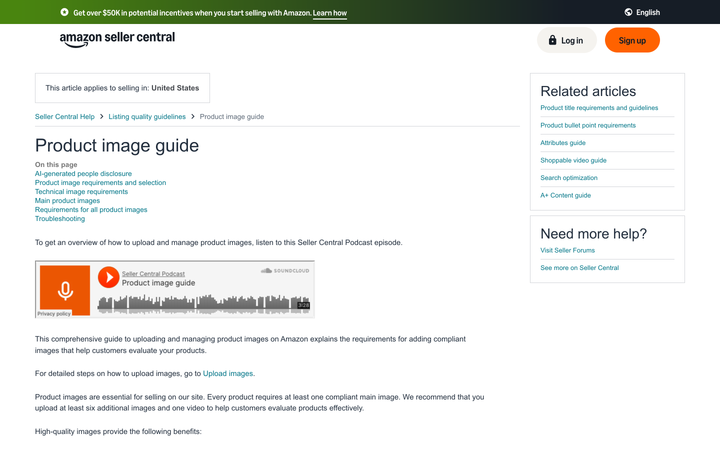
A 300-SKU catalog needs about 2,400 finished assets before you have shot a single variant. Amazon asks for one compliant main image plus at least six additional images and one video per product, and that is a recommendation rather than a ceiling. AI can produce that volume in a week. What it will not do unattended is keep asset 2,400 looking like asset 1.
Capacity stopped being the hard part of catalog photography some time ago. Consistency decides whether a catalog looks like one brand or like eleven freelancers.
How many images does a large catalog actually need?
Start from the platform, not from a wish list. Amazon's Product image guide, read on 3 August 2026, is explicit: "Every product requires at least one compliant main image. We recommend that you upload at least six additional images and one video to help customers evaluate products effectively."
That is eight assets per product as the recommended baseline. Run it across a catalog:
- 100 SKUs: 700 images and 100 videos
- 300 SKUs: 2,100 images and 300 videos
- 500 SKUs: 3,500 images and 500 videos
Then multiply. A SKU that ships in four colourways, where the colour is visible, is four image sets rather than one. A 300-SKU catalog averaging two visible variants per product is closer to 4,200 images. We worked through how to decide the per-SKU number in how many product photos you need per SKU.
This is the number most catalog projects get wrong at the planning stage, because people budget for SKUs and then discover they have been quoted for parent products.
What platform limits will you hit first?
File-size limits are generous. Asset-count limits are not.
| Constraint | Shopify | Amazon |
|---|---|---|
| Images per product | No documented cap | 1 main required, at least 6 additional recommended |
| Max image file size | 20 MB | JPEG recommended |
| Max image resolution | 20 MP | 500 to 10,000 px on the longest side |
| Video and 3D uploads | 250 on Starter/Basic, up to 100,000 on Enterprise | 1 video recommended per product |
| Max video file size | 1 GB | Not specified here |
| Max video length | 10 minutes, minimum 0.25 seconds | Not specified here |
| Video resolution | 100 to 4,096 px, up to UHD, max 120 fps | Not specified here |
| Total file storage | 100 GB on Starter/Basic, up to 10 TB on Enterprise | Not specified here |
| Image formats | JPEG, PNG, WEBP, HEIC, GIF | JPEG recommended |
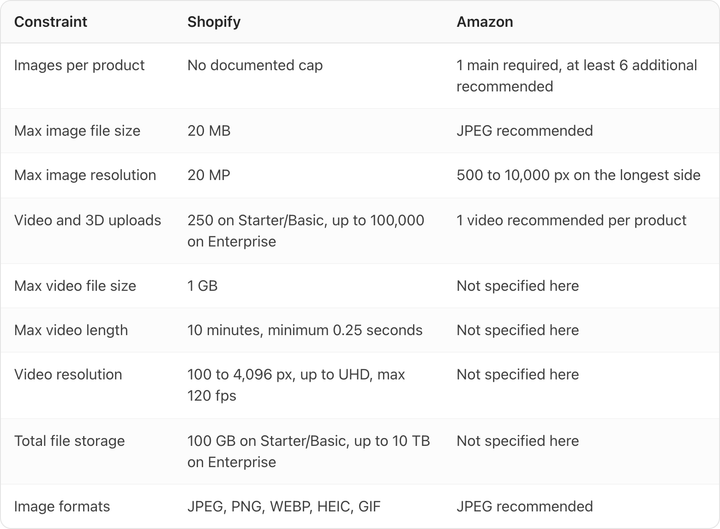
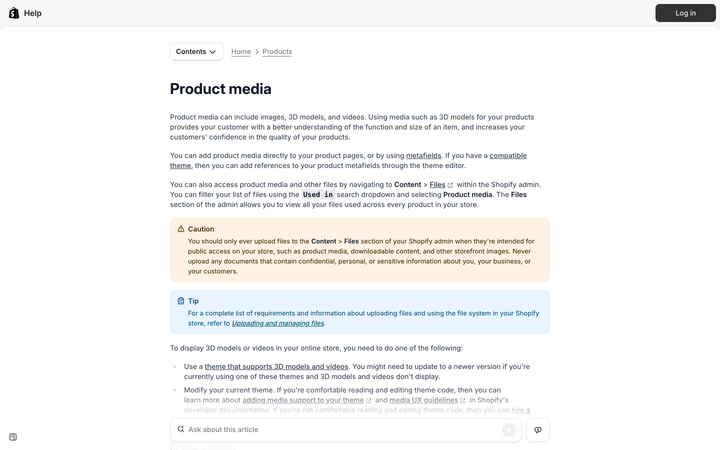
Shopify's limits were read on its Uploading and managing files help page on 3 August 2026. Its image ceiling is 20 megapixels, not the 25 MP figure that circulates on a lot of listicles.
Look at the video row. Shopify's Starter and Basic plans allow 250 video and 3D model uploads. Amazon recommends one video per product. A 300-SKU catalog following that recommendation needs 300 videos and hits the Basic ceiling with 50 SKUs still to go, which is a plan-tier problem that surfaces in month three of a rollout rather than at the start. If you are producing video at catalog scale, our guide to turning product photos into video ads covers the format specs on the ad side too.
What actually breaks at catalog scale?
Throughput is fine. Six things drift, and every one of them is invisible on a single image and obvious on a grid of forty.
Scale. A 30 ml serum and a 500 ml body wash shot to fill the same percentage of frame make the serum look enormous on a category page. Amazon wants the product at roughly 85% of the frame, and applying that literally across a catalog with mixed volumes destroys the size relationship between products.
Shadow direction. Batch one is lit from the left, batch three from the right, and nothing looks wrong until they sit side by side.
Background value. Pure white for a main image is a fixed target, RGB 255,255,255. Every off-white lifestyle background is a judgement call, and judgement calls drift across sessions.
Crop margin. The gap between product edge and frame edge varies by a few percent per batch, which reads as products of different sizes.
Colour. The most expensive one, because it triggers returns. A cap that reads warm in one batch and neutral in the next is a mismatched-expectations problem, and Amazon names reduced returns as a benefit of good imagery for exactly this reason.
Label text. On packaging with real copy on it, small type is where generated imagery fails first, by softening, re-flowing, or inventing words that were never on the box.
How do you lock a spec so 2,000 images match?
Write the spec down before the first batch, not after the third. A workable catalog spec fits on one page and covers six things:
- The angle set. Name the exact angles, in order, for every product: front, three-quarter left, back, top-down, in-scale, in-use, detail. Same order, every SKU, so the listing carousel reads the same way across the catalog.
- Frame fill by size band. Not one percentage for everything. Group products into two or three volume bands and fix a fill percentage per band, so relative size survives.
- Background values as numbers. RGB for main images, a named hex for each lifestyle background. "Warm neutral" is not a spec.
- Shadow direction and softness, stated once and never revisited mid-catalog.
- A reference SKU. Pick one product, shoot or generate it perfectly, and re-run it at the start of every batch as a calibration frame. If the reference drifts, the batch drifts.
- File naming that encodes the spec, as in
sku_angle_variant, so a wrong-angle file is visible in a directory listing rather than only in the CMS.
The reference SKU costs one generation per batch, and it turns "does this look right?" into a comparison against a known-good file.
Where your catalog lives changes the spec too. The same product needs different treatment on a marketplace listing than on your own storefront, which we covered in Amazon versus DTC product photography.
Can AI handle product photography for a large catalog?
For most of the work, yes, with two specific exceptions.
AI handles the parts of catalog production that are repetitive and additive: background replacement, scene and lifestyle generation, variant colourways, resizing and reformatting for each channel, and extending a single hero into the six supporting angles. That is where the volume is, and it is faster than a studio by an order of magnitude.
The two exceptions are small text on packaging and exact brand colour. Both fail quietly, both survive into published listings, and both are what customers notice. A distorted label is a misrepresentation of the product before it is a quality problem.
That distinction is what we built Pikes AI around: generating from a brand's actual product images and a persistent brand context rather than from a text description, because a description is where the label detail gets lost. Whatever tool you evaluate, run the same check. Generate one SKU ten times, open all ten at 100% zoom, and read the packaging copy. A tool that passes at ten will probably hold at 2,000. One that fails will fail more expensively later.
If you are putting generated imagery on live listings, the platform rules differ by channel and are narrower than most summaries suggest. Our guide to whether AI-generated product images are allowed covers what Amazon, Google Merchant Center and Meta each require, including Amazon's contains-synthetic-performer tag for photorealistic AI-generated people.
How do you QA a catalog batch without opening every file?
You cannot review 2,400 images individually and you do not need to. Three passes catch almost everything.
The contact sheet. Put every main image for a batch on one grid at thumbnail size. Scale errors, background drift and shadow flips are obvious at 200 px and invisible at full size. This pass takes ten minutes for 300 images.
The reference comparison. Open the batch's calibration render of your reference SKU next to the original. If those two match, the batch's lighting and colour settings held.
The 10% zoom sample. Pick one in ten at random, open at 100%, and read every word on the packaging. Label failures cluster, so if two of thirty are wrong, regenerate the batch rather than patching the two.
Anything that fails goes back as a batch, not as individual fixes. Fixing images one at a time is how a two-week catalog project becomes a two-month one. Full specs per platform are in our Amazon product image requirements guide.
FAQ
How many product images does a 500-SKU catalog need? Following Amazon's recommendation of one main image plus at least six additional images, 3,500 images and 500 videos. Visible variants multiply that, so a catalog averaging two colourways per product is closer to 7,000 images.
Is there a limit on how many images you can add to a Shopify product? Shopify does not document a per-product image cap. It does cap video and 3D model uploads by plan, 250 on Starter and Basic rising to 100,000 on Enterprise, and total file storage from 100 GB to 10 TB, as listed on its file-uploads help page on 3 August 2026.
Can AI product photography replace a studio for a whole catalog? For background, scene, variant and format work, largely yes. For products where fine packaging text is the selling point, plan on a real capture of each SKU as the source image and use AI to extend it, rather than generating the product itself from a description.
What is the most common consistency error across a large catalog? Frame fill applied uniformly across products of very different sizes, which breaks the relative-size relationship on category pages. Fix it by setting a fill percentage per volume band rather than one for the whole catalog.
How long should a 300-SKU catalog take? The binding constraint is usually approvals rather than production. Generation for 2,400 assets is days. Getting a spec agreed, a reference SKU signed off, and a review loop that does not re-open settled decisions is what sets the timeline.
Do you need a different image set for Amazon and your own site? Yes, though they share a source. Amazon's main image rules are strict, with a pure white background and the product filling roughly 85% of the frame, while a DTC storefront rewards lifestyle and in-scale imagery that would be rejected as an Amazon main image.
Create your next product image set
Use your product photos and brand context to create studio-style and lifestyle variations in Pikes.
AI product photography with PikesCompare plans and generation credits

Written by
Mike Lehman
Mike Lehman is a senior content strategist at Pikes. Before joining Pikes, Mike spent nearly a decade working with Glossier, Haus, and Athletic Brewing, leading campaigns that blended storytelling and data.