
Pontus Karlsson
Instacart Product Image Requirements: The 2026 Spec Guide
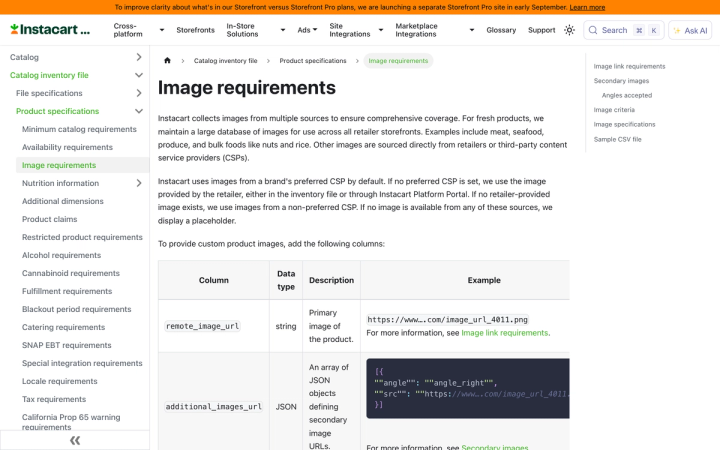
Instacart wants product images at 1000 × 1000 pixels and 300 DPI, square, on a pure white background, under 3 MB, in PNG or JPG, with the product filling 85% of the frame. The minimum accepted size is 600 × 600 and the maximum is 4000 × 4000. You can supply up to 10 images per product, and the primary image must exist before any secondary image is processed.
Those numbers come from Instacart's public catalog documentation, checked on 11 August 2026. The rest of this covers the rules that are less obvious than the pixel dimensions, and that cause most of the rejections.
What are Instacart's product image requirements?
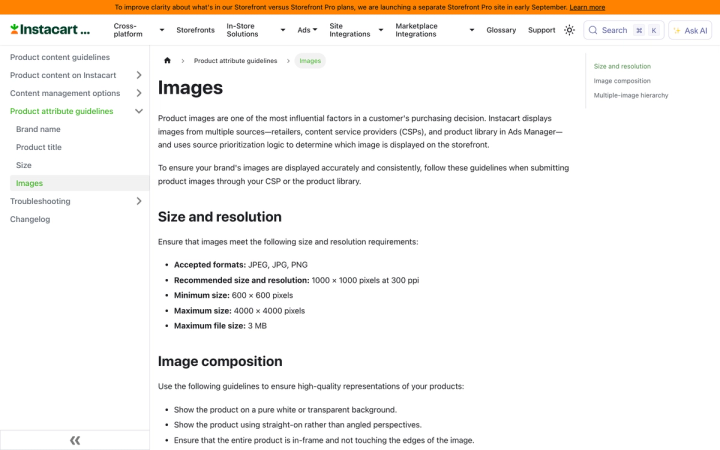
Instacart publishes its specs in two places that mostly agree: the catalog inventory file's Image requirements page and the ads-side product content guidelines. Both were last updated 14 May 2026.
| Requirement | Instacart's spec |
|---|---|
| Recommended resolution | 1000 × 1000 pixels at 300 DPI |
| Minimum size | 600 × 600 pixels |
| Maximum size | 4000 × 4000 pixels |
| Aspect ratio | Square (1:1) |
| Maximum file size | 3 MB |
| File formats | PNG or JPG |
| Background | Pure white (the ads guidelines also allow transparent) |
| Frame fill | Product fills 85% of the image area |
| Images per product | Up to 10 |
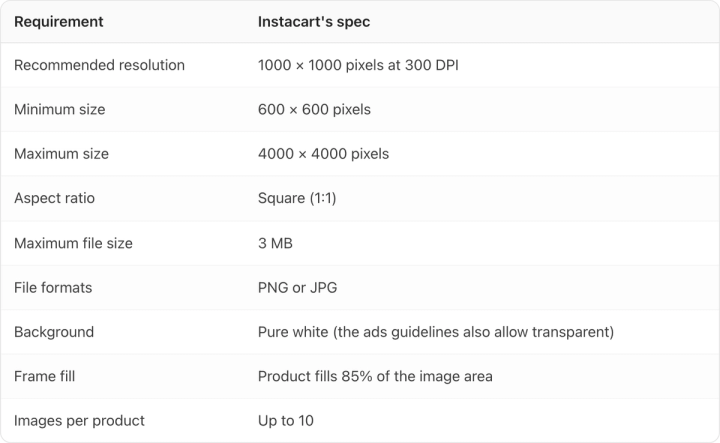
The 1000 × 1000 recommendation exists for a specific reason that the page states plainly: it is the size that supports image zoom. Ship 600 × 600 and you clear the minimum but lose the zoom behavior on the product page.
The composition rules are tighter than Amazon's or Google Shopping's. Instacart asks that brand, name and size are easily visible, that colors are accurate and realistic, that edges are crisp, that the full product is in frame without touching the edges, and that there is nothing else in the image: no added text, decorations, graphics or "confusing objects". The ads guidance adds that shots should be straight-on rather than angled.
What does the 85% frame-fill rule actually mean?
It means the product occupies 85% of the canvas and the remaining 15% is white margin. Not 85% of the width. 85% of the area.
That number is not Instacart-specific. Amazon's Product image guide says "Show the product as 85% of the image", and Google Shopping asks for no less than 75% and no more than 90%. All three were checked today.
So 85% is the single crop that satisfies every one of them. If you are producing one master file per SKU rather than one per channel, which is the only sane approach past a few dozen SKUs, crop to 85% and stop thinking about it. We go deeper on that production model in our guide to AI product photography for large catalogs.
Does Instacart allow AI-generated product images?
Not for product content. Instacart's image composition guidance is explicit: "Use only photo-realistic images. Do not use two-dimensional illustrations, CGI renders, or AI-generated lifestyle photos."
That is a different rule from the other platforms, and the difference matters:
- Instacart restricts a category of image. AI-generated lifestyle photos and CGI renders are not permitted in product content, regardless of how they are labeled.
- Walmart applies a truthfulness standard. Images generated by AI must be truthful, accurate and not misleading, with no metadata requirement published (verified 10 August 2026; see our Walmart Marketplace image requirements breakdown).
- Google Shopping and Amazon are metadata standards. Disclosure travels in the file, and Amazon's applies specifically to media containing an AI-generated person. Our post on whether AI-generated product images are allowed covers the exact fields.
The practical consequence for a CPG brand: your Instacart catalog images should be photographs of the actual pack. This is the one surface where our own category of tool is the wrong answer, and it is better to say so than to sell around it.
AI earns its place everywhere upstream and alongside: seasonal variations, ad creative, the marketing assets that never enter the catalog feed. Even there, Instacart's standard is the useful one to hold yourself to, with brand, name and size legible and colors accurate to the real product. That fidelity problem is what we built Pikes AI around, generating from a brand's actual SKUs rather than from a text description of them. Whichever tool you use, the test is the same. Open the output at 100% and read the label. If the type is soft or the color moved, it will not hold up as a pack shot.
How many images can an Instacart product page have?
Up to 10, and Instacart displays them in a fixed order based on the field name rather than the order you submit them. The published hierarchy is:
- Primary (the hero image on the storefront)
- Angle Left
- Angle Right
- Angle Back
- Angle Top
- Lifestyle
- Ingredients
- Nutrition
- Drugs
- Supplements
Secondary images are supplied through the additional_images_url field as a JSON array, where each object needs an angle and a src. The accepted angle values are ingredients, nutrition, drugs, supplements, lifestyle, angle_left, angle_right, angle_back, angle_top and unknown.
Two things follow from that ordering. Ingredients and nutrition panels rank below the angle shots, so if you sell food, supplements or anything with a regulated panel, those images exist to be found rather than to be seen first. And because Instacart requires a primary image before it processes any secondary image, a missing or rejected primary silently takes the whole set down with it.
If you are working out how many shots to produce per SKU in the first place, our guide to product photos per SKU sets out the counts by channel.
Why do Instacart images fail to appear?
Most failures come from the URL or the source hierarchy rather than the photograph.
URL rules. Instacart pulls images from a URL you supply. That URL cannot contain spaces and must include the file extension. .../image_url_4011.png works; .../image url 4011 does not. Dropbox hosting is permitted if the link is public, with the suffix changed from dl=0 to dl=1.
Updating an image means changing the URL. Instacart states that to change an image, or to update its location, you must change the URL itself. Overwriting the file at the same address is not a reliable update path. You have to publish it at a new one.
Source prioritization. Instacart draws images from retailers, content service providers and the Ads Manager product library, and uses prioritization logic to decide which wins. It defaults to a brand's preferred CSP; without one, it uses the retailer's image. A small number of retailers are configured to prioritize their own content over anything you submit, which is why a product can look correct at one banner and wrong at another.
Timing. Instacart's own FAQ puts content changes at typically 24 to 48 hours after submission. If an image looks unchanged an hour after upload, nothing has gone wrong yet.
Can one master file satisfy Instacart, Amazon and Google?
Yes, with one constraint doing most of the work. All three specs, verified 11 August 2026:
| Requirement | Instacart | Amazon | Google Shopping |
|---|---|---|---|
| Frame fill | 85% of image area | 85% of the image | 75%–90% |
| Maximum file size | 3 MB | None published | 16 MB |
| Size floor | 600 × 600 | 500 px longest side | 500 × 500 (from 31 Jan 2027) |
| Size ceiling | 4000 × 4000 | 10,000 px longest side | 64 megapixels |
| Aspect ratio | Square (1:1) required | Not required | Not specified |
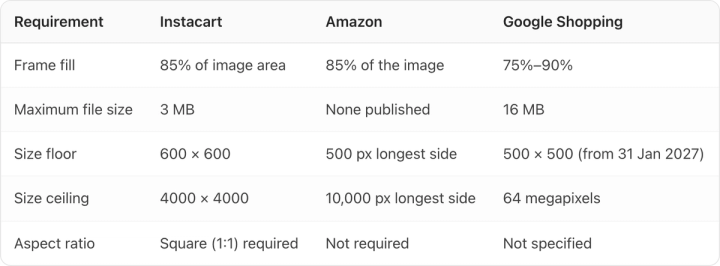
Instacart's 3 MB is the binding constraint of the three, tighter than Google's 16 MB and tighter than Walmart's 5 MB as verified on 10 August 2026. A 2200 × 2200 JPEG at high quality can clear 3 MB comfortably, but an uncompressed PNG at the same dimensions frequently will not. Export as JPEG and check the resulting file size per SKU rather than assuming.
Everything else nests cleanly. A 2200 × 2200 square sits above Instacart's 600-pixel floor and below its 4000-pixel ceiling, inside Amazon's 500–10,000 range, and far under Google's 64-megapixel cap at 4.84 MP. The 85% crop satisfies all three. Square is only mandatory for Instacart, which makes it the safe default.
The one master file: 2200 × 2200, 1:1, sRGB, JPEG under 3 MB, pure white background, product at 85% of frame, served from a public URL that ends in the file extension and contains no spaces. That single asset clears Instacart, Amazon and Google, and needs only a file-size check against Walmart's separate rules.
Holding that standard across a whole catalog rather than one hero SKU is the problem we built Pikes AI for, and it is worth seeing what a full set looks like before you commit to a production method.
Frequently asked questions
What size should Instacart product images be?
1000 × 1000 pixels at 300 DPI is Instacart's recommendation, because that is the size that supports image zoom on the product page. The accepted range is 600 × 600 minimum to 4000 × 4000 maximum, square in all cases.
What is Instacart's maximum image file size?
3 MB. That is tighter than Google Shopping's 16 MB cap and tighter than Walmart's 5 MB, which makes it the constraint to design your export settings around if you produce one file for several marketplaces.
Does Instacart require a white background?
Yes for catalog product images. The documentation says a pure white background is required. Instacart's ads-side product content guidelines also accept a transparent background.
Can I use AI-generated images on Instacart?
Not for product content. Instacart's guidelines state that only photo-realistic images should be used, and specifically exclude two-dimensional illustrations, CGI renders and AI-generated lifestyle photos.
How many images can I add to an Instacart product?
Up to 10, displayed in a fixed order: primary, then angle left, right, back and top, then lifestyle, ingredients, nutrition, drugs and supplements. A primary image must be present before secondary images are processed.
How long do Instacart image updates take to appear?
Typically 24 to 48 hours after submission, according to Instacart's image troubleshooting FAQ. If an image still has not changed after that, the likely causes are source prioritization or a rejected submission rather than a delay.
All Instacart, Amazon and Google specifications verified against their public documentation on 11 August 2026. Platform requirements change, so check the source pages before a large re-export.
Create your next product image set
Use your product photos and brand context to create studio-style and lifestyle variations in Pikes.
AI product photography with PikesCompare plans and generation credits