

Mike Lehman
Men's Grooming Product Photography: A Practical Guide
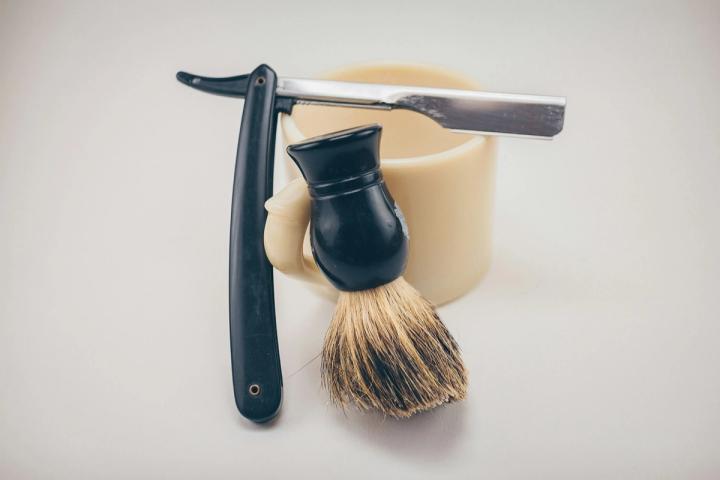
Men's grooming is one of the harder consumer categories to photograph, for two reasons that have nothing to do with taste. The packaging is usually matte black or polished metal, which are the two most difficult surfaces to light. And part of the catalog is legally a drug, which changes what you are allowed to imply in a picture.
Solve the lighting first, then build the shot list around what each platform accepts.
Why is men's grooming harder to shoot than skincare?
Skincare is mostly white, cream and frosted glass. Those surfaces are forgiving: put a big soft source over them and they look expensive.
Grooming packaging went the other way. Matte black plastic, brushed aluminium, chrome razor heads, amber glass, dark tins. Every one of those either swallows light or mirrors the room back at you. A single soft box over the top gives you a grey blob and a hotspot.
A grooming catalog is also usually mixed. One shoot might cover a matte black tin of balm, a stainless razor, an amber oil bottle and an aerosol can. Those need four lighting setups. Budget your time per surface, not per SKU.
How do you light matte black packaging?
Matte black absorbs light instead of reflecting it, so it has no highlights to give the eye shape. Against a dark background the edges vanish. Against pure white the pack reads as a silhouette with a muddy grey face.
Four things fix it.
Light the background separately from the product. Once you can set the background tone independently, you can decide exactly how much separation the silhouette gets rather than accepting whatever spill you get.
Add a hard rim light from behind and to one side. A bright line running down the edge of the pack is what tells the viewer where the product stops. On matte black it is doing the job a specular highlight would do on gloss.
Bring the key in close rather than flooding the set. Falloff across the face of the pack is the only thing giving a matte surface form. A distant source lights it evenly and evenly-lit matte black looks flat.
Put a black card opposite the key. It keeps the shadow side genuinely black instead of drifting to grey from room bounce.
That gives you a strong image on a gradient background, which is where matte black wants to live. Amazon will not take it as a main image, which has to have "a pure white background (RGB color values: 255, 255, 255)". Shoot the hero on white with the rim lights holding the edges, and keep the gradient version for alternate slots, ads and your own site.
How do you shoot a chrome razor without photographing your studio?
A polished razor head is a mirror. It does not reflect your light, it reflects everything around it, including you and the camera.
So you stop lighting the razor and start building what it reflects. Large white surfaces give it clean bright bands. Black cards give it dark bands, and the dark bands are what make it read as metal rather than as a white smear. Metal needs both.
Three things to watch on razors specifically:
- Your own reflection in the head. Shoot through a hole in a white card, or angle the head so the camera falls outside its reflection.
- Comb teeth turning to mush. The teeth on a safety razor are the detail buyers zoom in on. They need a defined edge light, not general fill.
- Knurling on the handle disappearing. Knurled grip texture only shows under a raking light across it. Front light flattens it completely.
What about amber glass and clear bottles?
Beard oils and pre-shave oils are almost always amber glass, and amber glass has one rule: light it from behind.
Front-lit, amber glass looks like dark brown plastic. Backlit, light passes through the liquid and it reads as oil, which is the whole point of the packaging. Put your source behind and slightly above, then use a white card in front to bring a highlight back onto the shoulder of the bottle and the cap.
Protect the specular strip running down the side of the glass. That strip is the thing that says "glass" instead of "plastic," and it is the first casualty of too much fill.
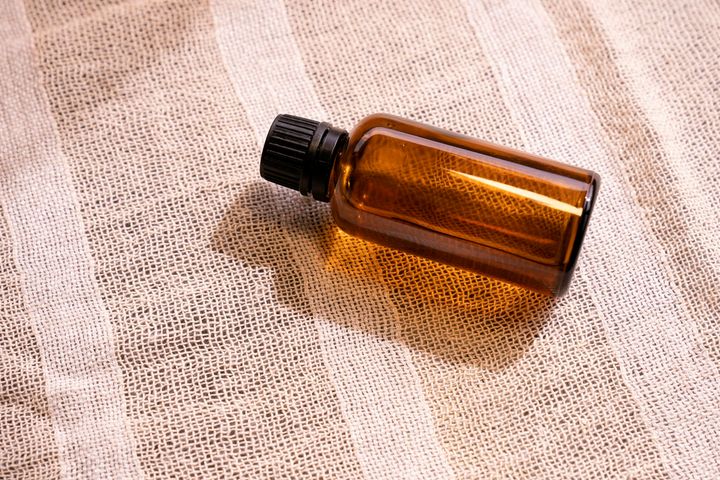
Note the cap in that shot. It is matte black, sitting on a backlit transparent bottle. You are lighting two opposite surfaces in one frame, which is the honest reason grooming still-life takes longer per SKU than skincare does. The same problem shows up with clear bottles and dark pumps, and we covered the transparent-container side of it in our skincare photography guide.
Which grooming SKUs are legally drugs, and why does that change the shot?
The FDA classifies by intended use, and for a grooming line that changes the brief.
Deodorant is a cosmetic: the Federal Food, Drug, and Cosmetic Act's list of cosmetics explicitly includes "deodorants." An antiperspirant is different. In the FDA's words: "deodorants that are also antiperspirants, and moisturizers and makeup marketed with sun-protection claims are cosmetic/drug products. Such products must comply with the requirements for both cosmetics and drugs."
That distinction reaches your shot list through one sentence. The FDA says intended use can be established by "Claims stated on the product labeling, in advertising, on the Internet, or in other promotional materials," and that "Certain claims may cause a product to be considered a drug, even if the product is marketed as if it were a cosmetic." Among its own examples of such claims: "claims that products will restore hair growth."
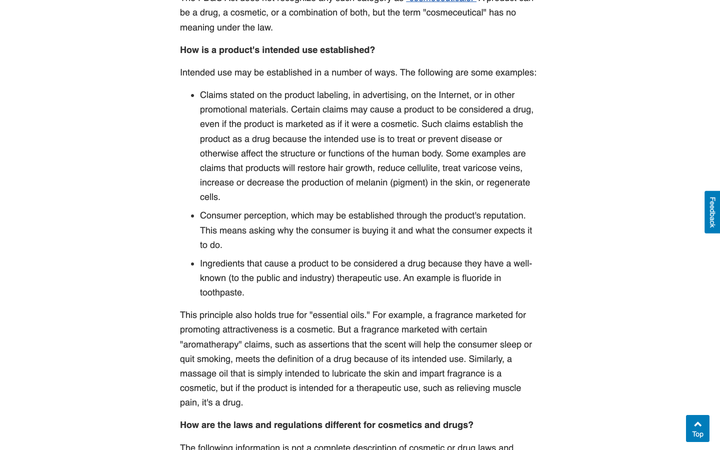
Advertising and the internet are named in that sentence, and product photography is advertising. A side-by-side before and after showing a fuller beard or a filled-in hairline is a regrowth claim whether or not any words appear in the frame. Same for a scalp shot implying density change.
None of this is legal advice, and the line between a cosmetic appearance claim and a drug claim is genuinely fine. Decide with your regulatory contact which SKUs are dual-classified before the shoot, then brief the photographer on what those SKUs cannot show. Finding out afterwards means a reshoot.
One knock-on effect: dual-classified packs typically carry more required copy, and Amazon's main image rule says to "Only show the product once in the image, for example, front only, and not both the front and the back in the same image." You cannot solve a crowded pack in the hero. The alternate slots have to carry it. We ran into the same constraint from a different direction in our guide to cleaning product photography.
What can't be in an Amazon main image for a grooming product?
Amazon's Product image guide is specific, and two of its rules bite this category harder than most.
The first is props. "Don't show accessories or any props that aren't included with the product and could confuse the customer." A men's grooming hero shot is almost always styled with a towel, a comb, a leather dopp kit, a shaving brush or a whisky glass. Unless those ship in the box, none of them belong in the main image.
The second is packaging. "Don't include packaging, unless it's an important product feature." For a balm in a tin or a foam in a can, the container is the dispensing mechanism, so it reads as part of the product. For a boxed razor set, the outer carton does not.
The rest of the main-image specs, verified on Amazon's guide on 8 August 2026:
- Pure white background, RGB 255, 255, 255
- "Show the product as 85% of the image"
- "Show the entire product within the frame of the image, not cutting off any part"
- No text, logos, borders, colour blocks or watermarks
- Minimum 500 pixels and maximum 10,000 pixels on the longest side
- JPEG recommended
On volume, Amazon's guidance is one compliant main image plus a recommendation to "upload at least six additional images and one video," so seven images and a video per SKU. We worked through how that number changes by category in how many product photos you need per SKU.
What should a grooming shot list include?
Seven slots, mapped to what a buyer in this category actually wants to check.
| Slot | Shot | What it has to prove |
|---|---|---|
| Main | Pack front, pure white, 85% fill, no props | It is the product in the title, at real scale |
| 2 | Angled three-quarter with rim light | Form and material, which flat-front hides |
| 3 | Back or side panel, legible | Ingredients, directions, any drug-facts copy |
| 4 | Scale reference in hand | Tin and bottle sizes are constantly misjudged |
| 5 | Texture or pour shot | Balm, clay, foam and oil all behave differently |
| 6 | In-use or on-model | Application and finish |
| 7 | Full kit or range flat lay | Cross-sell to the rest of the line |
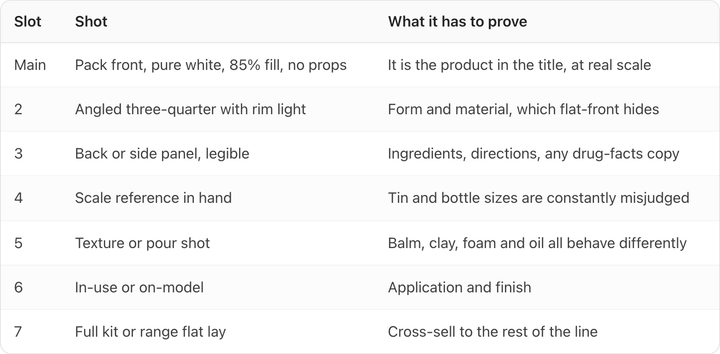
Slot 5 is the one grooming brands skip and shouldn't. A balm, a clay, a cream pomade and a gel look identical through the pack and behave nothing alike in the hand. A texture shot answers the question the reviews are full of.
Fragrance-forward SKUs in a grooming line have their own problem, since scent cannot be photographed at all. We wrote about the workarounds in our fragrance photography guide.
Where does AI fit in a grooming catalog?
The lighting problems above are physical, and they are repetitive. Once you have solved matte black and chrome for one SKU, you do it again for the next thirty in the line, plus every seasonal variant.
That repetition is what generation is good for, with one condition specific to this category. Grooming packs carry small type, fine metal detail and precise brand colour, all of which are the first things a general-purpose image model gets wrong. Run this test on any tool before you trust it with a catalog: generate one hero of your hardest SKU, open it at 100% zoom, and read the label out loud. If a word has gone soft, a letter is invented, or the knurling has smoothed over, that output cannot carry your listing slots.
That test is why we built Pikes AI to generate from a brand's real product images rather than from a text description of them. If you want to see how your own packs hold up, Pikes AI is free to start.

If you do put AI-generated people in grooming lifestyle shots, Amazon now asks for the keyword "contains-synthetic-performer" in the image's dc:subject XMP field. The full disclosure picture across marketplaces is in our guide to whether AI-generated product images are allowed.
Frequently asked questions
Why does my matte black packaging look grey? Room bounce is filling the shadow side. Put a black card opposite your key light and light the background separately from the product, so background tone and product tone stop fighting each other.
Can I show a towel or a comb in the shot? Not in an Amazon main image, unless those items ship with the product. Amazon's guide says "Don't show accessories or any props that aren't included with the product and could confuse the customer." Props are fine in alternate images, on your own site and in ads.
Is deodorant a cosmetic or a drug? Deodorant is named in the FD&C Act's list of cosmetics. An antiperspirant is both, and the FDA states that such products "must comply with the requirements for both cosmetics and drugs." Check which of your SKUs are dual-classified before you brief the shoot.
Can I use a before and after shot for a beard oil? Treat it carefully. The FDA lists "claims that products will restore hair growth" as an example of a claim that makes a product a drug, and it counts claims made "in advertising, on the Internet, or in other promotional materials." An image can carry that claim without words. Take it to your regulatory contact rather than to the retoucher.
How many photos does a grooming SKU need? Amazon requires one compliant main image and recommends "at least six additional images and one video." Seven plus video is the working target. The full breakdown by category is in our per-SKU guide.
What background works best for a matte black grooming pack? Pure white for the Amazon main image, because it is required. A dark gradient with rim lighting for everything else, because that is where matte black actually looks like a premium object rather than a hole in the frame.
Create your next product image set
Use your product photos and brand context to create studio-style and lifestyle variations in Pikes.
AI product photography with PikesCompare plans and generation credits

Written by
Mike Lehman
Mike Lehman is a senior content strategist at Pikes. Before joining Pikes, Mike spent nearly a decade working with Glossier, Haus, and Athletic Brewing, leading campaigns that blended storytelling and data.